Distribution pattern and habitat use of the protandrous shrimp Pandalus latirostris in relation to environmental characteristics in Akkeshi waters on the pacific coast of eastern Hokkaido, Japan
View/
Date
2023-09Author
Page views
930ASFA keyword

AGROVOC keyword
Taxonomic term


Metadata
Perlihat publikasi penuhShare
Abstract
A sampling of the protandric shrimp, Pandalus latirostris, was conducted at fixed sites from July 2015 to March 2020 in Akkeshi Bay and the connecting Lake Akkeshi on the Pacific coast of eastern Hokkaido. Based on the occurrence pattern of P. latirostris, most individuals begin mating as males at Age-1, followed by a sex change to females, spawn eggs as females at Age-2, and hatch their eggs in the spring of Age-3. Pre-hatching ovigerous females were mainly found in eelgrass beds near and in Lake Akkeshi, where the water temperature was relatively high. The females probably migrate there to hatch their eggs, making sure of the high survival and growth of the hatched larvae. Juveniles and small males were also abundant in near and in Lake Akkeshi, indicating that many larvae remained in the eelgrass beds where they hatched. These eelgrass beds play an important role in the maintenance of the shrimp population as a major egg-hatching site and nursery habitat in Akkeshi waters. With ontogenetic development, the occurrence rate of P. latirostris gradually increased on the offshore side of Akkeshi Bay, with its body size being larger. As P. latirostris grow, they will probably disperse to the offshore side of Akkeshi Bay. However, the density of P. latirostris in the eelgrass bed in the bay near the lake was extremely high, with its strong preference at all ontogenetic stages. This eelgrass bed would help maintain the shrimp population as a “key habitat” for the shrimp. The site-specific environmental characteristics of vegetation beds influence the distribution and abundance of individuals within a population of P. latirostris through their growth and the associated change in habitat preference. In this study, the importance of maintaining the diverse habitats of P. latirostris will be discussed as part of the shrimp stock management measures.
Keywords
Pandalus latirostris Protandric shrimp Habitat use Life history Sex change Stock managementSubjects
Gender transition
Suggested Citation
Ito, S., Nakagawa, T., Shirafuji, N., Yokota, T., Izumida, D., Onitsuka, T., Kuroda, H., Unuma, T., & Watanabe, T. (2023). Distribution pattern and habitat use of the protandrous shrimp Pandalus latirostris in relation to environmental characteristics in Akkeshi waters on the pacific coast of eastern Hokkaido, Japan. Regional Studies in Marine Science , 67, 103198. https://doi.org/10.1016/j.rsma.2023.103198
Type
ArticleISSN
2352-4855Koleksi
- Journal Articles [1266]
Related items
Showing items related by title, author, creator and subject.
-
Occurrence and disappearance of a non-native goby Rhinogobius sp. OR in relation to hydrological conditions in the Kamo River, southwestern Japan
Ito, Sayaka ; ; ; ; ; ; ; (Springer, 2022-01)
We monitored the abundance of a non-native (Rhinogobius sp. OR) and two native stream gobies (R. fluviatilis and R. nagoyae) over a decade, from 1995 to 2004, in a fixed reach of a tributary of the Kamo River, southwestern Japan. The non-native Rhinogobius sp. OR appeared and reproduced in 1997, when an increased deposition of fine sediments occurred. However, after a severe spate in 1999, the non-native goby almost completely disappeared from the study reach, while the density of the native R. fluviatilis increased. The severe spate is likely to have prevented the establishment of the non-native goby. Our results provide an example of abiotic barriers to invasion.
; ; ; ; ; ; ; (Springer, 2022-01)
We monitored the abundance of a non-native (Rhinogobius sp. OR) and two native stream gobies (R. fluviatilis and R. nagoyae) over a decade, from 1995 to 2004, in a fixed reach of a tributary of the Kamo River, southwestern Japan. The non-native Rhinogobius sp. OR appeared and reproduced in 1997, when an increased deposition of fine sediments occurred. However, after a severe spate in 1999, the non-native goby almost completely disappeared from the study reach, while the density of the native R. fluviatilis increased. The severe spate is likely to have prevented the establishment of the non-native goby. Our results provide an example of abiotic barriers to invasion. -
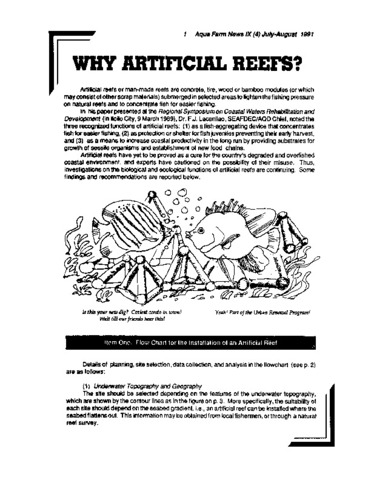
Why artificial reefs?
(Aquaculture Department, Southeast Asian Fisheries Development Center, 1991) -
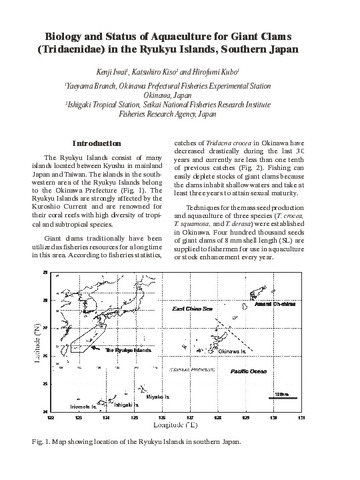
Biology and status of aquaculture for giant clams (Tridacnidae) in the Ryukyu Islands, southern Japan
(Aquaculture Department, Southeast Asian Fisheries Development Center, 2006)The Ryukyu Islands consist of many islands located between Kyushu in mainland Japan and Taiwan. The islands in the south-western area of the Ryukyu Islands belong to the Okinawa Prefecture. The Ryukyu Islands are strongly affected by the Kuroshio Current and are renowned for their coral reefs with high diversity of tropical and subtropical species. Giant clams traditionally have been utilized as fisheries resources for a long time in this area. According to fisheries statistics, catches of Tridacna crocea in Okinawa have decreased drastically during the last 30 years and currently are less than one tenth of previous catches. Fishing can easily deplete stocks of giant clams because the clams inhabit shallow waters and take at least three years to attain sexual maturity. Techniques for the mass seed production and aquaculture of three species (T. crocea, T. squamosa, and T. derasa) were established in Okinawa. Four hundred thousand seeds of giant clams of 8 mm shell length (SL) are supplied to fishermen for use in aquaculture or stock enhancement every year. This paper will review the (1) biology of giant clams, (2) present status of aquaculture of giant clams in Okinawa, and (3) other studies on giant clams in southern Japan.