Morphological and genetic diversity assessment of freshwater prawns (Macrobrachium spp.) in the Cairawan river, Antique province, Panay island, Philippines

Download URL
www.nfrdi.da.gov.ph日付
2024
Page views
NaN
AGROVOC keyword
Taxonomic term

Geographic names

Metadata
アイテムの詳細レコードを表示するShare
抄録
Freshwater prawns of the genus Macrobrachium are among the most valuable cultured aquatic species in the world. The systematic study of Macrobrachium species in the Philippines has often been based on morphological trait assessment. Here, we combined morphology and molecular approaches to study the presence and actual distribution of Macrobrachium species along the Cairawan River in Laua-an, Antique Province, Panay Island. Using morphological characteristics, we identified 11 Macrobrachium species, the highest number of species reported from a single river. Molecular results based on the cytochrome oxidase subunit I (COI) mitochondrial DNA (mtDNA) sequences confirmed the morphological identification. The analysis revealed eight major clades with 19 distinct haplotypes within the species. Our results provide information on the identification of Macrobrachium species inhabiting the Cairawan River. The baseline information can be helpful for future genetic studies involving freshwater prawns with potential use in aquaculture. It can provide scientific data to facilitate the formulation of selective breeding plans and direct governance policies in freshwater prawn resource conservation and management in the Philippines.
Suggested Citation
Santos, M. N. M., Wowor, D., Ikeda, M., Padilla, P. I., & Romana-Eguia, M. R. R. (2024). Morphological and genetic diversity assessment of freshwater prawns (Macrobrachium spp.) in the Cairawan river, Antique province, Panay island, Philippines. The Philippine Journal of Fisheries , 31(1), 35-48. https://doi.org/10.31398/tpjf/31.1.2023-0009
Type
ArticleISSN
0048-377X; 2672-2836Collections
- Journal Articles [1266]
Related items
Showing items related by title, author, creator and subject.
-
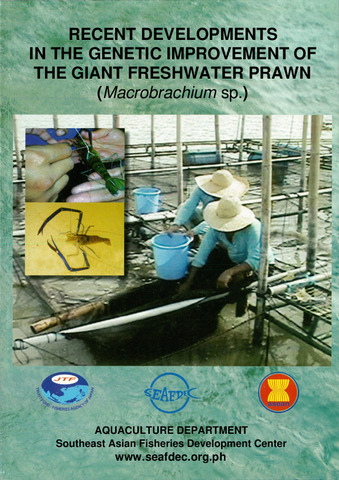
Recent developments in the genetic improvement of the giant freshwater prawn (Macrobrachium sp.)
(Aquaculture Department, Southeast Asian Fisheries Development Center, 2007)This publication contains results from the research project “Development of Genetically Improved Strain of Macrobrachium” covered by the Program on the Promotion of Sustainable Aquaculture in the ASEAN Region (previously known as Integrated Rural Aquaculture Program). It specifically includes activities from the inception of the project in 2002 up to 2005 under the Special Five-year Program on Sustainable Fisheries for Food Security in the ASEAN Region as well as research updates from 2006 to date. Project activities from 2006 to 2010 have been placed under the ASEAN-SEAFDEC Fisheries Consultative Group (FCG) collaborative mechanism with financial support from the Government of Japan Trust Fund. Dr. Koichi Okuzawa, AQD's Deputy Chief from 2005-2007, was project leader at the time the studies started until early 2007. -
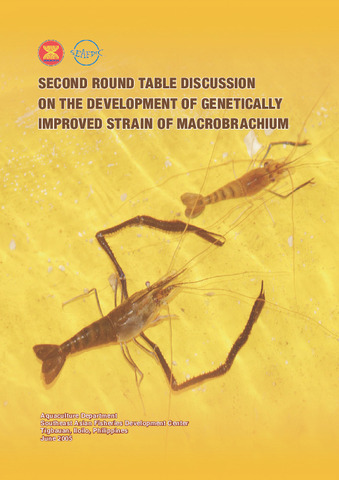
Second round table discussion on the development of genetically improved strain of Macrobrachium: A collaborative research under the Aquaculture Component of the ASEAN-SEAFDEC Special Five-Year Program on Sustainable Fisheries for Food Security in the ASEAN Region
(Aquaculture Department, Southeast Asian Fisheries Development Center, 2005-06)The Second Round Table Discussion on the Development of Genetically Improved Strain of Macrobrachium was held in the Philippines in September 2004 to evaluate the progress of activities of the collaborative research and ... -
Genetic characterization of GI Macro and freshwater prawns from Makassar-Sulawesi, Pangkalanbun-Kalimantan, Jambi-Sumatera, Sukabumi-Java using mtDNA CO-I markers
(Aquaculture Department, Southeast Asian Fisheries Development Center, 2007)The giant freshwater prawn (Macrobrachium rosenbergii) is a widely distributed indigenous species in Indonesia. The giant freshwater prawn from Pangkalanbun-Kalimantan has a big head, long claws and is yellow-green in color. On the other hand, those from Kuala Tungkal-Jambi has a small head, short claws and is gold in color (Sabar and Ali, 2001). The giant freshwater prawn is an important commodity that has been successfully fanned in Indonesia. It has been produced in several areas in West Java, i.e. Ciamis (Tambaksari, Parigi, Rancah and Pasir Nagara) and Tasikmalaya. Some commercial hatcheries (a local government hatchery, and seven private hatcheries) are found in Jogjakarta in East Java, freshwater prawns are cultured in brackishwater ponds. Freshwater prawn culture has also spread to some areas in the island of Bali, e.g. Gianyar, Klungkung, Buleleng and Tabanan, and in Riau, South Sulawesi and South Sumatera. Several natural populations of freshwater prawns are unique to Indonesia. To date, about 19 species are found in almost all of the islands in the archipelago (Holthuis, 1980). However, this potential genetic resource has not yet been fully used in freshwater aquaculture. Moreover, inspite the fact that the freshwater prawn culture technology has been developed and adopted in Indonesia, some problems are still plaguing the industry. To solve the problems of poor growth rate, disease susceptibility and small meat yield or edible portion, the Research Institute for Freshwater Aquaculture (formerly RIFF) started numerous research programs since 1996 to improve growth rate and the size of the edible portion of cultured prawns. The GI Macro, a selected strain of the giant freshwater prawn was developed by RIFA and has been distributed to farmers in Java. Varying results were obtained from growth trials conducted in different locations, hence another phase of selection is necessary to construct a wider and more improved base population using additional wild stocks. An assessment of the genetic background of the wild stocks is an important pre-requisite before the new selection program is initiated. Genetic variation is an important parameter to consider to enable the evaluation of individual fitness of the stock in the short term and their survival in the long term (Ferguson et al., 1995). In this study, genetic variation of giant freshwater prawns collected from Sulawesi, Kalimantan, Sumatera and Java were analyzed using molecular markers.