Commercial pelleted milkfish (Chanos chanos Forsskal) feeds: Physical characteristics and nutrient contribution to water quality in milkfish farming


Share
Abstract
In milkfish farming, when food wastage is high and assimilation is poor, most of the nutrients added to the culture species may ultimately pollute the environment. Assessment of water dispersion from ponds and cages rarely take into account the physical properties of feeds. This study dealt with settling velocity, physical stability, and the amount of nutrients (nitrogen and phosphorus) generated by milkfish feeds alone in water. Four locally manufactured milkfish (Chanos chanos) pelleted feeds labeled as: Grower A, Grower B, Grower C, and Finisher D were tested, with freshwater, brackishwater and seawater as test media. Settling velocities of the four feeds were generally greater in freshwater than in brackishwater and in seawater, ranging from 11.0-11.5 cm s-1 for 6-8. mm long pellets, and 12.8.0-13.0 cm s-1 for 9-11 mm pellets with Milkfish Finisher D. In brackishwater, settling velocities of size ranges 6-8 and 9-11 mm long were 9.8-10.0 and 11.0-11.6 cm s-1 respectively. In seawater, settling rates of milkfish feeds were 8.0-8.5 and 9.8-10.1 cm s-1, for the same size ranges. There was no significant difference on the settling velocities among feed brands tested but significantly different within water types (P> 0.05).
Water stability of these pellets was tested within 15, 30, 60 and 120 minutes immersion time. The four-feeds tested showed a range of water stability of 84.4-87% for the first 15 min in seawater, 70-82 % in brackishwater and 74-82% in freshwater. They are not that water stable after one hour with water stability of 35-40%.
Nutrient contribution assessment of these feeds was also carried out by submersion test. Total ammonia nitrogen (TAN) concentrations in freshwater generated by the four feeds were low and were not that significant during the first two days. Values abruptly rose above the initial concentrations of 0.04 to 3.25-6.97 mg l-1 on the6th day of submersion. In freshwater, Grower A had the highest TAN concentration value of 6.97 mg l-1 and Grower D had the lowest value of 0.1 mg l-1. Nitrite concentration was low at a range of 0.01-0.04 mg l-1 while nitrate ranged from 0.1-0.76 mg l-1 for all the feeds. In brackishwater, TAN concentrations steadily rose to a range of 2.5-3.5 mg l-1 in all feeds, while in seawater a lower concentration than the brackishwater of 0-1.2 mg l-1 within 7 days of submersion was obtained. Phosphate-P concentrations rose on the second day of submersion in all test media and abruptly fell on the fifth day. Grower B gave the highest phosphate concentration of 1.55 mg l-1 in freshwater and 1.44 mg l-1 in brackishwater by the same feed and 2.0 mg l-1 by Grower A in seawater. ANOVA showed no significant differences among the feeds in terms of N and P concentrations obtained within seven days of submersion (P< 0.05). Nutrient inputs from feed undergo nutrient transformation and nutrient buildup was very apparent especially in freshwater and in brackishwater.
The results of this study are measures of the significance of physical properties and nutrient releases of commercial feeds on the water quality of milkfish culture system. Data gathered can be applied into feeding management techniques, selection of good quality feeds and can be incorporated into models defining the impact of pollution from commercial feeds on the environment.
Subjects
Pelleted feed
Suggested Citation
Lantin-Olaguer, I. (2006). Commercial pelleted milkfish (Chanos chanos Forsskal) feeds: Physical characteristics and nutrient contribution to water quality in milkfish farming. Faculty Research Journal , 1(2), 22-41. http://hdl.handle.net/10862/6571
Type
ArticleISSN
2094-2206Collections
- Journal Articles [1266]
Related items
Showing items related by title, author, creator and subject.
-
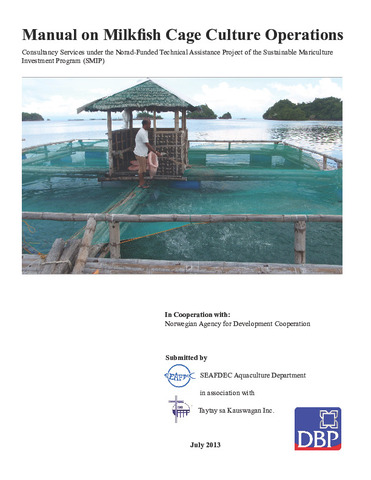
Manual on milkfish cage culture operations
(Aquaculture Department, Southeast Asian Fisheries Development Center, 2013-07)Milkfish (Chanos chanos, or bangus) culture is the largest finfish aquaculture industry in the Philippines and continues to be a top aquaculture commodity primarily because it is easy to culture and can be grown in a wide range of environments. Milkfish thrives in freshwater, brackishwater, marine, and even hypersaline habitats. Milkfish production is increasing rapidly with much of the production moving away from the traditional culture in brackishwater ponds to fish cages in coastal marine waters. To provide a general view of the milkfish culture industry, brief descriptions on breeding, hatchery production, and nursery operation are included in this manual. This manual is meant to serve as a guide for those interested to venture into marine cage farming of milkfish. Milkfish culture has been practiced in the Philippines, Indonesia, and Taiwan for centuries and has been the focus of aquaculture research in a number of institutions for several decades. Innovations in culture practices as a result of information from research data and from farmer’s experiences have been adopted by industry practitioners and these are documented in the recently published book entitled Milkfish Aquaculture in Asia (Liao and Leano, 2010). The recent concern about the rapid growth of aquaculture and its possible environmental impacts, and risks that can threaten the sustainability of this expanding industry has also been the subject of many conferences to develop good management practices in aquaculture. Principles and guidelines on better management practices in marine finfish culture had been drafted and included in this manual. -
[The Philippines recommends for milkfish:] Pond culture
(DOST-PCAARRD, 2016) -
Comparison of various water replenishment and fertilization schemes in brackishwater milkfish ponds
(Blackwell Publishing, 1989)The study was undertaken to determine the optimum combination of the frequency of water replenishment and fertilization that can yield the highest growth, survival, and gross production of milkfish. Results indicated that mean body weight and survival were not significantly different (P > 0.05) among the treatments. Gross fish production was higher in biweekly fertilization if considered as a single factor. However, when this was in combination with the weekly or biweekly water replenishment, similar gross fish production was attained. In any case, because biweekly fertilization has a better effect than a weekly schedule, the former should be used in combination with any other level of replenishment. A weekly water replenishment, however, is impractical in big pond areas of 5–10 ha compartments which are still common in some milkfish ponds in the Philippines. Therefore, biweekly water replenishment and fertilization with 16–20–0 at 50 kg ha-1 would be reasonable.