In vivo fitness correlates with host-specific virulence of infectious hematopoietic necrosis virus (IHNV) in sockeye salmon and rainbow trout

View/
Date
2011Page views
1,276ASFA keyword

AGROVOC keyword
Taxonomic term

Metadata
Perlihat publikasi penuhShare
Abstract
The relationship between virulence and overall within-host fitness of the fish rhabdovirus Infectious hematopoietic necrosis virus (IHNV) was empirically investigated in vivo for two virus isolates belonging to different IHNV genogroups that exhibit opposing host-specific virulence. U group isolates are more virulent in sockeye salmon and M group isolates are more virulent in rainbow trout. In both single and mixed infections in the two fish hosts, the more virulent IHNV type exhibited higher prevalence and higher viral load than the less virulent type. Thus, a positive correlation was observed between higher in vivo fitness and higher host-specific virulence in sockeye salmon and rainbow trout. Comparisons of mean viral loads in single and mixed infections revealed no evidence for limitation due to competition effects between U and M viruses in either rainbow trout or sockeye salmon co-infections.

Suggested Citation
Peñaranda, M. M. D., Wargo, A. R., & Kurath, G. (2011). In vivo fitness correlates with host-specific virulence of infectious hematopoietic necrosis virus (IHNV) in sockeye salmon and rainbow trout. Virology , 417(2), 312-319. https://doi.org/10.1016/j.virol.2011.06.014
Type
ArticleISSN
0042-6822Koleksi
- Journal Articles [1266]
Related items
Showing items related by title, author, creator and subject.
-
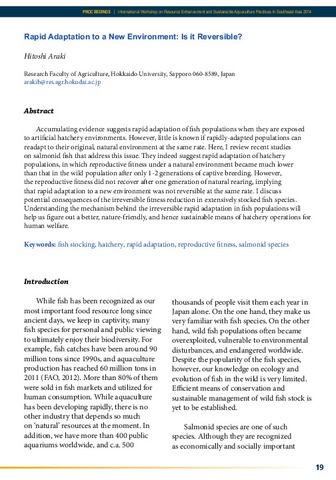
Rapid adaptation to a new environment: is it reversible?
(Aquaculture Department, Southeast Asian Fisheries Development Center, 2015)Accumulating evidence suggests rapid adaptation of fish populations when they are exposed to artificial hatchery environments. However, little is known if rapidly-adapted populations can readapt to their original, natural environment at the same rate. Here, I review recent studies on salmonid fish that address this issue. They indeed suggest rapid adaptation of hatchery populations, in which reproductive fitness under a natural environment became much lower than that in the wild population after only 1-2 generations of captive breeding. However, the reproductive fitness did not recover after one generation of natural rearing, implying that rapid adaptation to a new environment was not reversible at the same rate. I discuss potential consequences of the irreversible fitness reduction in extensively stocked fish species. Understanding the mechanism behind the irreversible rapid adaptation in fish populations will help us figure out a better, nature-friendly, and hence sustainable means of hatchery operations for human welfare. -
Status of resource enhancement and sustainable aquaculture practices in Japan
(Aquaculture Department, Southeast Asian Fisheries Development Center, 2015)Contrary to the rapid increase in the world aquaculture production, fish production in Japan has been decreasing slightly due to the decreasing trend in seafood consumption of Japanese. Aquaculture production is approximately 20% in terms of yield, and 30% in terms of market value, of the country s total fisheries production. In Japan, about 80 species are targeted for release for sea ranching and resource enhancement purposes. The local governments (prefectures) are the main driving force in resource enhancement programs. Chum salmon, Oncorhynchus keta, and scallop Mizuhopecten yessoensisis are examples of successful resource enhancement in Japan. Japanese flounder, Paralichthys olivaceus, and red seabream, Pagrus major, represent intensely released fish species in Japan, and around 10% of the total catch of those species are estimated as released fish. The low price of products and increasing costs of production, such as costs of fuel and fish meal, are the major pressing issues in coastal fisheries and aquaculture in Japan. For aquaculture, the guarantee of food safety, minimization of environmental impact, and management of natural stock populations are highly necessary in order to achieve the sustainability of the industry. For resource enhancement, budget constraint is the major issue, and possible impact on natural stocks caused by released fish should also be considered. The Government of Japan (GOJ) is implementing some measures to rectify unstable business practices of aquaculture and to improve production techniques in aquaculture. For resource enhancement, the GOJ encourages cooperation among local governments (prefectures) for seed production and release of certain targeted species in order to reduce the cost and improve the efficiency of stock enhancement. In Japan, traditionally, the purpose for release was mainly sea ranching, namely harvesting all released animals. Nowadays, actual resource enhancement, i.e. the integrated release program including resource management and development of suitable nursery for released fish, is encouraged by the government. The evaluation and counter measures for the negative impact of stocked fish on genetic diversity of the wild population are also implemented. Recently, marked progress was achieved in seed production technologies of two important tropical fish species, namely coral trout, Plectropomus leopardus, and humphead wrasse, Cheilinus undulatus. These technologies are expected to contribute to the advancement of the aquaculture industry in the South East Asian region. -
Phosphorus utilization in rainbow trout (Oncorhynchus mykiss) fed practical diets and its consequences on effluent phosphorus levels
(Elsevier, 2003)Excessive dietary phosphorous (P) concentrations in effluents from aquaculture present a major environmental problem. We therefore studied the effect of dietary P and vitamin D3 on P utilization by rainbow trout-fed practical diets and on P concentrations in the soluble, particulate and settleable components of the effluent from fish tanks. Rainbow trout (average weight: 78 g, initial biomass: 13 kg in 0.7 m3 tanks) were fed for 11 weeks, practical diets that varied in total P, available P, and vitamin D3 concentrations. Soluble, particulate (10–200 μm) and settleable (>200 μm) P in the effluent were sampled every 0.5–6 h for 1–3 days in the third and eleventh weeks of the experiment. Trout in all diets more than doubled their weight after 11 weeks. Increasing the concentrations of available dietary P from 0.24% to 0.88% modestly enhanced growth rate. Feed conversion ratio (FCR) and biomass gain per gram P consumed decreased as dietary P concentrations increased. Carcass P, daily P gain, and plasma P concentrations were lower in fish fed with low P diets. Soluble P concentrations in the effluent peaked immediately after and again 4–6 h after feeding, and is a linear function of available dietary P. No soluble P would be produced during consumption of diets containing less than 0.22±0.02% available P. Above this dietary concentration, soluble P would be excreted at 6.9±0.4 mg/day/kg for each 0.1% increase in available dietary P. Particulate P concentrations in the effluent were independent of dietary P concentrations. Settleable, presumably fecal, P concentrations tended to increase with dietary P concentrations. In trout fed with low P (0.24% available P, 0.6% total P) diets, 60% of total dietary P were retained by the fish and the remaining 40% were excreted in the effluent as settleable P (20–30%) and particulate or soluble P (10–20%). In trout fed with high P (0.59–0.88% available P; 0.9–1.2% total P) diets, 30–55% of total dietary P was retained by fish, and the remaining 15–25% appeared in the effluent as settleable P, 20–55% as soluble P, and 5–10% as particulate P. Vitamin D3 did not affect fish growth nor effluent P levels. Physicochemical management of aquaculture effluents should consider the effect of diets on partitioning of effluent P, the peaks of soluble P concentration following feeding, and the contributions of particulate P to total P in the effluent. Increasing our understanding of how dietary P is utilized and is subsequently partitioned in the effluent can contribute significantly towards alleviating this important environmental and industry problem.