Effects of restricted feeding rates on growth, production, and economics of Nile tilapia (Oreochromis niloticus) and giant freshwater prawn (Macrobrachium rosenbergii) polyculture in pond-based biofloc and traditional grow-out system
View/
Date
2025-01-15Page views
1,765ASFA keyword

AGROVOC keyword
Taxonomic term

Metadata
Perlihat publikasi penuhShare
Abstract
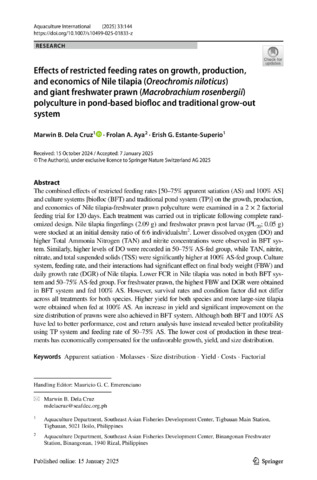
The combined effects of restricted feeding rates [50–75% apparent satiation (AS) and 100% AS] and culture systems [biofloc (BFT) and traditional pond system (TP)] on the growth, production, and economics of Nile tilapia-freshwater prawn polyculture were examined in a 2 × 2 factorial feeding trial for 120 days. Each treatment was carried out in triplicate following complete randomized design. Nile tilapia fingerlings (2.09 g) and freshwater prawn post larvae (PL20; 0.05 g) were stocked at an initial density ratio of 6:6 individuals/m2. Lower dissolved oxygen (DO) and higher Total Ammonia Nitrogen (TAN) and nitrite concentrations were observed in BFT system. Similarly, higher levels of DO were recorded in 50–75% AS-fed group, while TAN, nitrite, nitrate, and total suspended solids (TSS) were significantly higher at 100% AS-fed group. Culture system, feeding rate, and their interactions had significant effect on final body weight (FBW) and daily growth rate (DGR) of Nile tilapia. Lower FCR in Nile tilapia was noted in both BFT system and 50–75% AS-fed group. For freshwater prawn, the highest FBW and DGR were obtained in BFT system and fed 100% AS. However, survival rates and condition factor did not differ across all treatments for both species. Higher yield for both species and more large-size tilapia were obtained when fed at 100% AS. An increase in yield and significant improvement on the size distribution of prawns were also achieved in BFT system. Although both BFT and 100% AS have led to better performance, cost and return analysis have instead revealed better profitability using TP system and feeding rate of 50–75% AS. The lower cost of production in these treatments has economically compensated for the unfavorable growth, yield, and size distribution.
Suggested Citation
Dela Cruz, M., Aya, F., & Estante-Superio, E. (2025). Effects of restricted feeding rates on growth, production, and economics of Nile tilapia (Oreochromis niloticus) and giant freshwater prawn (Macrobrachium rosenbergii) polyculture in pond-based biofloc and traditional grow-out system. Aquaculture International , 33(2), 144. https://doi.org/10.1007/s10499-025-01833-z
Type
ArticleISSN
0967-6120; 1573-143XKoleksi
- Journal Articles [1266]
Related items
Showing items related by title, author, creator and subject.
-
Aquaculture development in Malaysia
(Aquaculture Department, Southeast Asian Fisheries Development Center, 1988)Malaysia is a fish-consuming country with fish representing 60% of a total animal protein intake. At an annual per capita consumption of 32 kg some 560 000 mt of fish is required for the projected of 17.5 million people in year 2000. Coastal marine capture fisheries, the mainstay of Malaysia's fishsupply, has not shown any increase in landings over the last few years. In fact in 1985 there was a decline of 3.7% compared to 1984 fish landings. This declining contribution of marine fisheries is compensated by an increase in aquaculture production. In 1985, aquaculture contributed 51 709 mt to the total fish supply. This represents 10% of the total fish landings of 514 570 mt or 13% of total table (edible) fish landings. Malaysia does not have a long standing aquaculture tradition unlike its neighbours in the Indo-Pacific. Even then, the industry has seen rapid growth in the last few years. Today there are 19 species of finfishes, crustaceans and shellfish cultured in the country. The main freshwater fish species bred and cultured are bighead carp (Aristichthys nobilis), grass carp (Ctenopharyngodon idella), common carp (Cyprinus carpio), Indonesian carp (Punctius gonionotus), catfish (Clarias macrocephalus and Pangasius spp), snakefish gourami (Trichogaster pectoralis) and tilapia (mainly Oreochromis niloticus). Marine finfishes bred and cultured are sea bass (Lates calcarifer), grouper (Epinephelus sp.) and snapper (Lutjanus johni). Penaeus monodon is the dominant marine prawn species bred and cultured but culture of P. merguiensis is receiving considerable interest. Macrobrachium rosenbergii is the only freshwater prawn cultured commercially. Molluscs cultured are the blood clam (Anadara granosa) and the green mussel (Perna viridis). In 1985, blood clam and mussel culture accounted for 87% of all aquaculture production of Malaysia, freshwater fish 12%, floating cage culture of marine fish 0.7% and brackishwater pond culture 0.3%. In terms of value blood clam and mussels represented 30% (M$15M) of total value (M$49.5M), freshwater fish 57% (M$28M),cage culture of marine fin fishes 7% (M$3.4M),and brackishwater pond production 6% (M$2.1M). Aquaculture in Malaysia has considerable growth potential. It is projected that 22 000 ha of mangrove will be opened by the year 2000 for shrimp culture. Some 330 000 m2 of protected coastal waters have been identified for cage culture. Some 6500 rafts can considerably expand the present capacity. In freshwater culture about 8000 ha of land and 17 500 ha of mining pools can be developed while 200 000 ha of artificial lakes and impoundments for freshwater fish cage culture are available. Yet such development is not without constraints. Freshwater finfish culture is hampered by lack of good quality broodstock. There is also a limited market for freshwater finfishes. Marine finfish culture is limited by lack of fingerlings and good quality compounded diet to replace trash fish which is deteriorating in quality and quantity. Marine prawn culture is heavily dependent on wild spawners, the supply unpredictable and inadequate. Acid sulfate soil continues to cause the deterioration of brackishwater ponds. Cockles and mussels can be sold to export markets only if they meet specific quality standards. -
Fish nutrition in Thailand: Status and constraints
(Aquaculture Department, Southeast Asian Fisheries Development Center, 1993)Aquaculture prior to World War II was limited because marine and freshwater fish catches were still abundant. But shortage of fuel and other necessities led to an increase in food prices including fish. The demand for increased fish production in turn increased the number of people involved in fish farming and the number of species cultured to more than 25. The 13 species most commonly cultured include the walking catfish (Clarias batrachus), snakehead (Channa straitus),striped catfish (Pangasius sutchi), gouramy (Trichogaster pectoralis), sand goby (Oxyeleotris marmoratus), grass carp (Ctenopharyngodon idellus), silver carp (Hypopthalmichthys molitrix), bighead carp (Aristichthys nobilis), Nile tilapia (Oreochromis niloticus), freshwater prawn (Macrobrachium rosenbergii), sea bass (Lates calcarifer), grouper (Epinephelus tauvina), and tiger shrimp (Penaeus monodon). Thailand is a major producer of agricultural products in Asia. Large quantities of raw feed materials are produced and consumed each year. Although aquaculture has been in existence as long as land-based agriculture, it has not kept up in terms of feed development. The feeding methods of most cultured fishes are still largely traditional and based on experience using trash fish, rice bran, and broken rice. It was only recently that aquaculture began using feeds to increase production. In 1986, shrimp culture began evolving toward the semi-intensive and intensive systems, and the demand for compound feeds greatly increased. Commercial feed factories expanded to include shrimp feeds, further developing the feed industry. -
Small-scale freshwater aquaculture development: Experiences from the Philippines on giant freshwater prawn, milkfish and tilapia
Aya, Frolan (Japan International Cooperation Agency, 2013-12)
The Aquaculture Department of the Southeast Asian Fisheries Development Center (SEAFDEC/AQD) has been promoting a number of programs towards effective dissemination and adoption of science-based aquaculture technologies for rural aquaculture development. This is in line with the national government development program on sustainable aquaculture, which is implemented in agreement with the country’s Fisheries Code of 1998 and Local Government Code of 1991. SEAFDEC AQD, through its Binangonan Freshwater Station (BFS), offers extension services and training courses on freshwater aquaculture. Also, AQD has been providing technical support to other countries through a series of regional trainings on freshwater aquaculture to facilitate the dissemination of aquaculture technologies and to capacitate the various stakeholders on this aspect. Aside from training activities, AQD established the Agree-Build-Operate-Transfer (ABOT) AquaNegosyo program which caters to private investors. In this program, AQD assists fish farmers from site selection, design and construction of facilities and monitoring of production run until harvest. Another program is called the Institutional Capacity Development for Sustainable Aquaculture (ICDSA) which aims to establish partnerships and build the capacities of local government units (LGUs), community-based organization and non-government organizations (NGOs), fishery schools and other local institutions. This is through training and information dissemination, on-farm demonstration and on-site consultations on fish culture. AQD continues to carry out research and development (R&D) activities on various commodities and disciplines. One of the R&D programs developed by AQD is the “Meeting Social and Economic Challenges in Aquaculture Program” or MSECAP. This program aims to develop and implement social and economic strategies in aquaculture and resource management for food security and poverty alleviation in rural communities (Salayo et al. 2012). The five-year targets (2012-2016) of the MSECAP are directed on the implementation of R&D activities which include the (1) promotion of aquaculture technologies in inland and coastal communities through verification and on-site demonstration activities and (2) the development of appropriate technology adoption pathways for aquaculture technologies, among others (Salayo et al., 2012).
(Japan International Cooperation Agency, 2013-12)
The Aquaculture Department of the Southeast Asian Fisheries Development Center (SEAFDEC/AQD) has been promoting a number of programs towards effective dissemination and adoption of science-based aquaculture technologies for rural aquaculture development. This is in line with the national government development program on sustainable aquaculture, which is implemented in agreement with the country’s Fisheries Code of 1998 and Local Government Code of 1991. SEAFDEC AQD, through its Binangonan Freshwater Station (BFS), offers extension services and training courses on freshwater aquaculture. Also, AQD has been providing technical support to other countries through a series of regional trainings on freshwater aquaculture to facilitate the dissemination of aquaculture technologies and to capacitate the various stakeholders on this aspect. Aside from training activities, AQD established the Agree-Build-Operate-Transfer (ABOT) AquaNegosyo program which caters to private investors. In this program, AQD assists fish farmers from site selection, design and construction of facilities and monitoring of production run until harvest. Another program is called the Institutional Capacity Development for Sustainable Aquaculture (ICDSA) which aims to establish partnerships and build the capacities of local government units (LGUs), community-based organization and non-government organizations (NGOs), fishery schools and other local institutions. This is through training and information dissemination, on-farm demonstration and on-site consultations on fish culture. AQD continues to carry out research and development (R&D) activities on various commodities and disciplines. One of the R&D programs developed by AQD is the “Meeting Social and Economic Challenges in Aquaculture Program” or MSECAP. This program aims to develop and implement social and economic strategies in aquaculture and resource management for food security and poverty alleviation in rural communities (Salayo et al. 2012). The five-year targets (2012-2016) of the MSECAP are directed on the implementation of R&D activities which include the (1) promotion of aquaculture technologies in inland and coastal communities through verification and on-site demonstration activities and (2) the development of appropriate technology adoption pathways for aquaculture technologies, among others (Salayo et al., 2012).