Perlihatkan publikasi sederhana
Comparison of gonad development between wild and hatchery-bred silver therapon Leiopotherapon plumbeus (Teleostei: Teraponidae) during an annual reproductive cycle
| dc.contributor.author | Aya, Frolan | |
| dc.contributor.author | Bismonte, Samantha Ally V. | |
| dc.contributor.author | Sayco, Mary Jane P. | |
| dc.contributor.author | Garcia, Luis Maria | |
| dc.coverage.spatial | Bay, Laguna de | en |
| dc.coverage.spatial | Philippines | en |
| dc.date.accessioned | 2025-09-11T07:17:21Z | |
| dc.date.available | 2025-09-11T07:17:21Z | |
| dc.date.issued | 2025-09 | |
| dc.identifier.citation | Aya, F. A, Bismonte, S. A. V., Sayco, M. J. P., & Garcia, L. M. B. (2025). Comparison of gonad development between wild and hatchery-bred silver therapon Leiopotherapon plumbeus (Teleostei: Teraponidae) during an annual reproductive cycle. Philippine Agricultural Scientist, 108(3), 205-213. https://doi.org/10.62550/AQ827073025 | en |
| dc.identifier.issn | 0031-7454 | |
| dc.identifier.uri | http://hdl.handle.net/10862/6612 | |
| dc.description.abstract | This study compared gonad development between wild-sourced and hatchery-bred silver therapon Leiopotherapon plumbeus. Wild fish from the east bay area of Laguna de Bay, Philippines, and hatchery-bred stocks grown to adult size in outdoor tanks were sampled, and somatic condition, gonad histology, gonadosomatic index (GSI), gut index (GI), and hepatosomatic index (HSI) were assessed during the annual reproductive cycle. Hatchery-bred fish condition was generally better than that of wild-sourced fish as a consequence of readily available food resources and environmental conditions. Hatchery-bred male GSIs were significantly higher than in wild male fish in November to February, coinciding with low water temperatures. However, female GSIs were significantly higher in July and November to December for the hatchery-bred fish, and in January to April for the wild-sourced fish. Together with spermatozoa and primary growth oocytes which were most abundant in the gonads, the presence of other gametogenic stages supports asynchronous gonad development. Hatchery-reared fish showed significantly higher GIs during the spawning season over their wild counterparts. Generally, mean HSI, regardless of sex, was also higher among hatchery-bred fish. These results suggest marked differences in the somatic and reproductive potential of wild and hatchery-bred silver therapon, although the presence of spermatozoa and vitellogenic oocytes in the gonads may allow this species to reproduce year-round. | en |
| dc.description.sponsorship | Funding for this study was provided by SEAFDEC Aquaculture Department (Study Code: Br-02-F2015B). | en |
| dc.language.iso | en | en |
| dc.publisher | College of Agriculture and Food Science, University of the Philippines Los Baños | en |
| dc.subject.lcsh | Reproductive biology | en |
| dc.title | Comparison of gonad development between wild and hatchery-bred silver therapon Leiopotherapon plumbeus (Teleostei: Teraponidae) during an annual reproductive cycle | en |
| dc.type | Article | en |
| dc.identifier.doi | 10.62550/AQ827073025 | |
| dc.citation.volume | 108 | en |
| dc.citation.issue | 3 | en |
| dc.citation.spage | 205 | en |
| dc.citation.epage | 213 | en |
| dc.citation.journalTitle | Philippine Agricultural Scientist | en |
| dc.subject.asfa | gonads | en |
| dc.subject.asfa | fish culture | en |
| dc.subject.asfa | gonadosomatic index | en |
| dc.subject.asfa | brood stock | en |
| dc.subject.asfa | feeding | en |
| dc.subject.asfa | reproduction | en |
| dc.subject.asfa | growth | en |
| dc.subject.asfa | hatcheries | en |
| dc.subject.asfa | aquaculture | en |
| dc.identifier.essn | 1655-9711 | |
| dc.subject.scientificName | Leiopotherapon plumbeus | en |
| local.subject | broodstock | en |
| local.subject | food intake | en |
| local.subject | gonads | en |
| local.subject | Leiopotherapon plumbeus | en |
| local.subject | reproductive activity | en |
| dc.subject.sdg | SDG 14 - Life below water | en |
Files in this item
| Files | Size | Format | View |
|---|---|---|---|
|
There are no files associated with this item. |
|||
Publikasi ini ada di koleksi berikut
-
Journal Articles [1267]
These papers were contributed by Department staff to various national and international journals.
Related items
Showing items related by title, author, creator and subject.
-
Gonad development and size‐at‐maturity of silver therapon Leiopotherapon plumbeus (Kner 1864; Teleostei:Terapontidae) in tropical volcanic lakes in south Luzon, Philippines
Denusta, Pastor Jones ; ; ; Aya, Frolan ; Garcia, Luis Maria (Wiley, 2019)
Gonad development of the silver therapon Leiopotherapon plumbeus in two volcanic crater lake habitats (Sampaloc Lake, Taal Lake) in south Luzon, Philippines was examined during the annual reproductive cycle. The minimum body size‐at‐maturity of fish in these two lake habitats was also compared. Four gonad development stages were characterized as basis for the classification of ovarian (immature, maturing, mature, spawned) and testicular maturation (immature, maturing, mature) phases. The occurrence of all development stages in individual gonads suggest an asynchronous development whereby advanced stages are recruited continuously from a pool of younger stage germ cells to result in elevated female and male GSI throughout the annual cycle due to active gonadogenesis. Together with the increasing occurrence of advanced stage oocytes and spermatozoa from March until October, the elevated GSI of fish may indicate peak gonadal growth during the onset of the dry season (December–January) for eventual spawning from the beginning (May–June) until the end of the wet season (October–November). In both lake habitats, male fish were smaller than females but, regardless of sex, the minimum size‐at‐maturity of fish in Sampaloc Lake was significantly smaller than fish in Taal Lake. Overall, asynchronous development during oogenesis and spermatogenesis allows for year‐round reproduction of silver therapon, with elevated gonad growth in the dry season in preparation for spawning during the wet season. Compared with fish in Taal Lake, a smaller size‐at‐maturity of fish in Sampaloc Lake may be a response of the wild fishery stock to long‐term high fishing mortality and degradation of the lake habitat.
; ; ; Aya, Frolan ; Garcia, Luis Maria (Wiley, 2019)
Gonad development of the silver therapon Leiopotherapon plumbeus in two volcanic crater lake habitats (Sampaloc Lake, Taal Lake) in south Luzon, Philippines was examined during the annual reproductive cycle. The minimum body size‐at‐maturity of fish in these two lake habitats was also compared. Four gonad development stages were characterized as basis for the classification of ovarian (immature, maturing, mature, spawned) and testicular maturation (immature, maturing, mature) phases. The occurrence of all development stages in individual gonads suggest an asynchronous development whereby advanced stages are recruited continuously from a pool of younger stage germ cells to result in elevated female and male GSI throughout the annual cycle due to active gonadogenesis. Together with the increasing occurrence of advanced stage oocytes and spermatozoa from March until October, the elevated GSI of fish may indicate peak gonadal growth during the onset of the dry season (December–January) for eventual spawning from the beginning (May–June) until the end of the wet season (October–November). In both lake habitats, male fish were smaller than females but, regardless of sex, the minimum size‐at‐maturity of fish in Sampaloc Lake was significantly smaller than fish in Taal Lake. Overall, asynchronous development during oogenesis and spermatogenesis allows for year‐round reproduction of silver therapon, with elevated gonad growth in the dry season in preparation for spawning during the wet season. Compared with fish in Taal Lake, a smaller size‐at‐maturity of fish in Sampaloc Lake may be a response of the wild fishery stock to long‐term high fishing mortality and degradation of the lake habitat. -
Effects of exogenous hormones and broodstock age on the spawning response of captive silver therapon Leiopotherapon plumbeus
Aya, Frolan; ; Garcia, Luis Maria (Wiley, 2022)
Evaluation of appropriate hormone and ideal broodstock age for optimal breeding efficiency may ensure the production of good quality eggs and larvae in the hatchery. In this study, the spawning response of captive silver therapon Leiopotherapon plumbeus to various hormonal treatments and broodstock age was examined. In Experiment 1, spawning success, latency period, absolute and relative fecundity, fertilization and hatching rates, and larval production of female silver therapon broodstock were determined after ovulation and spawning in response to human chorionic gonadotropin (hCG; 5000 and 10,000 IU/kg), Ovaprim (0.5 ml/kg), hCG + Ovaprim (5000 IU + 0.5 ml/kg; 10,000 IU + 0.5 ml/kg) or hCG + domperidone (5000 IU + 0.5 ml/kg; 10,000 IU + 0.5 ml/kg). In Experiment 2, reproductive performance of four domesticated broodstock age groups (1+, 2+, 3+ and 4+-year old) was examined for five consecutive months, coinciding with the spawning season. Higher dose of hCG + Ovaprim resulted in higher spawning (100%), fertilization (99.7 ± 0.1%), and hatching (85.8 ± 5.5%) rates than the other treatments. The effect of age on reproductive indices was not significant. However, better spawning performance was observed in 1+ to 3+-year old broodstock, with higher fertilization (96.8–98.5%) and hatching (63.7%–77.2%) rates than among the oldest age group (82.9% and 57.2%). Together, results suggest that the combination of hCG + Ovaprim is highly effective in inducing ovulation and spawning in silver therapon, and that domesticated broodstock up to 4+ years of age could still be used for breeding activities and seed production. -
Series: Aquaculture extension manual; No. 67
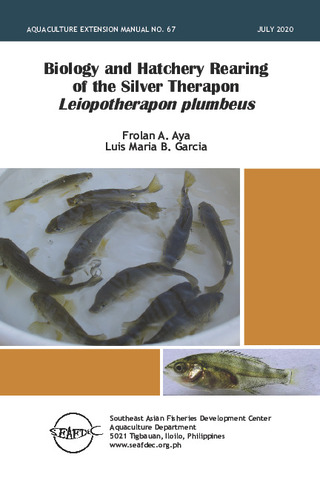
Biology and hatchery rearing of the silver therapon Leiopotherapon plumbeus
Aya, FrolanKnown for its tasty flesh, silver therapon, locally known as ayungin, has been regarded to be one of the most valuable edible native freshwater species in the Philippines. Demands for this fish species remain high which ...; Garcia, Luis Maria (Aquaculture Department, Southeast Asian Fisheries Development Center, 2020-07)