Institutional Reports: Recent submissions
Now showing items 121-140 of 180
-
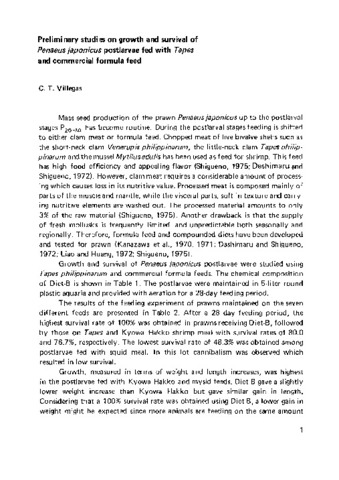
Preliminary studies on growth and survival of Penaeus japonicus postlarvae fed with Tapes and commercial formula feeds
(Aquaculture Department, Southeast Asian Fisheries Development Center, 1978)Growth and survival of P. japonicus postlarvae was studied using Tapes philippinarum and commercial formula feeds. After a 28-day feeding period, the highest survival rate of 100% was obtained in prawns receiving Diet-B, followed by those on Tapes Kyowa Hakko shrimp meal with survival rates of 80 and 76.7%, respectively. The lowest survival rate of 48.3% was obtained among postlarvae fed with squid meal. In this batch cannibalism was observed which resulted in low survival. Growth was highest in the postlarvae fed with Kyowa Hakko and mysid feeds. Diet-B gave a slightly lower weight increase but gave similar gain in length. The composition of the artificial diet, Diet-B, and growth and survival rates are tabulated. -
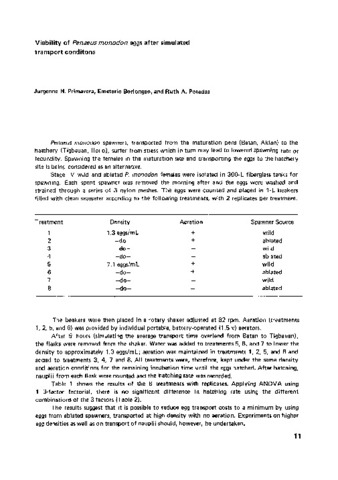
Viability of Penaeus monodon eggs after simulated transport conditions
Primavera, Jurgenne ; ; (Aquaculture Department, Southeast Asian Fisheries Development Center, 1977)
P. monodon spawners, transported from maturation pens suffer from stress which in turn may lead to lowered spawning rate or fertility. Spawning the females in the maturation site and transporting the eggs to the hatchery site is being considered as an alternative. Egg transport costs may be reduced to a minimum by using eggs from ablated spawners, transported at high density with no aeration. Experiments on higher egg densities as well as on transport of nauplii should, however, be undertaken.
; ; (Aquaculture Department, Southeast Asian Fisheries Development Center, 1977)
P. monodon spawners, transported from maturation pens suffer from stress which in turn may lead to lowered spawning rate or fertility. Spawning the females in the maturation site and transporting the eggs to the hatchery site is being considered as an alternative. Egg transport costs may be reduced to a minimum by using eggs from ablated spawners, transported at high density with no aeration. Experiments on higher egg densities as well as on transport of nauplii should, however, be undertaken. -
Isolation and culture in artificial media of Lagenidium from Penaeus monodon larvae
(Aquaculture Department, Southeast Asian Fisheries Development Center, 1977)Fungal infection of P. monodon larvae is a problem in hatchery operations. The fungus, which attacks the nauplius to postlarval stages and causes up to 100% mortality, has been tentatively identified as belonging to the genus Lagenidium. This pathogenic organism has recently been isolated and cultured. A description is given of the fungus, and features of its biology and pathology are discussed. -
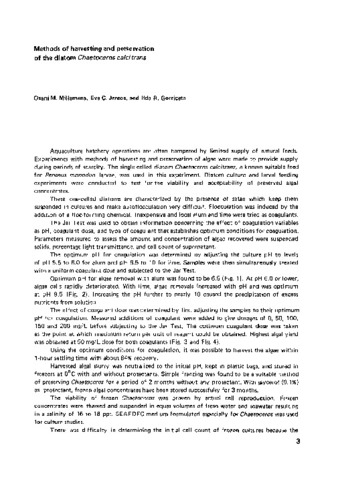
Methods of harvesting and preservation of the diatom Chaetoceros calcitrans
(Aquaculture Department, Southeast Asian Fisheries Development Center, 1977)Diatom culture and larval feeding experiments were conducted to test the viability and acceptability of preserved algal concentrates. C. calcitrans is characterised by the presence of setae which keep them suspended in cultures and make autoflocculation very difficult. Flocculation was induced by the addition of a floc-forming chemical. Using the optimum conditions, it was possible to harvest the algae within 1-h settling time and with about 84% recovery. The viability of frozen Chaetoceros was determined by actual cell reproduction. Preliminary feeding experiments showed that Chaetoceros can be successfully used as a substitute for fresh diatoms as feed for Penaeus monodon larvae. Simple freezing techniques, with or without the use of protectants has been found convenient for preserving algal concentrates in small volumes for both feeding and culture purposes. -
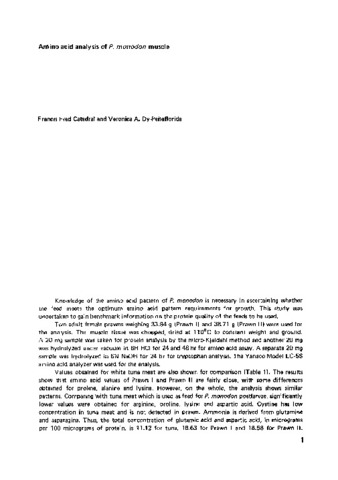
Amino acid analysis of P. monodon muscle
(Aquaculture Department, Southeast Asian Fisheries Development Center, 1977)Figures for the amino acid composition of Penaeus monodon, are tabulated, and compared to those for white tuna meat. -
Laboratory breeding of the mud crab Scylla serrata (Forskal) through the zoea and megalopa stages to the crab stage
(Aquaculture Department, Southeast Asian Fisheries Development Center, 1977)A series of experiments is being conducted to establish breeding techniques to mass-produce seedlings of S. serrata for pond cultivation to meet the commercial demand for the crab. The objective is to culture the crab through the 5 zoea stages and 1 megalopa stage to the crab stage. A brief resume of the experiments is presented. Heavy mortality occurred at the 1st, 2nd and 5th zoea stages, and during the megalopa stage. Initial mortality is attributed to unfavourable rearing conditions, and later mortality to cannibalism. -
Salinity preference of the milkfish Chanos chanos Forskal
(Aquaculture Department, Southeast Asian Fisheries Development Center, 1977)Extended abstract only. -
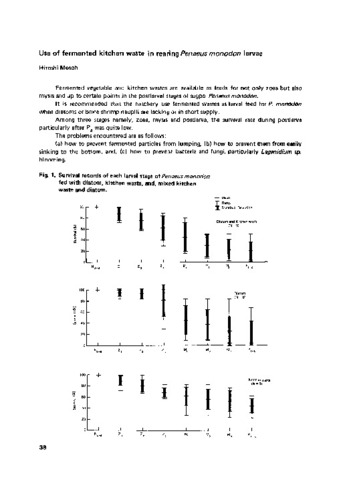
Use of fermented kitchen waste in rearing Penaeus monodon larvae
(Aquaculture Department, Southeast Asian Fisheries Development Center, 1977)Fermented vegetable and kitchen wastes are available as feeds for not only zoea but also mysis and up to certain points in the postlarval stages of sugpo, Penaeus monodon. It is recommended that the hatchery use fermented wastes as larval feed for P. monodon when diatoms or brine shrimp nauplii are lacking or in short supply. Among three stages namely, zoea, mysis and postlarva, the survival rate during postlarva particularly after P4 was quite low. The problems encountered are as follows: (a) how to prevent fermented particles from lumping, (b) how to prevent them from easily sinking to the bottom, and, (c) how to prevent bacteria and fungi, particularly Lagenidium sp blooming. -
Effect of temperature on the oxygen consumption of Penaeus monodon postlarvae
(Aquaculture Department, Southeast Asian Fisheries Development Center, 1977)Extended abstract only. -
Effect of nitrite, ammonia, and temperature on P. monodon larvae
(Aquaculture Department, Southeast Asian Fisheries Development Center, 1977)P. monodon larvae were studied for the effects of temperature, ammonia, and nitrite on survival. Toxicity levels of nitrite were found to vary with larval stage. Larvae could tolerate ammonia up to about 10 ppm, with the effect more clearly shown by the zoea stage. Survival and growth were not significantly affected by temperature, although moulting was enhanced at temperatures higher than 29°C. Larvae of P. monodon have lower tolerance toward nitrite and ammonia compared to postlarvae. Although high survival was obtained at low levels of nitrite and ammonia, it is still necessary to know their effects on metabolism, in order to examine possible biochemical parameters for diagnosing sublethal toxicity or stress. -
Notes on ovarian rematuration of ablated sugpo (prawn) Penaeus monodon Fabricius
Primavera, Jurgenne; (Aquaculture Department, Southeast Asian Fisheries Development Center, 1977)
To what extent spent P. monodon females can remature and spawn successive broods is an important question in terms of recycling spawners in a commercially viable operation. Corollary to this is the quantity and quality of fry from rematured females in comparison to those from first spawning. Of 347 experimental females, only 10.1% had a second spawning, and 1.4% a third spawning. To a large degree the low rate of rematuration is due to high spawner mortality - average survival period after spawning was only 6 days in a sample of 176 spawners. It took an average of 23 days after ablation for a prawn with undeveloped ovaries to mature and spawn. An ablated female may have another spawning in as little as 5 days after the previous one. Average fecundity was 180,000 eggs per second spawning, and 140,000 eggs per third spawning. The average number of eggs from first spawning ablated females was 110-120,000. Hatching rate was lower for rematuration: 44% for second spawnings, and 35% for third spawnings, as compared to 64% for first maturation. -
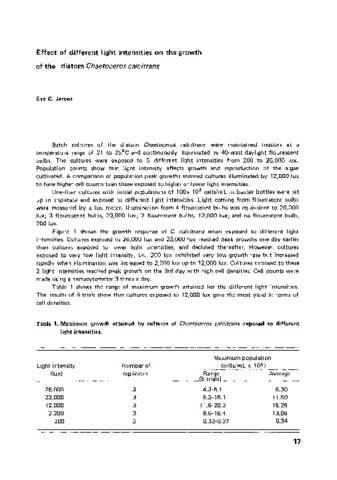
Effect of different light intensities on the growth of the diatom Chaetoceros calcitrans
(Aquaculture Department, Southeast Asian Fisheries Development Center, 1977)Batch cultures of C. calcitrans were maintained indoors at a temperature range of 21 to 25 C and continuously illuminated by 40-watt daylight fluorescent lights. Cultures were exposed to 5 different intensities from 200 to 25,000 lux. Population counts show that light intensity affects growth and reproduction of the algae cultivated. A comparison of population peak growths showed cultures illuminated by 12,000 lux to have higher cell counts than those exposed to higher or lower light intensities. -
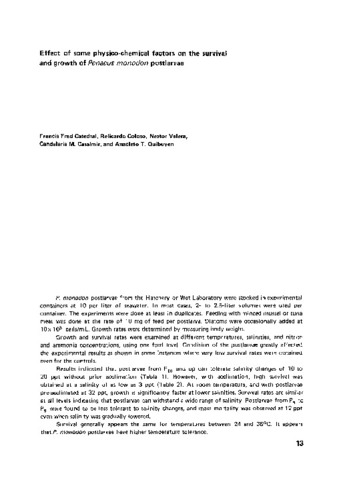
Effect of some physico-chemical factors on the survival and growth of Penaeus monodon postlarvae
(Aquaculture Department, Southeast Asian Fisheries Development Center, 1977)Growth and survival rates of P. monodon postlarvae were examined at different temperatures, salinities, and nitrite and ammonia concentrations, using one feed level. Condition of postlarvae greatly affected the experimental results shown in some instances where very low survival rates were obtained, even for the controls. Results indicated that postlarvae from P10 and up can tolerate salinity changes of 10 to 20 ppt without prior acclimation. Survival generally appears the same for temperatures between 24 and 36°C. It appears that P. monodon postlarvae have higher temperature tolerance. Tolerance of postlarvae at the early postlarval stage is between 30 and 50 ppm of nitrate. They were more tolerant from P10 upwards. Although survival was high in runs containing nitrite, growing appears to have been affected. Postlarvae could tolerate ammonia concentrations up to about 50 ppm. At 100 ppm higher mortality rates were observed. Whether or not there was any permanent effect by nitrate and ammonia at high but apparently tolerable levels is not known. -
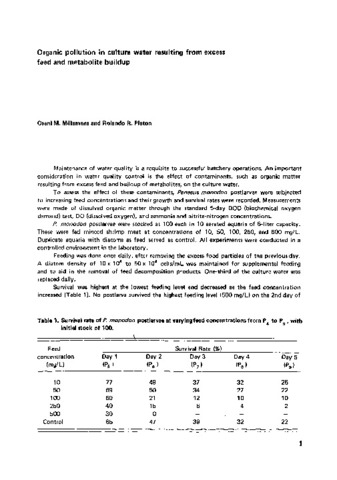
Organic pollution in culture water resulting from excess feed and metabolite buildup
(Aquaculture Department, Southeast Asian Fisheries Development Center, 1977)Penaeus monodon postlarvae were subjected to increasing feed concentrations and their growth and survival rates were recorded. Measurements were made of dissolved organic matter, and ammonia and nitrite-nitrogen concentrations. Survival was highest at the lowest feeding level and decreased as feed concentration increased. It is concluded that although organic matter enriches the food supply for P. monodon postlarvae, at higher concentration levels it can pollute the culture water, which in turn leads to mass mortality of the postlarvae. Secondly, the survival rate of P. monodon postlarvae is directly related to dissolved organic matter concentration, oxygen tension, and ammonia-nitrogen concentrations in the culture water. Even at sublethal levels these adverse environmental conditions decrease the survival rate. -
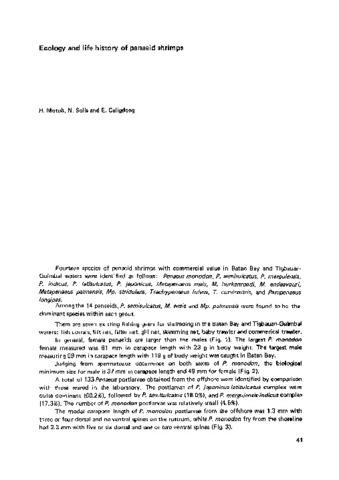
Ecology and life history of penaeid shrimps
(Aquaculture Department, Southeast Asian Fisheries Development Center, 1977)Fourteen species of penaeid shrimps with commercial value in Batan Bay and Tigbauan-Guimbal waters were identified as follows: Penaeus monodon, P. semisulcatus, P. japonicus, Metapenaeus ensis, M. burkenroadi, M. endeavouri, Metapenaeopsis palmensis, M. stridulans, Trachypenaeus fulvus, and Parapenaeus longipes. Among the 14 penaeids, P. semisulcatus, M. ensis and M. palmensis were found to be the dominant species within each genus. There are seven existing fishing gears for shrimping in the Batan Bay and Tigbauan-Guimbal waters: fish corrals, lift net, filter net, gill net, skimming net, baby trawler and commercial trawler. In general, female penaeids are larger than males. The largest P. monodon female measured was 81 mm in carapace length with 23 g in body weight. The largest male measuring 59 mm in carapace length with 119 g of body weight was caught in Batan Bay. Judging from spermatozoa occurrence on both sexes of P. monodon, the biological minimum size for male is 37 mm in carapace length and 49 mm for female. A total of 133 Penaeus postlarvae obtained from the offshore were identified by comparison with those reared in the laboratory. The postlarvae of P. japonicus-latisulcatus complex were quite dominant (60.2%), followed by P. semisulcatus (18.0%), and P. merguiensis-indicus complex (17.3%). The number of P. monodon postlarvae was relatively small (4.5%). The modal carapace length of P. monodon postlarvae from the offshore was 1.3 mm with three or four dorsal and no ventral spines on the rostrum, while P. monodon fry from the shoreline had 2.3 mm with five or six dorsal and one or two ventral spines. -
Land-based mass production of prawn (Penaeus monodon Fabricius) spawners
Primavera, Jurgenne (Aquaculture Department, Southeast Asian Fisheries Development Center, 1977)
The first spawnings were obtained 12 days after ablation with 4 spawners yielding 784,000 eggs and a harvest of 250,000 P10 fry. Survival of females after 1 month was approximately 30%. Mortalities were mostly due to handling stress during the regular ovarian samplings as well as disease from the accumulated excess feeds on the bottom of the tank. Male survival could not be recorded because of transfers to other tanks and addition of new stocks. Development seemed to peak 3 weeks after ablation. The average number of eggs per ablated spawner was 120,000. However, many of the partially spawned females were removed from the spawning tanks the following day so that remaining eggs released in the next 2 to 3 days could not be recorded. Estimate of the average number of eggs per ablated spawner is 120,000-150,000 in contrast to 500,000 per wild spawner. However, the low production cost more than compensates for the difference. Fry reared in the Wet Laboratory were used for experiments, mostly on feeding. Therefore, survival at harvest is not to be taken as a reflection of stock quality. Although fewer in number, larvae from ablated prawns are as healthy in terms of vigor in swimming and feeding as those from wild females. Most mortalities are due to inability to molt caused by lower water temperatures and inadequate feeding. -
Survival rates of different postlarval stages of Penaeus monodon Fabricius
Primavera, Jurgenne (Aquaculture Department, Southeast Asian Fisheries Development Center, 1977)
The objective of this study is to determine survival rates of different postlarval stages upon stocking in the Leganes ponds. Twelve 3m x 2m x 2m suspension nets made of nylon cloth (mesh size = 0.1 mm) were set up in a Leganes Station pond (ave. water depth = 1 m) by means of 3-m long poles stacked at distances approximating the area of each net. The net bottom was filled with topsoil at least 15 cm thick to stimulate the pond bottom. At least 60 cm of the upper edge of each net was above the water level to prevent mixing of water inside and outside the net. P. monodon of stages P11, P15, P21 (from the hatchery) and P25 (from the wet lab) were stocked in the nets at 200/sq m or 1,200 fry/net. Due to lack of fry, only one P25 net was stocked. Each net had two large dried miapi branches as shelter from predation and cannibalism for the young sugpo fry. Fresh lablab was fed at the rate of one pail (approximately 5 kg) every four days per net. Harvest data show relatively higher survival rates for P15 and P18 compared to P11 and P25 with no significant difference between these two stages. The results for P25 may not be valid because the stock came from the wet lab in comparison to the other postlarval stages which were reared in the hatchery. Moreover, the P25 stock had no replicates and the net itself (no. 10) was discovered to have many holes. These preliminary results point to P15 as the best stage for harvest from the hatchery in terms of high pond recovery and lesser expense in rearing compared to older postlarvae. -
Notes on the induced maturation and spawning in four-month-old Penaeus monodon Fabricius by eyestalk ablation
Primavera, Jurgenne; (Aquaculture Department, Southeast Asian Fisheries Development Center, 1977)
The ablation technique consisted of making an incision across the eyeball to allow free flow of fluids while holding the prawn under water, squeezing the eyeball contents outwards, and pinching hard the eyestalk tissue. The cut area heals completely in about a week; no application of antibiotics is necessary. Spent spawners were tagged with thin brass rings (Rodriguez, 1976) around the unablated eyestalk for a separate experiment on rematuration. Two spawning yielding approximately 277,000 eggs were obtained three weeks after ablation, followed four days later by two more spawnings with 160,000 eggs; all four spawners weighed more than 100 g. With a hatching rate of 98% and 78% for the first and second batch, respectively, the spawnings produced viable nauplii. Water temperatures as low as 23°C due to a delayed cold spell in March depressed molting; weakened larvae had to be discharged at the mysis stage. Although ovarian development continued, no further spawnings were obtained due mainly to the onset of bacterial and fungal disease. Infection is initiated in injured portions of the exoskeleton, sometimes penetrating right through the muscles to the ovarian tissues. The non-flowthrough conditions and mussel meat feeding led to fouling of the culture water resulting in consecutive mortalities caused by disease. Female P.monodon held in maturation pens were ablated at the age of 15 months (Santiago, et al., 1976); they averaged only 16 g body weight after four months growth in ponds. In another experiment, pond-reared P.monodon females ranging from 50 to 80 g were ablated at approximately seven months (Aquacop, 1977). The present results show a minimum age of four months from postlarve that P.monodon is capable of ovarian development and spawning upon ablation. However, maturation is probably affected by size as well as age - the four-month old females weighed an average of 100 g in contrast to the smaller animals in the earlier experiments. -
Notes on the external sex characters of Chanos chanos Forskal spawners
(Aquaculture Department, Southeast Asian Fisheries Development Center, 1977)In this study, the authors did not find any visible differences between the sexes with reference to external features such as coloration, shape of head, snout and operculum, presence of tubercles or nasal pores, length, size and shape as well as any roughness in the various fins. However, the anal region of the mature milkfish exhibits discernible anatomical differences in the male and female. In the males, there are 2 main openings visible externally. These are the anterior anus and the posterior urogenital opening at the tip of the urogenital papilla. Internally, the vasa deferentia (male genital ducts) from the testes join into a common duct about 5-10 mm from the urogenital pore. The urinary pore opens into this common duct from the dorsal side. In addition, there are 2 small pores situated on each side of the base of the urogenital papilla opening ventrally into the coelom. In the females, there are 3 main openings in the anal region instead of 2 as found in the males. The anteriormost opening is the anus followed by the genital pore. The third opening is the urinary pore which is posterior to the genital pore located at the tip of the urogenital papilla. -
The biology and control of Caligus sp., an ectoparasite of the adult milkfish Chanos chanos Forskal
(Aquaculture Department, Southeast Asian Fisheries Development Center, 1977)One unidentified species of copepod belonging to the genus Caligus of the family Caligidae was found to infest the adult milkfish broodstock. To control the parasites infesting the adult milkfish, tests were made using the chemical (2,2,2-trichloro-1-hydroxyl)-phosphonic acid-dimethylethol (Neguvon) at a concentration of 0.25 ppm. It is noted that a concentration of 0.25 ppm of Neguvon maintained for 12-24 hours in the sabalo-containing tanks in a closed water system but with aeration is effective in controlling the parasites. Fish mortality during the experiment was due to inadequate aeration in the tanks.