SEAFDEC Asian Aquaculture: Recent submissions
Now showing items 261-280 of 305
-
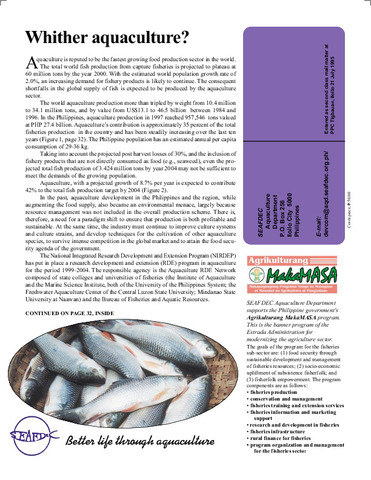
Whither aquaculture?
(Aquaculture Department, Southeast Asian Fisheries Development Center, 2000) -
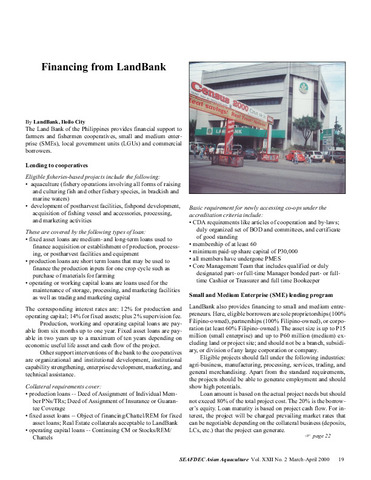
Financing from LandBank
(Aquaculture Department, Southeast Asian Fisheries Development Center, 2000) -
The hidden traps in aquaculture
(Aquaculture Department, Southeast Asian Fisheries Development Center, 2000)New investors in aquaculture probably know that they can make mistakes as they continue to operate their farms. Whether the mistakes happen immediately or not are risks they take as long as the mistakes are manageable and can easily be corrected. But many aquaculturists who have long been in the business say that there are costly mistakes that can wipe out one's investment. This paper is based on interviews with experienced aquaculturists and some popular articles from other aquaculture newsletters (Lindberg and Pryor on ways to lose money in aquaculture, Proceedings, sustainable aquaculture 95) and shares some insights regarding mistakes that may be hidden to new investors but obvious to experienced aquaculturists. -
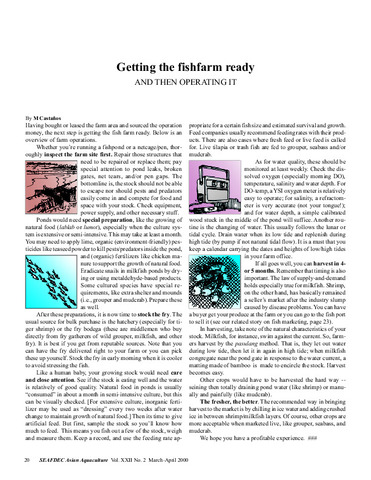
Getting the fishfarm ready and then operating it
(Aquaculture Department, Southeast Asian Fisheries Development Center, 2000) -
Food safety through HACCP
(Aquaculture Department, Southeast Asian Fisheries Development Center, 2000) -
A glimpse at shrimp culture in Indonesia
(Aquaculture Department, Southeast Asian Fisheries Development Center, 2000) -
Middlemen: the most maligned players in the fish distribution channel
(Aquaculture Department, Southeast Asian Fisheries Development Center, 2000) -
The fishery resources of Indonesia
(Aquaculture Department, Southeast Asian Fisheries Development Center, 2000) -
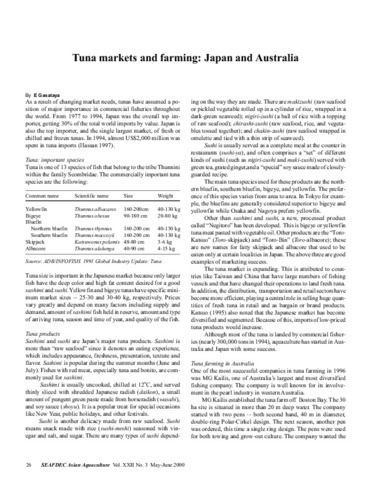
Tuna markets and farming: Japan and Australia
(Aquaculture Department, Southeast Asian Fisheries Development Center, 2000) -
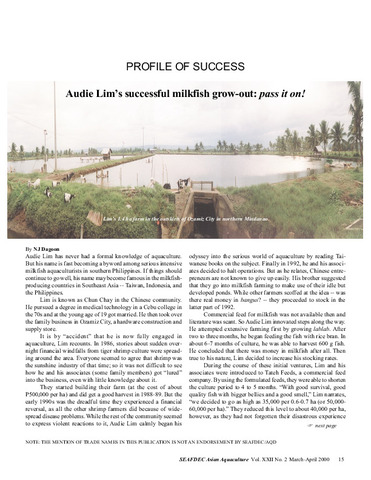
Audie Lim's successful milkfish grow-out: pass it on!
(Aquaculture Department, Southeast Asian Fisheries Development Center, 2000) -
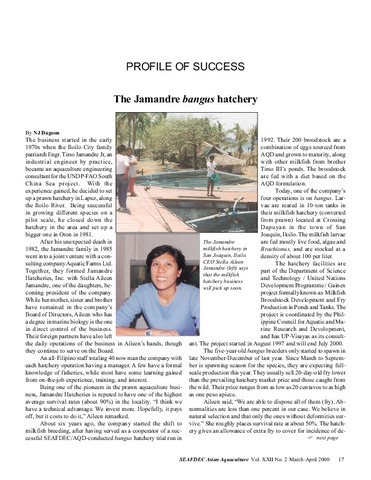
The Jamandre bangus hatchery
(Aquaculture Department, Southeast Asian Fisheries Development Center, 2000) -
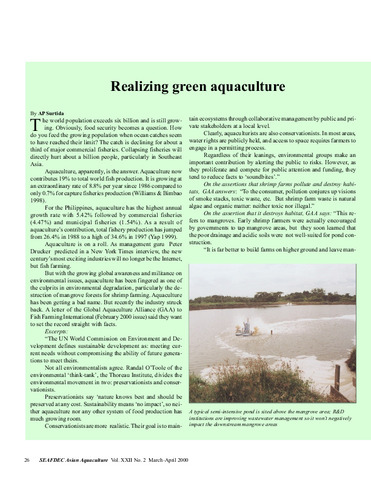
Realizing green aquaculture
(Aquaculture Department, Southeast Asian Fisheries Development Center, 2000) -
I'd like to invest in aquaculture, what choices do I have?
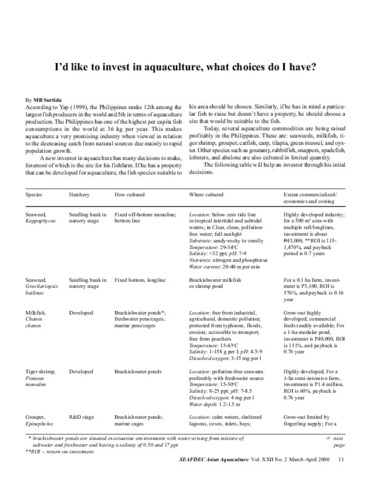
(Aquaculture Department, Southeast Asian Fisheries Development Center, 2000)The Philippines, which lies 5th in terms of aquaculture production world-wide, has one of the highest per capita fish consumptions in the world. This makes aquaculture a very promising industry when viewed in relation to the decreasing catch from natural sources, which is due mainly to rapid population growth. A new investor in aquaculture has many decisions to make, foremost of which is the site for the farm. A table is given listing the major species which are being raised profitably in the Philippines. It also includes information as to how and where the species are cultured, the extent to which the sector is commercialized, and economics and costings. -
Managing Laguna lake for the small fishermen
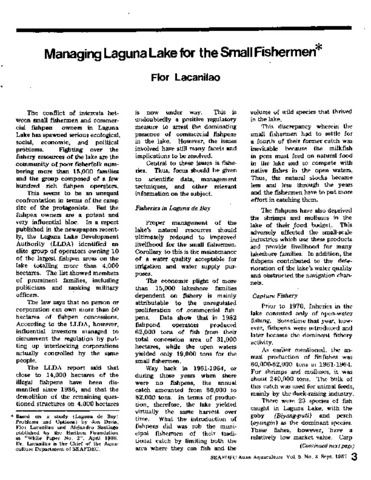
(Aquaculture Department, Southeast Asian Fisheries Development Center, 1987)Based on a study (Laguna de Bay: Problems and Options) by Jon Davis, Flor Lacanilao and Alejandro Santiago published by the Haribon Foundation as "White Paper No. 2", April 1986. -
A glimpse into some sea cucumbers in Panay, Philippines
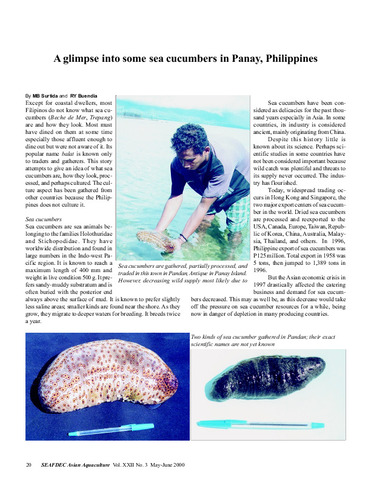
(Aquaculture Department, Southeast Asian Fisheries Development Center, 2000)Except for coastal dwellers, most Filipinos do not know what sea cucumbers are, although most must have dined on them at some time. A description is given of what sea cucumbers are and how they look, how they are processed and how they are cultured. Sea cucumbers, which belong to the families Holothuridae and Stichopodidae, have a worldwide distribution and are found in large numbers in the Indo-West Pacific region. In the Philippines, sea cucumbers have never been cultured, although it is one of the sources of dried sea cucumbers in the international market. This is most probably due to the fact that wild supply has apparently been sufficient for trading. -
Crocodile farming: a multi-million dollar industry
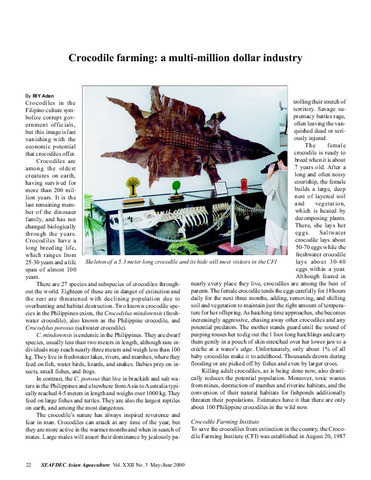
(Aquaculture Department, Southeast Asian Fisheries Development Center, 2000)Crocodiles have a long breeding life, which ranges from 25-30 years. There are 27 species and subspecies of crocodiles throughout the world, 18 of which are in danger of extinction, the rest being threatened with declining population due to overhunting and habitat destruction. Two known crocodile species exist in the Philippines: Crocodylus mindorensis (freshwater crocodile) and C. porosus (saltwater crocodile). Killing adult crocodiles, as is being done now, drastically reduces the potential population. Moreover, toxic wastes from mines, destruction of marshes and riverine habitats, and the conversion of their natural habitats for fishponds additionally threaten their populations. Estimates indicate that there are only about 100 Philippine crocodiles in the wild now. The Crocodile Farming Institute (CFI) was established in Palawan, in 1987, in order to save the crocodiles from extinction in the Philippines. It is now one of the components of the Palawan Wildlife and Conservation Center, and aims to conserve the 2 endangered species in the Philippines and also to develop and introduce a suitable crocodile farming technology that will help uplift the socio-economic well-being of the Filipino people. CFI believes in the potential of commercial utilization of crocodiles as a dollar-generating industry for the Philippines. It is a very profitable business and could be a multi-million dollar industry. A brief outline is given of the economic and marketing potentials of farming crocodiles in the Philippines. -
Malaysian school engages in bullfrog and turtle farming
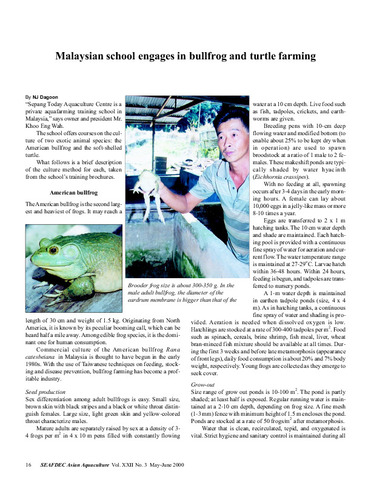
(Aquaculture Department, Southeast Asian Fisheries Development Center, 2000)A brief description is given of the culture methods used in the Sepang Today Aquaculture Centre, a private aquafarming training school in Malaysia, regarding American bullfrog (Rana catesbeiana) and the soft-shelled turtle (Trionyx sinensis). Seed production, grow-out, marketing and future potential are discussed, referring to the school s training brochures for both culture methods. -
The sargeant fish and the eel
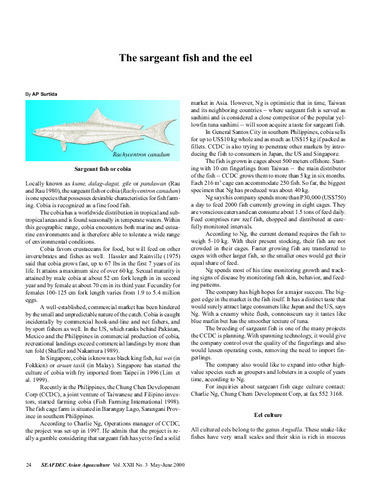
(Aquaculture Department, Southeast Asian Fisheries Development Center, 2000)The culture of sargeant fish, or cobia (Rachycentron canadum) and eel (Anguilla spp) in the Philippines is discussed. Market potentials for the cultured products are examined. -
The culture of seabass
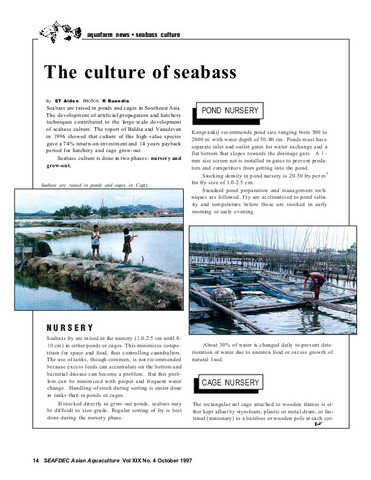
(Aquaculture Department, Southeast Asian Fisheries Development Center, 1997)Seabass (Lates calcarifer) are raised in ponds and cages in Southeast Asia. Details are given of the 2 phases involved in the pond and culture culture systems -- nursery and grow-out. Both monoculture and polyculture systems are used for pond production of seabass. Polyculture may involve milkfish and tilapia, groupers, seaweed, tilapia or snapper, grouper and shrimp. -
Mangrove community structure survey
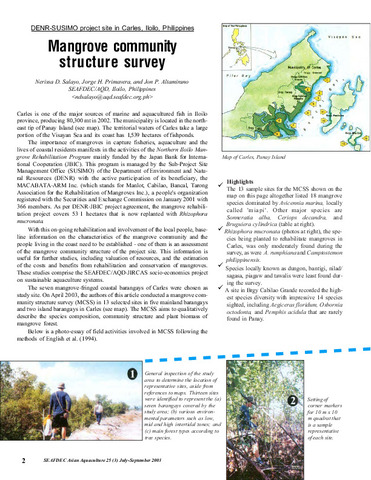
(Aquaculture Department, Southeast Asian Fisheries Development Center, 2003)Highlights are given of a mangrove community structure survey conducted in the coastal barangays of Carles, Panay Island, Philippines, in April 2003. The survey aimed to qualitatively describe the species composition, community structure and plant biomass of mangrove forests. The 13 sample sites showed a total of 18 mangrove species, dominated by Avicennia marina. The findings, which indicate a modest yet declining diversity of mangroves in Carles, reinforce the need for their protection and management. This is due not only to their importance as habitats for fish and shellfish juveniles that replenish stocks for capture fisheries and aquaculture, but also due to the fact that Carles is one of the few remaining areas in Panay where rare mangrove species can still be found.