Water quality criteria for farming the grass shrimp, Penaeus monodon


Share
Abstract
Physiological and growth effects of pH, salinity, temperature, heavy metals, pesticides and others on juvenile grass shrimp Penaeus monodon have been investigated to
determine the biologically safe concentrations. Optimal pH, salinity and temperature are found to be in the range of 8.0-8.5, 15-25 ppt, and 28-33°C, respectively. A dissolved oxygen concentration of 3.7 ppm seems to be the critical oxygen pressure to support the normal life of grass shrimp. To avoid poor survival and retarded growth, the recommended level for each pollutant are: heavy metals, 0.0025 ppm Hg, 0.1 ppm Cu, 0.15 ppm Cd, 0.25 ppm Zn; pesticides, 0.0004 ppb parathion, 0.001 ppb malathion, 0.008 ppb rotenone, 0.01 ppb Azodrin, 0.033 ppb Saturn, 0.01 ppb paraquat, 0.01 ppb Endosulfan, 1 ppb Butachlor; surfactants, 0.1 ppm Dunall OSE, 0.2 ppm BP 1100, 0.5 ppm Seagreen 805; and others, 0.033 ppm H2S, 0.1 ppm NH3.
Description
Abstract only.
Suggested Citation
Chen, H.-C. (1985). Water quality criteria for farming the grass shrimp, Penaeus monodon (Abtract only). In Taki Y., Primavera J.H. and Llobrera J.A. (Eds.). Proceedings of the First International Conference on the Culture of Penaeid Prawns/Shrimps, 4-7 December 1984, Iloilo City, Philippines (p.165). Iloilo City Philippines: Aquaculture Department, Southeast Asian Fisheries Development Center.
Type
Oral presentationISBN
9718511008Related items
Showing items related by title, author, creator and subject.
-
An overview of the nutrition, feed and feeding techniques of prawn penaeid/shrimps
(Philippine Council for Aquatic and Marine Research and Development, 1989)This paper echoes what transpired during the first International Conference of Penaeid Prawns/Shrimps held in Iloilo City in December 4-7, 1984, particularly on the Nutrition nd Feed Development. Around 25 papers were presented during the conference. The nutrient requirements of P. japonicus and to some extent, P. monodon have been studied quite extensively compared to other penaeid species. Requirements for protein, carbohydrates fats, amino acids and essential fatty acids for juveniles and larvae have been defined compared to those of the broodstock. Optimum protein levels for prawn juveniles vary from 28-38% for P. kerathurus, 40-46% for P. monodon, 43% for P. indicus and 50-54% for P. japonicus. Dissacharides like sucrose and trehalose have been found to be good source of carbohydrates at 20-25% in the diet. Crustacean diets require around 0.5% cholesterol. There are few studies on vitamine and mineral requirements. There are artificial diets for juveniles and microencapsulated diets that can completely replace live organisms as larval feed. Microencapsulated diets have been field-tested for P. vannamei, P. stylirostris, P. monodon, P. indicus and P. merguiensis in Ecuador, Taiwan, Malaysia, Thailand and the Philippines. When a commercial diet for the broodstock becomes available ther will be an artificial diet for athe life cycle of tha prawn. -
Series: Aquaculture extension manual; No. 19
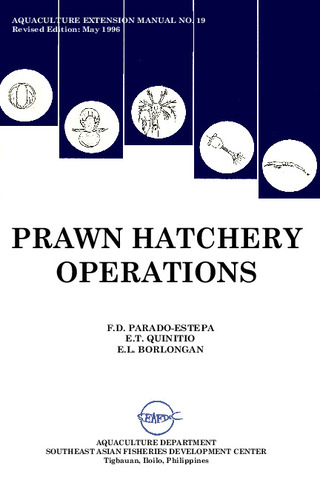
Prawn hatchery operations
; Quinitio, Emilia T. ; (Aquaculture Department, Southeast Asian Fisheries Development Center, 1996-05)
The manual, an updated version of the 1984 SEAFDEC/AQD manual, presents the underlying principles and step-by-step instructions of prawn larval and post-larval rearing. The techniques described are not only applicable to Penaeus monodon, but may also be modified and applied to other penaeid and metapenaeid species. The following aspects are covered: Site selection; Life cycle; Hatchery design and planning; Hatchery operations; Diseases; and Economics.
; (Aquaculture Department, Southeast Asian Fisheries Development Center, 1996-05)
The manual, an updated version of the 1984 SEAFDEC/AQD manual, presents the underlying principles and step-by-step instructions of prawn larval and post-larval rearing. The techniques described are not only applicable to Penaeus monodon, but may also be modified and applied to other penaeid and metapenaeid species. The following aspects are covered: Site selection; Life cycle; Hatchery design and planning; Hatchery operations; Diseases; and Economics. -
The lowdown on world shrimp culture - II
(INFOFISH, 2001)This paper introduces some new members of the international shrimp culture club and goes on to discuss some recent technological innovations in the industry, particularly the polyculture of tilapia (mainly Oreochromis mossambicus) and shrimp.