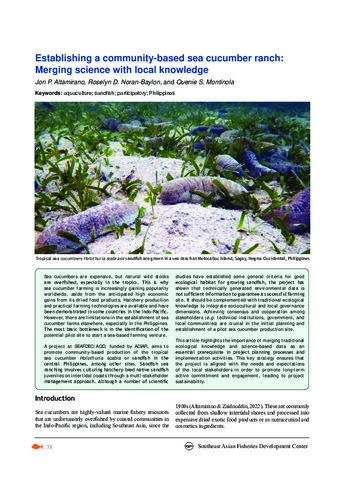
Establishing a community-based sea cucumber ranch: Merging science with local knowledge


Share
抄録
Sea cucumbers are expensive, but natural wild stocks are overfished, especially in the tropics. This is why sea cucumber farming is increasingly gaining popularity worldwide, aside from the anticipated high economic gains from its dried food products. Hatchery production and practical farming technologies are available and have been demonstrated in some countries in the Indo-Pacific. However, there are limitations in the establishment of sea cucumber farms elsewhere, especially in the Philippines. The most basic bottleneck is in the identification of the potential pilot site to start a sea-based farming venture.
A project at SEAFDEC/AQD, funded by ACIAR, aims to promote community-based production of the tropical sea cucumber Holothuria scabra or sandfish in the central Philippines, among other sites. Sandfish sea ranching involves culturing hatchery-bred native sandfish juveniles on intertidal coasts through a multi-stakeholder management approach. Although a number of scientific studies have established some general criteria for good ecological habitat for growing sandfish, the project has shown that technically generated environmental data is not sufficient information to guarantee a successful farming site. It should be complemented with traditional ecological knowledge to integrate sociocultural and local governance dimensions. Achieving consensus and cooperation among stakeholders (e.g. technical institutions, government, and local communities) are crucial in the initial planning and establishment of a pilot sea cucumber production site.
This article highlights the importance of merging traditional ecological knowledge and science-based data as an essential prerequisite in project planning processes and implementation activities. This key strategy ensures that the project is aligned with the needs and expectations of the local stakeholders in order to promote long-term active commitment and engagement, leading to project sustainability.
Subjects
Sea cucumbers
Suggested Citation
Altamirano, J., Noran-Baylon, R. D., & Montinola, Q. S. (2024). Establishing a community-based sea cucumber ranch: Merging science with local knowledge. Fish for the People , 22(1), 38-43. http://hdl.handle.net/20.500.12066/7484
Type
magazineArticleCollections
- Fish for the People [41]
Related items
Showing items related by title, author, creator and subject.
-
Series: ACIAR Proceedings; No. 136
Overview of sea cucumber aquaculture and sea-ranching research in the South-East Asian region
(Australian Centre for International Agricultural Research, 2012)South-East Asia has traditionally been the global centre of production of tropical sea cucumbers for Chinese markets. Early research into culture methods took place outside this region, notably in India, the Pacific region and China. However, recent investment in Holothuria scabra (sandfish) culture has led to some significant advances within this region. The Philippines and Vietnam have been at the forefront of recent efforts, with involvement from substantial national programs and local institutions as well as international donors and scientific organisations. Smaller programs are ongoing in Thailand, Malaysia and Indonesia. Recent advances and simplifications in hatchery techniques are a major step forward, having promoted the development of experimental-scale sea-ranching ventures, and given rise to a small, commercial pond-based culture industry in Vietnam. Technology developments in nursery systems are likely to provide opportunities for culture enterprises in a broader range of environments than is now possible. A major research thrust in the Philippines towards developing cooperative sea-ranching enterprises has demonstrated good potential, and institutional/legislative arrangements to ensure adequate property rights have been tested. Rotational culture with shrimp is proving successful in Vietnam, while the possibility of proximate co-culture of sandfish and shrimp has largely been ruled out. Small-scale experiments in the Philippines raise the possibility of co-culture in ponds with a number of finfish species. Current research directions are looking at diversifying technology to increase success in a range of coastal conditions, better understanding the social and biophysical conditions required for success, and finding ways of effectively scaling-out developed systems and technology. -
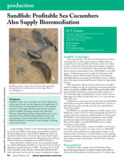
Sandfish: Profitable sea cucumbers also supply bioremediation
(Global Aquaculture Alliance, 2011)Sandfish, a type of sea cucumber, are both a high-value culture species and one that supports the aquaculture of other fish species by cleaning up waste on the bottoms of ponds or sea cages. Hatchery and nursery technologies for sandfish are being continuously refined by Vietnam’s Research Institute of Aquaculture No. 3, the Southeast Asian Fisheries Development Center and their partners. These technologies have also been initially transferred to the private sector through a training course and manual. -
Resource assessment of sea cucumber in northern Iloilo, central Philippines
(Aquaculture Department, Southeast Asian Fisheries Development Center, 2015)A resource assessment of sea cucumber was conducted in six out of eight coastal towns in northern Iloilo, a fisheries rich area facing the Visayan Sea in the central Philippines. A yearlong assessment was conducted in 2012. Fishery dependent survey was done with the use of survey questionnaire translated into dialect. Six trained enumerators administered the questionnaires to 114 gatherers and 18 local traders. Fishery independent survey involving Belt Transect Method (BTM) for intertidal areas and Timed-Search Method (TSM) for subtidal areas were conducted in 21 GPS (Global Positioning System)-referenced sampling stations. Sample specimens were also collected and prepared for taxonomic identification. External morphology, internal structures (dissected samples) and spicule analysis were used in the identification. Fishery dependent survey showed that gleaning (40%) is the most dominant extraction method used. Various methods were also employed including the dangerous compressor diving and the destructive karas, a method using a rake-like device to scrape the sea bed. In terms of volume, the most heavily exploited sea cucumber belongs to the Stichopus groups. The trade of sea cucumber is dominated by island-based traders. Almost half of the traders are women, signifying that trading is a woman's domain as well. Derived monthly income from sea cucumber trade ranges from PhP 2,000-3,000 for gatherers and PhP 2,000-5,000 for the traders. Fishery independent survey resulted in the identification of six sea cucumber genera (Bohadschia, Holothuria, Paracaudina, Pseudocholochirus and Stichopus). Of the 32 species found belonging to the six genera, only 16 were identified up to the species level. Samples of unidentified specimen were sent to the University of the Philippines - Marine Science Institute (UP MSI) laboratory for molecular taxonomic identification. In terms of species count, the most dominant genera is the Holothuria with nine identified and seven unidentified species. H. impatiens is also the most dominant sea cucumber found in the area. Further, the recorded catch per unit effort (CPUE) for fishery-independent survey is 3-4 pcs/diver/hr. The resource assessment showed that the trade of sea cucumber is dictated by economic value rather than by ecological abundance. While the scale and extent of sea cucumber fishery in northern Iloilo is small-scale and island based, the study highlights the need for trade regulation and stock enhancement of heavily exploited species as extraction affects the ecological distribution of sea cucumber stocks in the area.