SEAFDEC/AQD Institutional Repository: Recent submissions
Now showing items 461-480 of 4221
-
Tilapia marketing in Metro Manila
(Philippine Council for Agriculture, Forestry and Natural Resources Research and Development, 1987)The culture of tilapia in the Philippines has spread across the country. Tilapia production is increasing as reflected in the volume of tilapia unloaded in major fish landings in the country. In Metro Manila, where a large percentage of the country s population is concentrated, tilapia consumption has gained wide acceptance among consumers. The introduction of a new and better tilapia species which is meaty and bigger in size than the first species introduced in the country has ushered in the acceptance of tilapia even among sophisticated consumers in urban areas. While literature on the culture of tilapia abounds, only a few papers on the marketing of this fish have been written, thus leaving much questions on this matter still unanswered. This paper hopes to add to whatever information is available on the marketing of tilapia. Primary focus is given on the marketing of tilapia in Metro Manila. Special emphasis of this paper will be on the distribution, production, price trends and problems in marketing of tilapia in Metro Manila. The data are based on a study conducted among fish traders, wholesalers and retailers and other available information related to the subject. Experiences and observations of the author in marketing tilapia in Metro Manila for the past five years have also been included to add practical relevance to this paper. -
Culture studies on Tilapia sp. under saline conditions at the Brackishwater Aquaculture Center
(Philippine Council for Agriculture, Forestry and Natural Resources Research and Development, 1987)This paper reviews the various researches on tilapia at the BAC with the purpose of disseminating the information so far generated and identifying the gaps in tilapia research under saline conditions. Primary studies on tilapia at BAC were concentrated on increasing production of tilapia in brackishwater ponds and how this targetted production could be obtained more effectively and efficiently. Monoculture and polyculture procedures for tilapias including fertilization and feeding were studied. Forage fish: carnivore fish ratios were established for certain species which could be effective in thinning down the population of young tilapia while allowing the original stocks to grow bigger and at the same time producing fingerlings for restocking. This paper presents the results of various studies on tilapia. -
Commercial production of tilapia in freshwater ponds and cages in the Philippines
(Philippine Council for Agriculture, Forestry and Natural Resources Research and Development, 1987)This paper reviews the state-of-the-art of Nile tilapia production on a commercial scale in Philippine freshwater ponds and cages. Culture practices and problems are also discussed. Commercial production of tilapia as applied here refers to growing of table fish to generate income. -
Improved tilapia strains through broodstock development in the Philippines
(Philippine Council for Agriculture, Forestry and Natural Resources Research and Development, 1987)Increased tilapia production can be attained in several ways. It can be achieved through development of better diets, proper stocking densities, increasing cultural inputs, efficient management practices, etc. but yields cannot be optimized if genetically inferior species are used. The continued use of deteriorated stocks of tilapia (i.e. Tilapia nilotica) is a deterring factor in the expansion of the tilapia industry (PCARRD, 1985). -
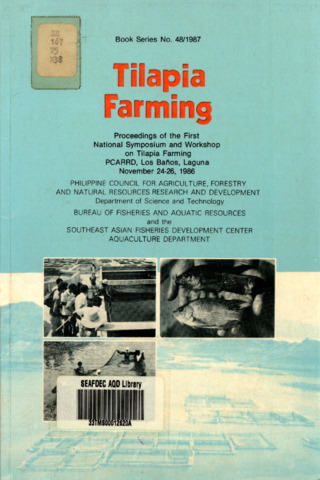
Tilapia Farming: Proceedings of the First National Symposium and Workshop on Tilapia Farming, PCARRD, Los Baños, Laguna, November 24-26, 1986
(Philippine Council for Agriculture, Forestry and Natural Resources Research and Development, 1987) -
Proceedings of the First National Congress on Philippine Lakes
(Southeast Asian Regional Center for Graduate Study and Research in Agriculture (SEARCA), 2005)The interconnectivity of land and water ecosystems and the uniqueness of lakes render lake management and conservation a very complex task. This is worsened by the predictable increasing demand for water and the continuing ... -
Photo exhibit on key ecotourism sites in the Philippines
(Southeast Asian Regional Center for Graduate Study and Research in Agriculture (SEARCA), 2005)Executive Order (EO) 111 issued on June 17, 1999 establishing the guidelines for the development of ecotourism in the Philippines provided the legal framework for the partnership of the Department of Tourism (DOT) and the Department of Environment and Natural Resources (DENR), in cooperation with other concerned stakeholders. The EO required the formulation of the Philippine National Ecotourism Strategy (NES) to provide the framework for sustainable ecotourism development. The NES is envisioned to provide an integrated and coordinated mechanism through partnerships among the government, the private sector, and local communities and tourists, to ensure the industry s viability and competitiveness. The implementation of the strategy through the short-, medium-, and long-term plans and programs will be one of the many ways to go forward towards positioning the Philippines as a premier ecotourism destination. One of the components of the ecotourism program developed is the identification of key ecotourism sites following a set of criteria. The key sites are categorized as banner, emerging and potential areas of the selection. This was made through a process of top-down and bottom-up approaches during which local, regional, and national consultations, seminars, planning workshops, and ecotourism congresses were held. Many of the key ecotourism sites are protected areas which include lakes and freshwater ecosystems with potentials for ecotourism development such as Wawa Dam, Bulusan Lake, Lake Danao, Agusan Marsh and Lake Sebu, among others. Ecotourism development of on-going model projects will showcase best practices, partnership of stakeholders and lessons learned in protecting the environment and managing the resources for ecotourism. -
Naujan Lake National Park: An Anatidae Site Network
(Southeast Asian Regional Center for Graduate Study and Research in Agriculture (SEARCA), 2005)The Anatidae Family consists of ducks, geese and swans. These birds are one of the groups of waterbirds that are ecologically dependent on wetlands*, at least at some parts of their life cycle. Anatidae species and their habitats provide social, cultural, economic, and scientific benefits to human life. Wetlands and associated upland habitats are one of the world s most highly productive environments with wide biological diversity. Many populations of the Anatidae species are migratory. The typical migrations of Anatidae are populations breeding in the Arctic or northern temperate regions and wintering in temperate and tropical zones. During their migration, they regularly cross international borders of several countries and territories. Many tropical species are sedentary while others mainly have seasonal movements related to the occurrence of rains and the temporary flooding of wetlands. Almost all Anatidae species are temporarily flightless during the moult of their flight feathers after breeding, and many species make moult migration to the safe moulting grounds. Thus, the conservation of these populations and their habitats requires cooperation at the regional and international levels. The Anatidae Site Network is a cooperative international program with key sites of international importance to the Anatidae populations in the East Asian Flyway (migration route). Its goal is to ensure the long-term conservation of migratory Anatidae populations through recognition and appropriate management of a network of sites of international importance. It is a network of both sites and people. It encourages site management bodies and/or organizations relevant to the management of the site to promote appropriate management of the site through development of a site management plan and other conservation measures. It also promotes the local recognition of the importance of the site for the conservation of Anatidae populations through awareness and educational programs. The Site Network is being coordinated by Wetlands International under the Asia-Pacific Waterbird Conservation Strategy. Key sites of international importance to Anatidae populations are those that:- regularly support > 20,000 migratory Anatidae populations;
- regularly support > 1% of the individuals in population of one migratory species or subspecies in the family Anatidae; or,
- support appreciable numbers of a migratory Anatidae population with unfavorable conservation status.
-
Conservation and farming of a common freshwater food clam, tulla (Corbicula manilensis Philippi 1844), in the Laguna Lake basin
(Southeast Asian Regional Center for Graduate Study and Research in Agriculture (SEARCA), 2005)Stocking of tulla (Corbicula manilensis) in small water impounding dam was studied in the Angat Watersheds, Bulacan, Philippines at elevation 209 m above mean sea level. Result of the study indicates that tulla introduction and production in higher elevation streams is possible. From 10 pieces of small tulla thrown into the impounding pond, the species multiplied rapidly that at the end of one year, the populations of tulla at the upstream and downstream side of the impounding dam are 1,436 and 840 pcs/m2, respectively. Based from group classifications of tulla as advanced by Villadolid et al. (1930), results indicated that 45.17% belongs to Size Group I; 27.86% for II; 18.01% for III; and the least is for Size Group IV which is 8.96%. The total population in the 24.50 m2 pond was estimated at 27,881 individuals consisting of all size groups. It should be noted that there was no harvesting or collection done within the year. There is no fish in the pond except few edible frogs that consider the pond its home. The stream has never been inhabited by tulla before. The concentration of individuals at the upstream side of the pond could be due to deeper substrate, sandy and gravelly sediments, constant aeration from the waterfalls and presence of rich detrital matter from decomposition of deposited leaves. The exceptionally high concentration of tulla in the pond is due to the structure that prevents them from being washed downstream by strong current or flood waters. Tulla is a low-cost food item very rich in calcium and other minerals that could support the nutritional needs of our poor and low income population, and could be grown in streams in the watersheds. The study shows the feasibility of introduction and production of tulla in streams at higher elevation for food, poultry and shrimp feed, fertilizer, and for improving the quality of water in rivers. -
Lake Leonard: A lake revived
(Southeast Asian Regional Center for Graduate Study and Research in Agriculture (SEARCA), 2005)Lake Leonard is a potential ecotourism destination still unknown to many. It is located within the hinterlands of Maco, Compostela Valley Province (formerly part of Davao del Norte), Philippines. The lake was formerly utilized as tailing pond of mine waste generated by North Davao Mining Company from 1984 to 1992 and fortunately, its operations were stopped due to financial problems. In 1997, the Provincial Mining Regulatory Board recognized the lake s ecological importance and recommended for its establishment as a Protected Area under the National Integrated Protected Areas System (NIPAS). The Department of Environment and Natural Resources (DENR) conducted initial studies and among the results were: 1. Water analysis revealed that the lake falls under Class B, recreational water for bathing, swimming and skin diving. 2. Protected Area Suitability Assessment (PASA) showed, among others, that there are few inhabitants and it is surrounded by adequately-stocked dipterocarp forest. Biodiversity is high as shown by the presence of varied species of flora and fauna. The establishment of the lake and its environs as a protected area is imperative considering its unique biological and physical features. Likewise, it would contribute in the global effort towards biological diversity conservation and sustainable development. -
Legal provisions for the governance of Philippine lakes
(Southeast Asian Regional Center for Graduate Study and Research in Agriculture (SEARCA), 2005)Lakes have been governed in legal history under laws on fisheries. The Local Government Code (LGC) and the spate of recent legislation on fisheries, ancestral domain, protected areas, and wildlife have thrown into disarray the system of lake governance and authority. However, there is a silver lining to the chaos - the opportunity to craft a lake management regime that is rooted in strategies that respond to local needs and priorities, is appropriately-scaled, and is culturally- and scientifically-sound. The current state of affairs has set the stage for experimentation, adaptive and collaborative approaches, and policy and institutional exploration that could yield the best lake management systems yet. -
Partnership for biodiversity conservation: Experiences in reviving the stock of sinarapan, the world s smallest commercial fish
(Southeast Asian Regional Center for Graduate Study and Research in Agriculture (SEARCA), 2005)This paper presents the successful partnership of the Buhi local government, the San Ramon Barangay Council and its residents, and the Bicol University for successfully reviving the stock of sinarapan (Mistichthys luzonensis Smith), through the Sinarapan Re-population Strategy (SRS), implemented in two mountain lakes in Buhi, Camarines Sur, Philippines. Given the very low population of the small fish in Lakes Buhi and Bato, where the fish was very abundant in the 1940s to the 1960s, developing the SRS is the direct approach to revive the stock of the world s smallest commercial fish . It has faced the problem of declining stock with a logical and immediate solution through a natural experiment . Sinarapan stock revival through the SRS exemplifies adequately practical use of scientific information for biodiversity conservation and comanagement. SRS is the only fish translocation strategy in mountain lake conditions in Asia. Success with the SRS is a vital prerequisite to the goal of reviving the sinarapan in Bicol s major lakes where the fish supported major fisheries and gave fame to the region. Experiences in implementing the SRS confirmed that natural science should agreeably blend with rural sociology towards the aim of successful biodiversity conservation. Local government support and active community participation are indispensable to effective biodiversity protection and management. Pro-active information dissemination mechanisms to local government councils were a key strategy for enjoining their cooperation for conservation. -
Community rehabilitation of Lake Lahit in South Cotabato, Philippines
(Southeast Asian Regional Center for Graduate Study and Research in Agriculture (SEARCA), 2005)Lake Lahit, situated at the north central part of the Municipality of Lake Sebu in South Cotabato, Philippines, is the smallest lake among the three lakes of Lake Sebu. It has an area of 24 ha. It is the center of livelihood of the residents through operation of fish cages; source of water for irrigation and domestic purposes; sources of food; and for recreation and tourism. However, due to the proliferation of water lilies in the lake, fish production decreased and its tourism potential was lost. For years, Lake Lahit was considered dead until the creation of the Lake Sebu Rehabilitation, Conservation and Development Council. The Department of Environment and Natural Resources (DENR) was one of the members of this multi-sectoral body, which formulated the program for the rehabilitation of the lake. The Provincial Government of South Cotabato, under the leadership of Governor Daisy P. Avance-Fuentes, provided initial funding of P1.2 million for the program. The Council created an Interim Team, headed by the Provincial Agriculture Office, which supervised the rehabilitation of Lake Lahit. A Task Force, Water Hyacinth for Barangay Lahit , was also formed which implemented the rehabilitation activities, including establishment of buffer zone, erosion control, community organizing, monitoring, and evaluation. The clean-up of Lake Lahit was completed in a month, with the following activities undertaken prior to the clean-up: coordination with public officials; environmental scanning; rapid rural appraisal; strategic planning attended by all public officials from the Municipality of Lake Sebu and other government offices, farmer leaders, fish cage operators, resort owners, and non-government organization (NGO) representatives; and information, education and communication (IEC) through radio programs. After the clean-up activities, the following activities were done: lakeshore reforestation through planting of mahogany seedlings, dispersal of 100,000 tilapia fingerlings, and issuance of an Executive Order prohibiting the catching of tilapia and other species in the lake five months after dispersal. The Barangay Lake Lahit Council a resolution of cleaning the lake by the local communities. Through this program, the local communities appreciated the environmental and economic importance of the Lake and became actively involved in its protection. Cooperation and coordination were established among the different entities with direct stake on the lake. -
Investigation of massive fish kill in Lake Buhi, Camarines Sur, Philippines
(Southeast Asian Regional Center for Graduate Study and Research in Agriculture (SEARCA), 2005)Lake Buhi is a multi-species fishery resource and known worldwide for being the home of the world s smallest commercial fish (Mistichthys luzonensis). The lake is used for fishery, agriculture, irrigation, hydroelectric power, navigation, and domestic purposes. Any particular use of the lake s resource system will have beneficial or adverse effect to its immediate environment. Man-made intervention such as unregulated fish cages, unsound farming system practices, establishment of control structure for irrigation and the hydroelectric power plant, and improper waste disposal alter the ecosystem. Ecological imbalance has serious consequences for it affects the entire lake. The occurrence of massive fish kill in Lake Buhi is due to depletion of oxygen. Values dropped from 0.05 to 1.0 mg/L, which is lethal to the fish. This is brought about by the upwelling of accumulated organic pollutants from the lake bottom: (detritus and domestic waste, decaying unused feeds, fish excretes accumulated by overstocked tilapia in cages), the proliferation of water hyacinths, and fluctuating water level. These resulted to the formation of ammonia (NH3), carbon dioxide (CO2), and hydrogen sulfide (H2S) that have exceeded the tolerable level for fish life. These factors caused high temperature (29°-30°C), enhanced respiration of aquatic life, and decreased the solubility of oxygen. Likewise, increased bottom sediments (2.3 - 3.0 m) and very low transparency (0.82m) that block the penetration of sunlight and hinder photosynthetic activity in the water were recorded. The inequitable access and use of fishery resource are the major problems that beset the lake. There is a need for sound fishery management and regulatory intervention to help resolve the problems affecting the productivity and stability of the lake s ecosystem. -
Pansipit river rehabilitation program, Batangas, Philippines
(Southeast Asian Regional Center for Graduate Study and Research in Agriculture (SEARCA), 2005)In the early 1990s, fish cages were established in Pansipit River, the only outlet from Taal Lake going to Balayan Bay, Batangas, Philippines. This resulted to the clogging of water current and population decline of marine species like tawilis and maliputo. To address these problems, the Department of Environment and Natural Resources (DENR) through the Presidential Commission on Tagaytay-Taal, conducted confiscatory dismantling of fish cages on September 16, 1996. This was also based on the Tagaytay-Taal Integrated Masterplan that states that the River must be cleared of obstructions before prior development could be started in the area. However, fish cages were again established in the river due to the absence of alternative livelihood for the affected fish cage operators. In 1998, Republic Act 8550 (The Philippine Fisheries Code of 1998) took effect and this law prohibits the construction of any structures that would hamper the flow of the river and obstruct the migration path of migratory fish species. In consideration of the Protected Area Management Board (PAMB) Resolution No. 2001-03, tasking the local government units (LGUs) to be in charge of clearing Pansipit River, the Provincial Government of Batangas had spearheaded the clean-up and dismantling activities in the said river, in coordination with various people s organizations (POs), non-government organizations (NGOs) and LGUs. By December 2002, 623 illegal structures were cleared out. The success of the said activities was attributed to the effective use of government powers and willingness to enforce the law using people s participation and massive Information, Education and Communication (IEC). Further, the program was carried out and sustained through collaboration and effective coordination mechanisms. Alternative livelihood assistance (cattle-raising, aquarium fish culture, etc.) were also provided to the affected fish cage operators. The river is now generally free from obstructions. To sustain the program, the Provincial Government-Environment and Natural Resource Office (PG-ENRO) continues to monitor the status of Pansipit River and Taal Lake, and coordinates activities with lower-level LGUs and other collaborating institutions. Water quality monitoring is regularly undertaken. A pre-feasibility study had also been completed for an investment portfolio on the development of a tourism circuit in Taal Lake and Pansipit River area. The river rehabilitation practically sustained a vital lifeline to a larger and fragile ecosystem of Taal Lake. The strategy in Pansipit River rehabilitation is being replicated and applied to other water bodies in the province. -
Integrated water resources management: the experience of Laguna Lake Development Authority (LLDA), Philippines
(Southeast Asian Regional Center for Graduate Study and Research in Agriculture (SEARCA), 2005)Laguna de Bay is the largest inland body of water in the Philippines and one of the largest lakes in Southeast Asia. The lake and its watershed, technically referred to as the Laguna de Bay Region or Basin, encompasses the provinces of Rizal and Laguna, portions of Cavite, Batangas and Quezon and a large portion of Metro Manila. It is a host to a total of 66 local government units (LGUs) (49 municipalities, 12 cities and five provinces) and is home to over 10 million people. Over recent decades, uncontrolled population growth, indiscriminate deforestation and land conversion, intense fisheries, widespread industrialization, and urban sprawl have produced massive changes in the Laguna de Bay and its watershed. The resulting problems relate to solid waste management, sanitation and public health, congestion, sedimentation, unmitigated input of domestic, agricultural and industrial wastes, deteriorating water quality, flooding problems, and loss of biodiversity. The task of turning the tide of environmental degradation and of protecting and conserving the lake and its watershed for posterity calls immediate and decisive action. Using the so-called Integrated or Basin Approach to water resources management, the Laguna Lake Development Authority (LLDA) has initiated a number of innovative actions that could spell the difference in the effort to save Laguna de Bay. These include: a) the Environmental User Fee System (EUF), a market-based instrument designed to motivate polluters to comply with effluent standards; b) Zoning and Management Plan (ZOMAP) for fish pens and fish cages; c) Shore Land Development and Management Plan (SMDP); and d) the River Rehabilitation Program. The module for River Rehabilitation developed over seven years has produced a model for multistakeholder and community participation and involvement in the task of resource conservation and management which is gaining recognition internationally. -
Capability building of Local Government Units (LGUs): A tool towards the sustainable management of lakes in the Philippines
(Southeast Asian Regional Center for Graduate Study and Research in Agriculture (SEARCA), 2005)Under the Local Government Code (LGC), the management jurisdiction over the municipal waters lies with the local government units (LGUs). To enhance the capability of the LGUs as resource managers, in partnership with the other stakeholders of the lake, four training sessions were conducted in mainland Luzon, Palawan, central and eastern Visayas, and Mindanao. The training curriculum consists of four modules dealing with lake ecosystem, man-environment interaction, resource rehabilitation, and social aspects of resource rehabilitation. The outputs of these trainings were 134 potential lake management practitioners consisting of 52.2% LGUs, 22.4% national government agencies (NGAs) and academe, and 25.4 % Fisheries and Aquatic Resource Management Councils (FARMCs) and fisherfolks; and action plans for the management of 15 lakes and one reservoir highlighting development priorities. About 83% of the participants considered the contents of the training modules sufficient and effective showing that the training was able to improve the level of understanding of the lake ecosystem, increase awareness on the vulnerability of the resource to the impacts of human activities, and provide a venue for the integration of sectoral initiatives on lake management. -
Successful translocation of mountain Lake Makuwaw with sinarapan (Mistichthys luzonensis), the "world's smallest commercial fish"
(Southeast Asian Regional Center for Graduate Study and Research in Agriculture (SEARCA), 2005)Some 75,000 pieces of live sinarapan (Mistichthys luzonensis) individuals were transferred to mountain Lake Makuwaw in San Ramon, Buhi, Camarines Sur in January to May 2001. Before the fish transfers, the lake was chosen from among four mountain lakes evaluated for their suitability for the fish. Five months before the direct live fish transfers, regular monthly seinings in the lake were done using fine-mesh push-net. No sinarapan or similar-looking small goby was found. This confirmatory survey was vital in evaluating the re-population strategy because it was ascertained that the new stock came from individuals stocked during the fish transfer activities. About 30-70% of the fish died during transport and until a day after each stocking of 15,000 per batch (with four batches a month). The minimum viable fish transfer quantity of 10,000 to 15,000 was estimated based from information on the population dynamics of the fish. Viable stock of the fish in the lake has thrived, matured, and bred as evidenced by live juvenile and gravid adult sinarapan sampled starting July 2001. Morphometrics and biological characteristics of the Makuwaw stock do not differ significantly (a=0.05) with those of the stock from Lake Manapao where the live sinarapan translocated were taken. From knowledge of the population dynamics and aspects of the reproductive biology of the fish, the change in the fish population in the lakes was quantified. Population analyses showed that the role of natural mortality is primary and critical to re-population success. Natural mortality is 95% and 99% for six-month and 12-month periods, respectively. Given the goby s high natural mortality, absence of pre- and post-hatching parental care, and the general vulnerability of eggs to environmental factors, the key biological determinants to successful re-population of the species are stocking at its viable quantity and meeting the basic life requirements of the fish. The social dimension related to community support and participation to strengthen network of protection for the sanctuaries is equally vital to sustain re-population efforts. -
Fish cage and pen aquaculture: Impact on lake environment
(Southeast Asian Regional Center for Graduate Study and Research in Agriculture (SEARCA), 2005)The continuous utilization of the aquatic resources of the Philippines - both fresh and marine waters -for food and feeds including export of fish and other fishery products, had resulted to greater exploitation of these resources. Despite these, a deficit is attained which is filled up by the government through importation. To reduce fish importation, there is a need to tap other resources. Coastal marine resources is overexploited, thus, off-shore or deep-water aquaculture has been introduced. The development of freshwater aquaculture has been envisioned to expand where pens and cages in lakes and rivers shall dominate. The contribution of aquaculture to fish production is very significant and has been identified as the sub-sector that will play a major role in enhancing fish production of the country. Given the above scenario, and focusing only on lakes, this paper aims to identify various aquaculture activities in lakes that have negative impact on the lake environment. It hopes to be able to recommend means by which aquaculture could play more significantly not as a means for greater exploitation but as an agent of conservation, protection, rehabilitation, and sustainable utilization of these resources. The impacts of fish cage and pen aquaculture in aquatic bodies included: enrichment of aquatic ecosystem; pollution of adjacent habitats; deterioration of water quality; increased interaction with wildlife resulting to enhanced vulnerability to parasites and diseases; reduction of species diversity, including socioeconomic issues like displacement of rural communities, exclusion of traditional fisherfolks and navigational hazards; and other social and political implications. The expectation from both the government and the public is to support each other by being conscious of the commitment of the government to the three Earth Summits. To the future generation, the expectations are to come up with implementable policies and to have the political will to enforce the laws that originate from the citizens, not from the whims of political leaders and legislators. -
Issues, challenges, and lessons learned in lake resources management in the Philippines
(Southeast Asian Regional Center for Graduate Study and Research in Agriculture (SEARCA), 2005)The Philippines is endowed with more than 200 lakes that are abundant in water, fisheries and other resources. With the exception of five major lakes (Laguna de Bay, Lake Lanao, Lake Taal, Lake Naujan and Lake Buhi), there is little or no information on resources management of other lakes in the country. The main issues and problems identified regarding lake resources management are the decline in their fisheries production and loss of biodiversity due to overfishing, destruction of habitat, pollution, introduction of exotic species and multiple-use conflicts. These challenges need an effective management framework, a national management plan for lakes with the ecosystems or integrated approach for their sustainable development and the capability-building of local government units (LGUs) and other institutions for lake management. The lessons learned from the management of the Laguna de Bay by the Laguna Lake Development Authority (LLDA), the Master Plan for Lake Taal, and the case studies of Lake Buhi for the sinarapan, and the cyprinids of Lake Lanao will be highlighted.