SEAFDEC/AQD Institutional Repository: Recent submissions
1061-1080 / 4221
-
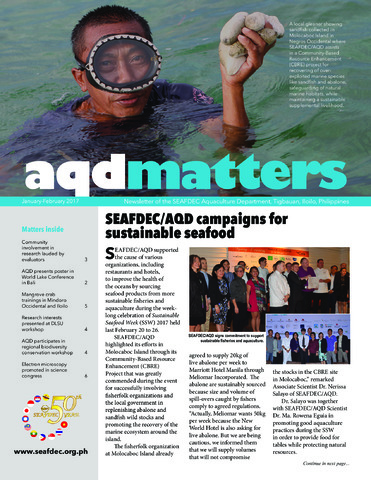
AQD Matters 2017 January - February
(Aquaculture Department, Southeast Asian Fisheries Development Center, 2017) -
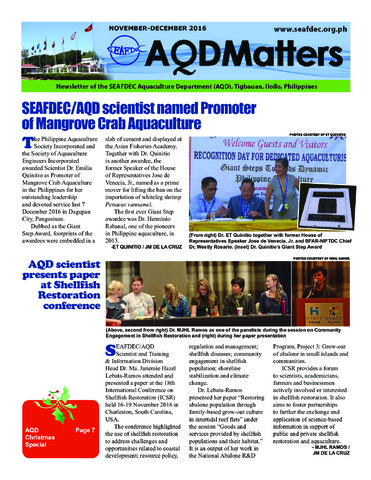
AQD Matters 2016 November - December
(Aquaculture Department, Southeast Asian Fisheries Development Center, 2016) -
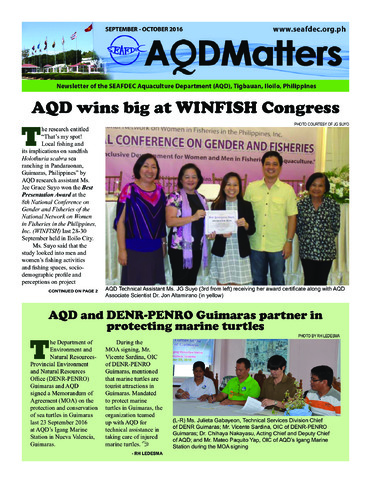
AQD Matters 2016 September - October
(Aquaculture Department, Southeast Asian Fisheries Development Center, 2016) -
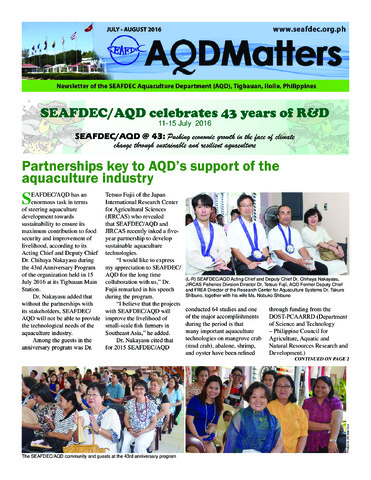
AQD Matters 2016 July - August
(Aquaculture Department, Southeast Asian Fisheries Development Center, 2016) -
AQD Matters 2016 May - June
(Aquaculture Department, Southeast Asian Fisheries Development Center, 2016) -
AQD Matters 2016 March - April
(Aquaculture Department, Southeast Asian Fisheries Development Center, 2016) -
AQD Matters 45th Anniversary Special Issue
(Aquaculture Department, Southeast Asian Fisheries Development Center, 2018) -
AQD Matters 2018 May - June
(Aquaculture Department, Southeast Asian Fisheries Development Center, 2018) -
AQD Matters 2018 March - April
(Aquaculture Department, Southeast Asian Fisheries Development Center, 2018) -
AQD Matters 2018 January - February
(Aquaculture Department, Southeast Asian Fisheries Development Center, 2018) -
AQD Matters 2017 November - December
(Aquaculture Department, Southeast Asian Fisheries Development Center, 2017) -
AQD Matters 2017 September - October
(Aquaculture Department, Southeast Asian Fisheries Development Center, 2017) -
AQD Matters 2017 July - August
(Aquaculture Department, Southeast Asian Fisheries Development Center, 2017) -
AQD Matters 2016 January - February
(Aquaculture Department, Southeast Asian Fisheries Development Center, 2016) -
Status of sea cucumber fishery and populations across sites with different levels of management in Palawan, Philippines
(Elsevier, 2018)This study was conducted to investigate the sea cucumber fishery and compare populations between exploited and unexploited sites. Three islands were selected, the Arrecife Island as the unexploited site and the Johnson and Green Islands representing the exploited sites. In each site, sea cucumber species richness, diversity and densities were assessed by laying as much as 15 transects (50 m × 5 m) per habitat in each island. Differences in species richness, diversity and relative densities across sites and habitats were tested using a Two-way Analysis of Variance (ANOVA) and Tukey test for post hoc comparisons. An interview with gatherers, key informants and focus group discussions were also conducted to gather information on the sea cucumber fishery and its management. Results showed that the unexploited site had a higher species richness (14 vs. 7 and 7). Relative density of species was also higher in the unexploited site at 1245 ind ha-1 while it was only 78 and 39 ind ha-1 in exploited sites (p < 0.05). Interviews and a focus group discussion revealed that national regulations on permit system and size limits were not enforced at the local level and that gatherers had low levels of awareness regarding regulations on sea cucumber harvest. Current management measures appear to be ineffective and insufficient, leaving the sea cucumbers in areas open to exploitation at risk of depletion. Given that sea cucumbers provide substantial income to local communities, the depletion of this resource could compromise the livelihood of people in island communities that rely heavily on marine resources for living. Thus, this study highlights the need to review national policies on sea cucumber fishery and place the management at the local level. -
Responsible aquaculturists: The information-seeking behavior of milkfish farmers in Iloilo, Philippines
Superio, Daryl ; Nemiz, Elvi S. ; ; ; ; (SAGE Publications, 2019)
Compliance with a policy, law, standard or code requires understanding of its provisions. However, for someone to understand it, he must be aware of its existence and be provided access to it. A qualitative-quantitative research was conducted to determine the awareness of milkfish farmers about the Philippine Code of Practice for Aquaculture in the municipalities of Leganes and Zarraga, Iloilo Province, the Philippines and their information-seeking behaviors. Results revealed that the majority of the respondents were not aware of the existence of the Code, hence, there is a low level of compliance. When seeking everyday life information, the majority of the milkfish farmers depended on television, personal or person-to-person communication and radio, while when seeking for fish farming information, personal communication was the preferred source. None of the respondents was aware of the existence of their municipal libraries.
; Nemiz, Elvi S. ; ; ; ; (SAGE Publications, 2019)
Compliance with a policy, law, standard or code requires understanding of its provisions. However, for someone to understand it, he must be aware of its existence and be provided access to it. A qualitative-quantitative research was conducted to determine the awareness of milkfish farmers about the Philippine Code of Practice for Aquaculture in the municipalities of Leganes and Zarraga, Iloilo Province, the Philippines and their information-seeking behaviors. Results revealed that the majority of the respondents were not aware of the existence of the Code, hence, there is a low level of compliance. When seeking everyday life information, the majority of the milkfish farmers depended on television, personal or person-to-person communication and radio, while when seeking for fish farming information, personal communication was the preferred source. None of the respondents was aware of the existence of their municipal libraries. -
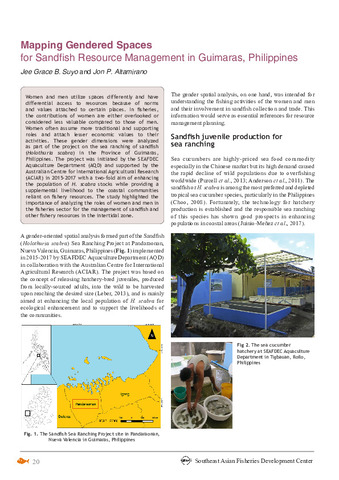
Mapping gendered spaces for sandfish resource management in Guimaras, Philippines
(Secretariat, Southeast Asian Fisheries Development Center, 2018)Women and men utilize spaces differently and have differential access to resources because of norms and values attached to certain places. In fisheries, the contributions of women are either overlooked or considered less valuable compared to those of men. Women often assume more traditional and supporting roles and attach lesser economic values to their activities. These gender dimensions were analyzed as part of the project on the sea ranching of sandfish (Holothuria scabra) in the Province of Guimaras, Philippines. The project was initiated by the SEAFDEC Aquaculture Department (AQD) and supported by the Australian Centre for International Agricultural Research (ACIAR) in 2015-2017 with a two-fold aim of enhancing the population of H. scabra stocks while providing a supplemental livelihood to the coastal communities reliant on fishery resources. The study highlighted the importance of analyzing the roles of women and men in the fisheries sector for the management of sandfish and other fishery resources in the intertidal zone. -
Series: Aquaculture extension manual; No. 34
Biology and hatchery of mangrove crabs Scylla spp.
Quinitio, Emilia T.; ; (Aquaculture Department, Southeast Asian Fisheries Development Center, 2018)
This manual includes the biology of crab (Scylla serrata, S. tranquebarica, and S. olivacea), and describes principles and procedures for spawning the mature crabs and rearing the zoea to ‘fly’ size crabs. It focuses on the hatchery rearing of S. serrata as the farming of this species is more economically viable than the two other species. The techniques may be modified depending on the conditions or problems encountered in a specific site. -
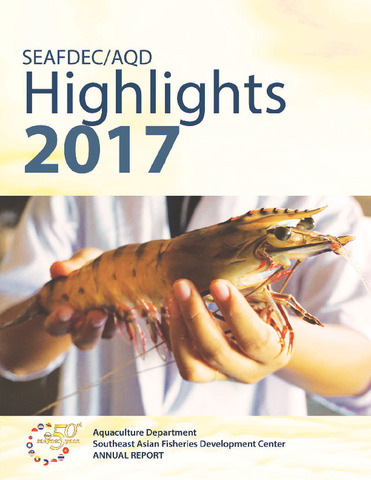
SEAFDEC/AQD highlights 2017
(Aquaculture Department, Southeast Asian Fisheries Development Center, 2018)SEAFDEC/AQD highlights 2017 is SEAFDEC/AQD’s annual report updating on its accomplishments and progress for the year 2017. -
Phylogeographic patterns in the Philippine archipelago influence symbiont diversity in the bobtail squid-Vibrio mutualism
(Wiley Open Access, 2018)Marine microbes encounter a myriad of biotic and abiotic factors that can impact fitness by limiting their range and capacity to move between habitats. This is especially true for environmentally transmitted bacteria that cycle between their hosts and the surrounding habitat. As geologic history, biogeography, and other factors such as water temperature, salinity, and physical barriers can inhibit bacterial movement to novel environments, we chose to examine the genetic architecture of Euprymna albatrossae (Mollusca: Cephalopoda) and their Vibrio fischeri symbionts in the Philippine archipelago using a combined phylogeographic approach. Eleven separate sites in the Philippine islands were examined using haplotype estimates that were examined via nested clade analysis to determine the relationship between E. albatrossae and V. fischeri populations and their geographic location. Identical analyses of molecular variance (AMOVA) were used to estimate variation within and between populations for host and symbiont genetic data. Host animals demonstrated a significant amount of variation within island groups, while symbiont variation was found within individual populations. Nested clade phylogenetic analysis revealed that hosts and symbionts may have colonized this area at different times, with a sudden change in habitat. Additionally, host data indicate restricted gene flow, whereas symbionts show range expansion, followed by periodic restriction to genetic flow. These differences between host and symbiont networks indicate that factors “outside the squid” influence distribution of Philippine V. fischeri. Our results shed light on how geography and changing environmental factors can impact marine symbiotic associations at both local and global scales.