SEAFDEC/AQD Institutional Repository: Recent submissions
Now showing items 1081-1100 of 4221
-
Immunization regimen in Asian sea bass (Lates calcarifer) broodfish: A practical strategy to control vertical transmission of nervous necrosis virus during seed production
Pakingking, Rolando V., Jr. ; ; ; (Elsevier, 2018-08)
Outbreaks of viral nervous necrosis (VNN) in Asian sea bass (Lates calcarifer) at the larval stages via vertical transmission of nervous necrosis virus (NNV) from asymptomatic broodfish remain as a major deterrent during seed production. A five-year study was conducted to produce NNV-specific-free sea bass broodfish reared in land-based tanks through an annual immunization regimen with the formalin-inactivated NNV. We primarily immunized (intraperitoneal injection) sea bass juveniles (5 g) and monitored the neutralizing antibody (Nab) titers in the sera of these fish at scheduled intervals post-immunization. Nab titers in the sera of immunized fish peaked at Month 2 (titer: 1:4480 ± 1185) but thereafter gradually declined and significantly dropped (1:260 ± 83) at Month 12 post-primary immunization. Booster immunization of these fish at Month 12 post-immunization led to abrupt increases in Nab titers in booster immunized (B-Im) fish at Month 1 (1:12800 ± 6704) but thereafter declined and dropped at Month 12 (1:480 ± 165) post-booster immunization. The annual booster injections with the inactivated vaccine or L-15 (Unimmunized [U-Im]) were consecutively conducted for 4 years until the fish became sexually mature. Mature fish from both groups were successively induced to spawn twice (1-month interval) via intramuscular injection with luteinizing hormone-releasing hormone analogue (LHRH-a; 100 µg/kg BW). NNV was not detected by RT-PCR in oocytes and milts, and spawned eggs of B-Im fish. In contrast, oocytes and milts, and spawned eggs of U-Im fish were NNV positive. Spawned eggs of B-Im broodfish exhibited Nab titers ranging from 1:192 ± 34 to 1:240 while such was not detected (<1:40) in eggs of U-Im fish. Taken together, current data clearly demonstrate that annual immunization regimen with inactivated NNV vaccine is a pragmatic approach for sustaining immunocompetent sea bass broodfish reared in land-based tanks and circumvent the risk of vertical transmission of NNV from asymptomatic broodfish to their offspring under stress of repetitive spawning.
; ; ; (Elsevier, 2018-08)
Outbreaks of viral nervous necrosis (VNN) in Asian sea bass (Lates calcarifer) at the larval stages via vertical transmission of nervous necrosis virus (NNV) from asymptomatic broodfish remain as a major deterrent during seed production. A five-year study was conducted to produce NNV-specific-free sea bass broodfish reared in land-based tanks through an annual immunization regimen with the formalin-inactivated NNV. We primarily immunized (intraperitoneal injection) sea bass juveniles (5 g) and monitored the neutralizing antibody (Nab) titers in the sera of these fish at scheduled intervals post-immunization. Nab titers in the sera of immunized fish peaked at Month 2 (titer: 1:4480 ± 1185) but thereafter gradually declined and significantly dropped (1:260 ± 83) at Month 12 post-primary immunization. Booster immunization of these fish at Month 12 post-immunization led to abrupt increases in Nab titers in booster immunized (B-Im) fish at Month 1 (1:12800 ± 6704) but thereafter declined and dropped at Month 12 (1:480 ± 165) post-booster immunization. The annual booster injections with the inactivated vaccine or L-15 (Unimmunized [U-Im]) were consecutively conducted for 4 years until the fish became sexually mature. Mature fish from both groups were successively induced to spawn twice (1-month interval) via intramuscular injection with luteinizing hormone-releasing hormone analogue (LHRH-a; 100 µg/kg BW). NNV was not detected by RT-PCR in oocytes and milts, and spawned eggs of B-Im fish. In contrast, oocytes and milts, and spawned eggs of U-Im fish were NNV positive. Spawned eggs of B-Im broodfish exhibited Nab titers ranging from 1:192 ± 34 to 1:240 while such was not detected (<1:40) in eggs of U-Im fish. Taken together, current data clearly demonstrate that annual immunization regimen with inactivated NNV vaccine is a pragmatic approach for sustaining immunocompetent sea bass broodfish reared in land-based tanks and circumvent the risk of vertical transmission of NNV from asymptomatic broodfish to their offspring under stress of repetitive spawning. -
Nutrition in tropical aquaculture: Essentials of fish nutrition, feeds, and feeding of tropical aquatic species
(Aquaculture Department, Southeast Asian Fisheries Development Center, 2002)This book is intended to teach undergraduate students the essentials of aquaculture nutrition, feed formulation, and feeding management. It serves as a reference book for researchers in aquaculture, aquaculturists, fish farmers, and aquaculture nutritionists. For the basic understanding of the materials presented, it is essential that the students, teachers, and researchers have a good background in chemistry, fish biology, or fisheries. The book covers the subject areas of known nutrient requirements, effects of nutrient deficiencies on various aquatic species, nutrient sources, digestibility, and digestive physiology. Feed formulation, processing and storage, evaluation and quality control, feeding management, as well as the economics of feeding are included. Aspects on feeds and feeding related to the conservation of the aquatic environment are also dealt with. Each chapter of this book has common features such as an introduction, basic concepts, and a summary. Both the basic and practical aspects of fish nutrition are included to give the students and allow the readers who are unfamiliar with the topics a clear understanding and knowledge of these concepts. Study questions at the end of each chapter serve as a guide to summarize and impress on the students the salient points of the subject matter in each chapter. To easily comprehend the subject matter, there is an appendix containing the analytical methods and a glossary of technical terms. The users particularly the students are encouraged to broaden their knowledge by referring to the list of references and suggested readings at the end of each chapter. -
Economics of feeding
(Aquaculture Department, Southeast Asian Fisheries Development Center, 2002)This chapter aims to introduce concepts and methods in doing economic analysis applicable in aquaculture in general with emphasis in feed production and feeding in aquaculture farms. This chapter discusses the following topics: cost of producing feeds; simple single-input (feeds) and single output (fish) production function; indices for measuring economic efficiency of feeds; the least-cost combination; and linear programming as used in the allocation of limited resources such as feed ingredients that will meet the nutritional requirements of the fish. -
Management of feeding aquaculture species
(Aquaculture Department, Southeast Asian Fisheries Development Center, 2002)This chapter teaches the reader to: differentiate the different feeding strategies in pond culture; learn feeding management methods such as stock sampling and record keeping, calculating daily feed ration, choosing appropriate feed size, and methods of applying feeds; understand the impact of feeding management on water quality and environment and on the cultured animal’s growth, survival, and feed conversion ratio; and describe the different feeding schemes used to culture fishes (milkfish, tilapia, rabbitfish, bighead carp, native catfish, sea bass, orange-spotted grouper, and mangrove red snapper; and crustaceans (tiger shrimp and mud crab). Other species for aquaculture stock enhancement (donkey’s ear abalone, seahorses, window-pane oyster) are also discussed. -
Series: Asia-Pacific Marine Finfish Aquaculture Network; Publication No. 2005–01
A guide to small-scale marine finfish hatchery technology
(Network of Aquaculture Centres in Asia-Pacific, 2005)Recent improvements in hatchery production technology for high-value marine finfish species such as groupers have led to an increased interest in setting up hatcheries to produce fingerlings for aquaculture. Small-scale hatcheries make this technology available to poor people in developing countries. Capital costs for small-scale hatcheries are relatively low, and the profitability of these ventures ensures rapid payback of capital investment. This guide provides an outline of the requirements to establish a small-scale marine finfish hatchery, particularly the economic aspects. It is intended to provide sufficient information for potential investors to decide whether investment in such ventures is appropriate for them. The guide provides some basic technical information in order to give an indication of the level of technical expertise necessary to operate a small-scale marine finfish hatchery. However, it is not intended as a detailed technical guide to the operation of small-scale hatcheries. Additional resources, such as training courses in marine finfish hatchery production, are available and these are listed in this document. Development of small-scale hatcheries may be more appropriate where there are existing marine hatchery operations, e.g. for shrimp or milkfish. By definition, small-scale hatcheries do not have broodstock facilities, so a supply of fertilised eggs (usually from a larger hatchery) is essential. Access to fertilised eggs and experienced hatchery staff will limit the application of small-scale hatchery technology. Despite this, there is considerable potential for this technology to be widely adopted. This guide has been written by a team of experts in marine finfish aquaculture who have been involved in a multinational collaborative research project since 1999. -
Evaluation of feedstuffs and aquafeeds
(Aquaculture Department, Southeast Asian Fisheries Development Center, 2002)This chapter discusses how to evaluate feedstuffs and feeds. The results of feed evaluation will be used to ensure the production of high quality feeds for fish, crustaceans, and shellfish. -
Processing of feedstuffs and aquafeeds
(Aquaculture Department, Southeast Asian Fisheries Development Center, 2002)This chapter will help the reader understand and appreciate the basic principles of processing, preparation, storage, and quality control in the preparation of aquafeeds. The material in this section is presented in sequence beginning with the processing of basic ingredients to remove antinutritional factors, followed by steps in feed preparation, from the easiest to the more complex processes, and storage. This chapter presents methods and equipment that are useful not only for feed millers, but also for extension workers and fish farmers. -
Formulation of aquafeeds
(Aquaculture Department, Southeast Asian Fisheries Development Center, 2002)The development of a feed that is both effective and economical for an aquaculture species in all its life stages is a continuous effort. Aquafeed development started when natural food sources in culture systems became inadequate and had to be supplemented with prepared feed. As fish stocking densities in culture increase, supplemental feeding is no longer sufficient. A complete feed that contains all the necessary nutrients in sufficient amounts to bring about good growth, survival, and reproduction is needed. Feed ingredients generally come from animal or plant sources and some are by-products of the food industry. There is no single feed ingredient or feedstuff that contains all the nutrients in adequate amounts. Thus, different feed ingredients are combined to make a feed that has the desired composition and nutrient levels. In combining various feed ingredients, it is important to know how much of each feed ingredient should be used to produce a cost-effective aquafeed. With the growth and expansion of aquaculture into a major industry, several fish species are being cultured; thus, the development of more efficient aquafeed formulations should continue. In developing cost-effective formulated diets, many important factors have to be considered. This chapter discusses these factors and the mathematical calculations in formulating a feed. It aims to enable students to formulate diets using purified and practical feed ingredients, and also to formulate effective supplemental and complete diets for aquaculture species. -
Morphological development and survival of Philippine silver therapon larvae, Leiopotherapon plumbeus (Kner, 1864) reared under different feeding schemes
; Eguia, Maria Rowena R. (De La Salle University, 2016)
Philippine silver therapon, Leiopotherapon plumbeus, locally known as ayungin, is an endemic fish species in the country. The demand for silver therapon remained high despite the decline of its population and commercial catches. Taking into account the potential of this species for stock enhancement, this study focused on developing an initial feeding strategy necessary to provide potential L. plumbeus juveniles for aquaculture. The experiment conducted was a short duration 10-day feeding experiment which used different feeding schemes utilizing live food organisms [Brachionus (B), Moina (M), co-fed with BM, Chlorella (C) and filtered lake water (L)]. Morphometric measurements were evaluated to assess growth performance of larvae among different feeding schemes. Survival rate was determined at the end of feeding experiment at 9 DAH (days after hatching). Growth parameters of L. plumbeus larvae reared under different feeding schemes showed significant differences starting at 5 DAH (P < 0.05) onward. After a total of 10 days, a significant decline in fish larval samples was observed under two feeding schemes (C and L). BM has a significant higher rate of survival (18.07 ± 7.09%) compared to other treatments. B. rotundiformis (15-20 mL-1) can be considered as a starter food for silver therapon larviculture and M. micrura (5-10 mL-1) can be utilized during an assumed co-feeding phase at 6 DAH. -
Feeding habits and digestive physiology of fishes
(Aquaculture Department, Southeast Asian Fisheries Development Center, 2002)This chapter provides basic information on the feeding habits and behavior, and physiology of fishes and crustaceans. The mechanisms that control the movement and digestion of food, methods of assessing digestibility of feed, factors affecting digestion and absorption of food nutrients, and feeding processes in fish are discussed. An understanding of the feeding habits, feeding mechanisms, and the digestion and absorption processes can help fish farmers and nutritionists maximize the use of feed. The rate at which fish digest their food is of primary importance in determining feeding rates, frequency, and ration size. Knowledge of the digestive physiology of fish is also necessary for an effective feed formulation and in choosing a proper feeding regime. This chapter aims to teach the reader: the feeding habits and behavior of fishes and crustaceans; the structural adaptation in the anatomy of the digestive tract; the various organs of the digestive systems of fishes and crustaceans and their functions; nutrient digestion and absorption by fishes and the fate of digested and undigested food; the factors that affect the rate of digestion and absorption; and the feeding process in fish. -
The essential nutrients: Minerals
(Aquaculture Department, Southeast Asian Fisheries Development Center, 2002)This section discusses the macro, micro, and trace minerals; their physiologic functions; and deficiency signs and symptoms. It also gives a summary of the mineral functions and mineral requirements of fishes and shrimp. -
The essential nutrients: Vitamins
(Aquaculture Department, Southeast Asian Fisheries Development Center, 2002)This section describes the various lipid-soluble and water-soluble vitamins, their differences, physiological functions, and the symptoms of vitamin deficiencies in fish. It also shows a summary of nutritional deficiency signs and the requirements of various fish species for vitamins. -
The essential nutrients: Energy
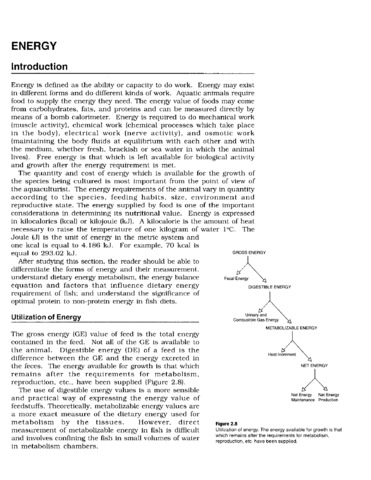
(Aquaculture Department, Southeast Asian Fisheries Development Center, 2002)After studying this section, the reader should be able to differentiate the forms of energy and their measurement. Understand dietary energy metabolism, the energy balance equation and factors that influence dietary energy requirement of fish; and understand the significance of optimal protein to non-protein energy in fish diets. -
The essential nutrients: Carbohydrates
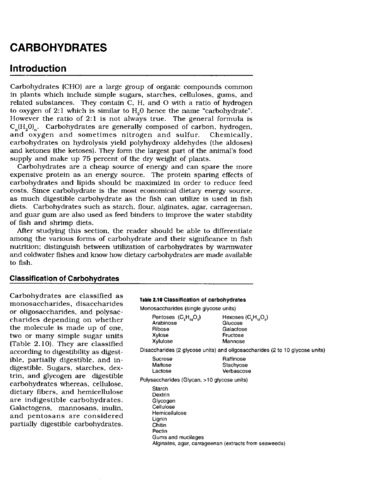
(Aquaculture Department, Southeast Asian Fisheries Development Center, 2002)This section discusses the difference among the various forms of carbohydrate and their significance in fish nutrition; distinguish between utilization of carbohydrates by warmwater and coldwater fishes and know how dietary carbohydrates are made available to fish. -
The essential nutrients: Lipids and fatty acids
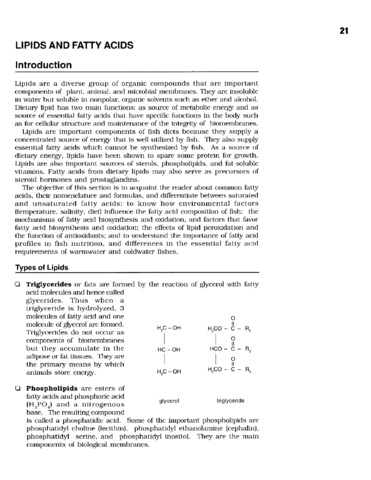
(Aquaculture Department, Southeast Asian Fisheries Development Center, 2002)The objective of this section is to acquaint the reader about common fatty acids, their nomenclature and formulas, and differentiate between saturated and unsaturated fatty acids; to know how environmental factors (temperature, salinity, diet) influence the fatty acid composition of fish; the mechanisms of fatty acid biosynthesis and oxidation, and factors that favor fatty acid biosynthesis and oxidation; the effects of lipid peroxidation and the function of antioxidants; and to understand the importance of fatty acid profiles in fish nutrition, and differences in the essential fatty acid requirements of warmwater and coldwater fishes. -
The essential nutrients: Proteins and amino acids
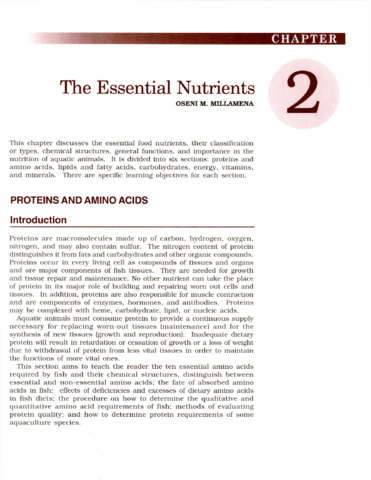
(Aquaculture Department, Southeast Asian Fisheries Development Center, 2002)This section aims to teach the reader the ten essential amino acids required by fish and their chemical structures, distinguish between essential and non-essential amino acids; the fate of absorbed amino acids in fish; effects of deficiencies and excesses of dietary amino acids in fish diets; the procedure on how to determine the qualitative and quantitative amino acid requirements of fish; methods of evaluating protein quality; and how to determine protein requirements of some aquaculture species. -
Competitive and comparative advantages of brackishwater aquaculture of tiger shrimp, mud crab, and milkfish in the Philippines in 1985-1995
(Bureau of Agricultural Research, Department of Agriculture, 2007)The brackishwater aquaculture sector contributes considerably to the growth of the fisheries sector. Tiger shrimp Penaeus monodon, mud crab Scylla serrata, and milkfish Chanos chanos, in particular are efficient users of domestic resources and earners of foreign exchange. These three commodity sectors have not been fully developed because of inadequate policies in research, technology generation, and extension, and in public investment and support services in production, marketing, and post-harvest processing. Our analysis used the domestic resource cost approach. The average resource cost ratios for the Philippines were 0.44 for tiger shrimp, 0.66 for mud crab, and 0.35 for milkfish. If the peso overvaluation is corrected, the comparative advantage can be dramatically enhanced with respective resource cost ratios of 0.36 and 0.55, and 0.28. Given the current international market and production technologies for these commodities, competitive and comparative advantage can be sustained above the breakeven border price per kilogram of US$6–7 for tiger shrimp, US$5–6 for mud crab, and about US$1 for milkfish. The actual border prices per kilogram during the past five years have been higher at US$12.34 for tiger shrimp, US$8.39 for mud crab, and US$2.39 for milkfish. At current domestic costs and border prices of the these commodities, the advantage in exports may be sustained at yields per hectare greater than about 2 mt tiger shrimp, 100 kg mud crabs, and 500 kg milkfish. To enhance the efficiency of production of these commodities, the following areas of intervention are needed:- Technology improvements in seed production from the hatchery of tiger shrimp, mud crab, and milkfish
- Research and technologies for diagnosis, prevention, and control of diseases of tiger shrimp (e.g. luminous bacteria)
- Training in farm management to enhance the skills of small-scale pond operators
- Public investments in infrastructures and support services including credit access to enhance efficient flow of goods and services from the farm to strategic market outlets
- Market development to ensure sustainable outlets for brackishwater pond production
- Reforms in trade and exchange rate policies to enhance global competitiveness
-
The fish processing industry in Central Luzon and the processors' assessment of the extension program of the Department of Agriculture
(Bureau of Agricultural Research, Department of Agriculture, 2007)A survey was done in 1992 of 242 fish processors in Region III or Central Luzon: 57 in Bataan, 39 in Bulacan, 24 in Nueva Ecija, 45 in Pampanga, 41 in Tarlac, and 36 in Zambales. The fish processors were engaged in three major fish processing enterprises: fish smoking (52%), fish drying (17%), and fish fermentation (31%). The products were smoked fish ‘tinapa’, dried fish ‘daeng’, fish paste ‘bagoong’, rice-fish paste ‘buro’, and fish sauce ‘patis’. Most of the processors in Zambales, Bataan, and Bulacan produced bagoong; ‘buro’ was produced only in Pampanga. Of the processors, 105 were small-scale operators, most of them in Pampanga, Bataan, and Bulacan, who had average capital of P11,000, worked an average of 3 days a week, and processed an average of 5,000 kg of fish a year. The 90 medium-scale processors had average capital of P20,000 and handled between 5,000 and 20,000 kg of fish a year, 5 days a week. The 47 large-scale processors, mostly in Zambales, Bataan, and Tarlac, invested an average of P94,000, and handled more than 20,000 kg of fish a year, seven days a week. The 242 fish processors in Region III in 1992 employed 501 people, 47% of them family members. The total production of processed fish products was about 73,000 kg a month, including about 21,511 kg ‘tinapa’, 4,790 kg ‘daeng’, and 46,634 kg ‘bagoong’. Processors in Zambales fermented the most fish, about 23,000 kg/month, followed by those in Bulacan. Among those in fish smoking, Bataan processors produced the biggest volume of 5,900 kg/month. Fish drying was done only in Bataan and Bulacan, and Bataan processors produced about 2,800 kg/month. The fish processors in Region III sold their produce three ways: wholesale, retail, and contract buying. They followed a simple marketing plan, using outlets in nearby towns and cities, including Metro Manila. For six months of operation, the cost was lowest in fish smoking and highest in fish drying. Gross sales was also lowest in fish smoking, but highest in ‘bagoong’-making. Net profit was lowest in fish smoking and highest in ‘bagoong’-making. Return on investment was 38% in fish smoking, 41% in ‘bagoong’-making, but only 19% in fish drying. More than one-half of the processors earned incomes of P20,000–35,000 a month, one-fifth earned less, but one-fourth earned more. Fish processors in Region III in 1992 were on average 46 years old; nearly 80% were 26–55 years old and only two were younger than 26 years. There were more women than men in fish processing, particularly in Bataan, and about 93% were married. The respondents had formal education, but 60% did not go beyond elementary school. The respondents had considerable experience in fish processing, 60% of them having been in the business for 5–20 years, and 19% of them for even longer. Many reported household expenditures of P1,000–3,000 a month, but some also as high as P6,000–7,000 a month. The processors owned household appliances and furniture, and a few owned motorized boats. The Department of Agriculture provided extension services and credit to fish processors in Region III. Services included technical assistance, direct consultation, field visits, lectures, demonstrations, training, seminar, and preparation of feasibility study when availing of loans. Most fish processors in Bulacan considered extension services important, but most of those in Nueva Ecija were indifferent to extension services, apparently because they already had the needed knowledge and skills. In Pampanga, the older processors and those with greater investment considered extension services very important. In Zambales, processors with more experience required less extension services. In Bataan, gender, education level, investment, civil status, and income significantly influenced the processors’ assessment of the importance of extension services and the extent of their participation in the government’s extension program. Women considered it very important to avail of extension services, especially those who were married and those with little formal education. -
Bacteria and toxin isolated from the dinoflagellate Pyrodinium bahamense var. compressum and production of monoclonal antibodies and diagnostic kits to monitor red tide and toxic mussels
(Bureau of Agricultural Research, Department of Agriculture, 2007)Six bacterial isolates obtained from the red tide dinoflagellate Pyrodinium bahamense var. compressum were found to be toxic. The most toxic isolate MM-11 was cultured, characterized, and identified to be Micrococcus luteus. MM-11 and M. luteus had similar DNA bands on agarose gel, and contained 70.0–75.5% mole G+C. Several Micrococcus species were isolated from pure culture and field samples of Pyrodinium and from red tide affected mussels. MM-11 and the other Micrococcus isolates tested positive for saxitoxin. MM-11 was grown on seawater agar; peak cell density of 1.36 x 10¹⁰ cells/ml occurred after 3 days of incubation. Toxin production was directly proportional to cell density. The crude toxin from the optimized culture of MM-11 resulted in death of mice in only 1.8–2.4 min, equivalent to a toxicity of 5.9–13.4 mouse units. MM-11 was inoculated into healthy mussels and yielded bacterial isolates that had characteristics of MM-11, and extracts of toxin similar to MM-11 toxin. Mice injected with extracts from the inoculated mussels showed symptoms of paralytic shellfish poisoning (dyspnea 12–15 min after injection), but did not die. Partially purified extracts from red tide affected mussels killed mice in 3.4 min, equivalent to a toxicity of 3.4 mouse units. Addition of 5, 25 and 50% coconut milk to this toxin extract reduced the toxicity to only 34%, 29%, and 25% of that without coconut milk. The ELISA test similarly showed reduction of saxitoxin concentration from 4.78 g toxin/g at 5% added coconut milk to 3.62 g toxin/g at 50% added coconut milk. PSP toxins were extracted from bacteria and red tide affected mussels. The 24 purified extracts of MM-11 toxin were shown by mouse bioassay to have concentrations from 0.6 to 71.6 μg toxin/g bacteria. Green mussels sampled from Bataan and Zambales during incidence of red tides from 1994 to 1998 contained lower amounts of toxin per unit weight than the bacterial extracts. Analysis of the MM-11 toxin by HPLC-fluorometry showed two fractions similar to those of standard gonyautoxin 1 and gonyautoxin 3. -
The squid fishery in Carigara Bay, Samar: catch of Photololigo duvaucelii by squid jigs and Sepioteuthis lessoniana by hanging squid pot
(Bureau of Agricultural Research, Department of Agriculture, 2007)The squid fishery in Carigara Bay used the following gears: hanging squid pots, squid jigs, drive-in net, and spear by slingshot. Hanging squid pot operations were concentrated in the municipal waters of Capoocan and Carigara and targeted Sepioteuthis lessoniana. During the one-week survey in Carigara Bay, 705 hanging squid pots with markers were found offshore of barangays Culasian, Pinamopoan, Cabul-an and Talarian, all in Capoocan town. Other operators in Carigara, Babatngon, Barugo, and San Miguel towns hung their squid pots from fish shelters (arong) offshore of Carigara and Capoocan towns. Test fishing operations were conducted in Carigara Bay from January to December 1992 using the hanging squid pot, squid jigs, and a squid cast net. A 16 hp motorized boat F/B Ellah Meh was used during the fishing operations. A total of 162 days test fishing with 15 hanging squid pots yielded 125.7 kg of the longfin squid Sepioteuthis 1essoniana. Sixty nights of fishing with the ordinary squid jig yielded 97 kg of Indian squid Photololigo duvaucelii. Two test fishing operations with the squid cast net yielded no squid at all. The S. lessoniana (75-500 g body weight) caught by pots were larger than the P. duvaucelii (7-270 g) caught by jigs.