SEAFDEC/AQD Institutional Repository: Recent submissions
1981-2000 / 4221
-
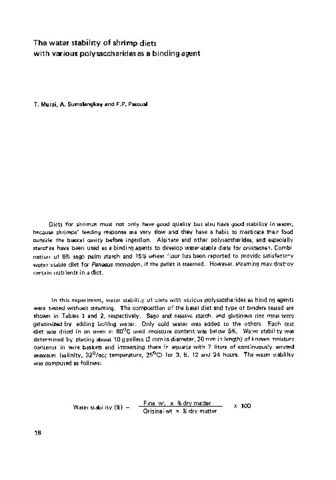
The water stability of shrimp diets with various polysaccharides as a binding agent
(Aquaculture Department, Southeast Asian Fisheries Development Center, 1981)The water stability of shrimp (Penaeus monodon) diets with various polysaccharides as binding agents were tested without steaming. The diet with alginate showed the best water stability and did not completely disintegrate in 24 hours. However, the use of alginate is dependent on cost and availability, so alternate choices may be a combination of sago palm starch and wheat flour or glutinous rice flour. -
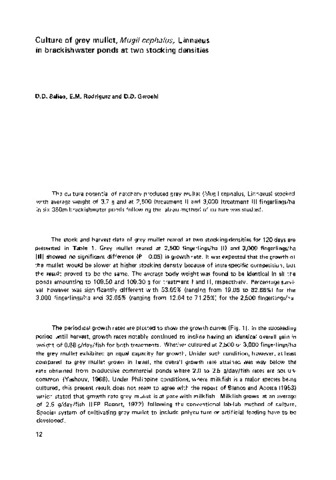
Culture of grey mullet, Mugil cephalus, Linnaeus in brackishwater ponds at two stocking densities
(Aquaculture Department, Southeast Asian Fisheries Development Center, 1981)The culture potential of hatchery-produced grey mullet (Mugil cephalus , Linnaeus) stocked with average weight of 3.7 g and at 2,500 (treatment I) and 3,000 (treatment II) fingerlings/ha in six 350m brackishwater ponds following the lab-ab method of culture was studied. -
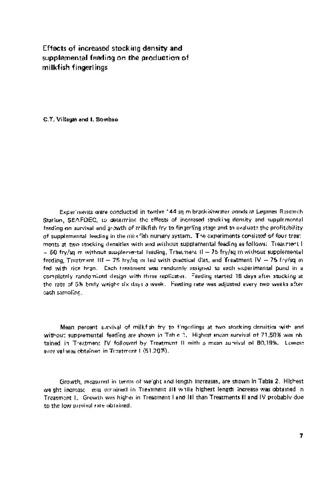
Effects of increased stocking density and supplemental feeding on the production of milkfish fingerlings
(Aquaculture Department, Southeast Asian Fisheries Development Center, 1981)Experiments were conducted to determine the effects of increased stocking density and supplemental feeding on survival and growth of milkfish (Chanos chanos) fry to fingerling stage and also to evaluate the profitability of supplemental feeding in the milkfish fry nursery. Results showed that increased stocking density from 50 to 75 fry/m2 increased net income and is profitable. Survival was further increased through supplemental feeding with rice bran, which is cheap and easily obtainable. -
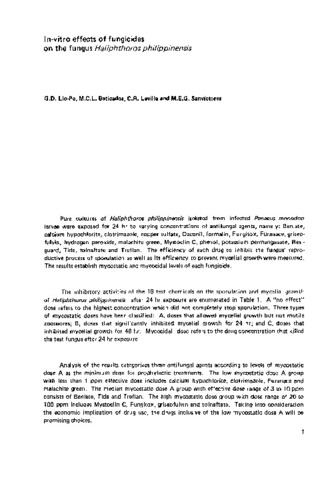
In vitro effects of fungicides on the fungus Haliphthoros philippinensis
(Aquaculture Department, Southeast Asian Fisheries Development Center, 1981)Pure cultures of Haliphthoros philippinensis, isolated from infected Penaeus monodon larvae, were exposed for 24 hours to varying concentrations of antifungal agents. The efficiency of each agent to inhibit sporulation and mycelial growth was measured. Effects on P. monodon eggs and larvae were also investigated. It is concluded that preliminary bioassay of larval tolerance to the suggested effective doses should always be made prior to prophylaxix or therapeutic applications. -
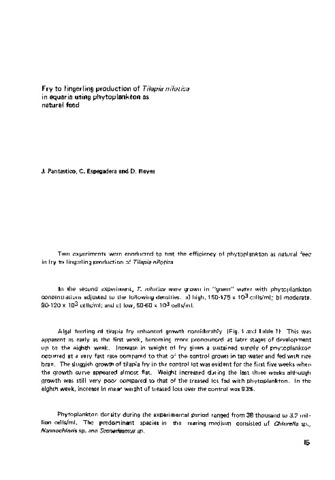
Fry to fingerling production of Tilapia nilotica in aquaria using phytoplankton as natural feed
(Aquaculture Department, Southeast Asian Fisheries Development Center, 1981)Overall results of the study indicate that the availability of high concentrations of phyloplankton in the rearing medium favoured growth of T. nilotica fry to fingerling. -
Culture of the mud crab, Scylla serrata (Forskal) at different stocking densities in brackishwater ponds
(Aquaculture Department, Southeast Asian Fisheries Development Center, 1981)The mean weight percentage survival, relative growth increment, net production and feed conversion value of S. serrata stocked in monoculture at different stocking densities are presented. -
Survival, growth and production of Penaeus monodon and P. indicus at different density combinations with milkfish
(Aquaculture Department, Southeast Asian Fisheries Development Center, 1981)Penaeus monodon and P. indicus juveniles were stocked and reared for about 3 months in earthen ponds at different density combinations with Chanos chanos. The presence of either Penaeus species at any density ratio did not affect significantly the C. chanos survival. Survival rates of the penaeids indicated that intraspecific and interspecific competition occurred and were reduced with the reduction in stocking rate. It is concluded that further studies on higher density ratios and feeding and economic consideration would be of help to the development of this kind of fishpond management system. -
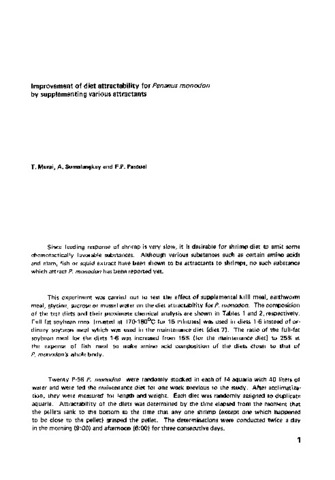
Improvement of diet attractability for Penaeus monodon by supplementing various attractants
(Aquaculture Department, Southeast Asian Fisheries Development Center, 1981)An experiment was undertaken to test the effect of supplemental krill meal, earthworm meal, glycine, sucrose or mussel water on diet attractibility of Penaeus monodon. Only glycine or mussel water significantly improved diet attractibility. -
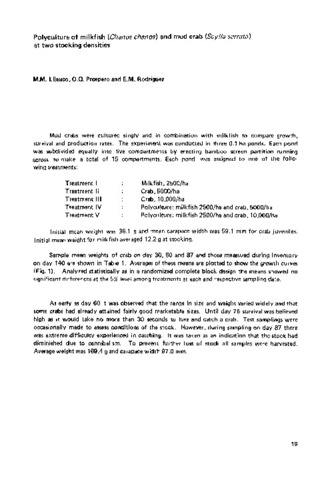
Polyculture of milkfish (Chanos chanos) and mud crab (Scylla serrata) at two stocking densities
(Aquaculture Department, Southeast Asian Fisheries Development Center, 1980)Mud crabs (Scylla serrata) were cultured singly and in combination with milkfish (Chanos chanos) to compare growth, survival and production rates. Net production of crab was higher in polyculture than monoculture, but the reverse was observed for milkfish. -
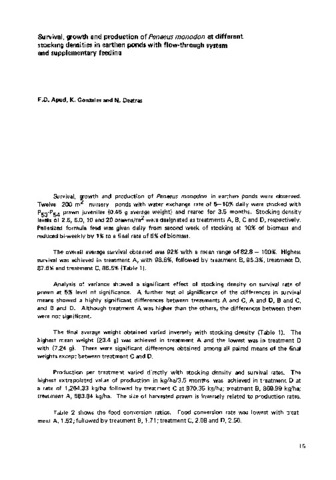
Survival, growth and production of Penaeus monodon at different stocking densities in earthen ponds with flow-through system and supplementary feeding
(Aquaculture Department, Southeast Asian Fisheries Development Center, 1980)The survival, growth and production of Penaeus monodon in earthen ponds were observed. A significant effect of stocking density on the survival rate of prawns was observed. The final average weight obtained varied inversly with the stocking density and the production varied directly with stocking density and survival rates. The maintenance of a clear water environment is recommended as a preventive measure against Vorticella attack. -
Growth and survival rates of hatchery-produced and wild milkfish fry grown to fingerling size in earthen nursery ponds
(Aquaculture Department, Southeast Asian Fisheries Development Center, 1980)Growth and survival rates of hatchery-produced and wild milkfish (Chanos chanos) fry grown to fingerling size were compared. Data show no significant difference between the 2 fry. At a recommended stocking density of 30 fry/m2, hatchery-produced milkfish fry could attain fingerling size of almost 2g with a survival of 68%. The study indicates that hatchery-produced fry/fingerlings can equal the culture performance of the wild fry. Comparative performance of hatchery-bred and wild fry should encourage intensified research on milkfish broodstock development and refinement of induced spawning methods. -
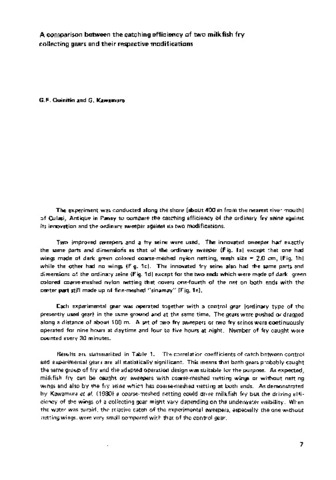
A comparison between the catching efficiency of two milkfish fry collecting gears and their respective modifications
(Aquaculture Department, Southeast Asian Fisheries Development Center, 1980)An experiment was conducted along the shore of Culasi, Antique in Panay to compare the milkfry (Chanos chanos) catching efficiency of the ordinary fry seine against its innovation and the ordinary sweeper against its 2 modifications. Results show that it is possible to replace the wings of the presently used sweeper and the ends of the fry seine with a coarse-meshed netting. This improvement decreases the water resistance of the gears and thus enables fry gatherers to use larger ones thereby giving more catch. -
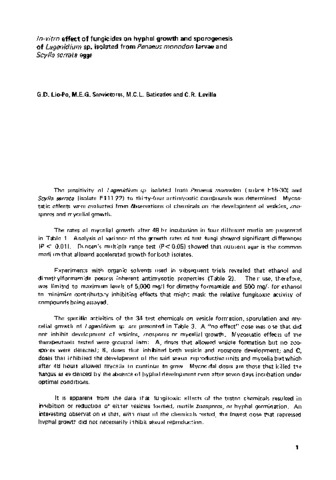
In-vitro effect of fungicides on hyphal growth and sporogenesis of Lagenidium sp. isolated from Penaeus monodon larvae and Scylla serrata eggs
(Aquaculture Department, Southeast Asian Fisheries Development Center, 1980)The sensitivity of Lagenidium, isolated from Penaeus monodon, Scylla serrata , to 34 antimycotics was determined. Effects on the development of vesicles, zoospores and mycelial growth were evaluated. Although mycoidal levels of the chemicals tested will be ideal for lethal treatment on control of the fungus, the high dose required may be lethal to the host, thus the use of mycostatic concentrations is more practical. Treatments of rearing water containing larvae, adult shrimps or crabs should be done only after preliminary tolerance experiments using at least the mycostatic dose prove to be safe for the hosts. Mycocidal doses can be used for determining disinfection doses of equipment and facilities used in rearing procedures as well as for destroying batches of infected larvae. -
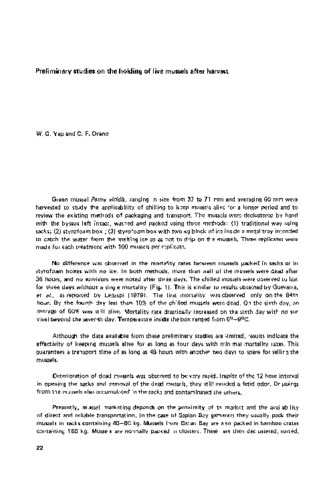
Preliminary studies on the holding of live mussels after harvest
(Aquaculture Department, Southeast Asian Fisheries Development Center, 1980)Green mussel (Perna viridis) were harvested to study the applicability of chilling to keep the mussels alive for a longer period of time and to review existing methods of packaging and transport. Data obtained from preliminary studies indicated the effectiveness of keeping mussels alive as long as 4 days with minimal mortality rates. -
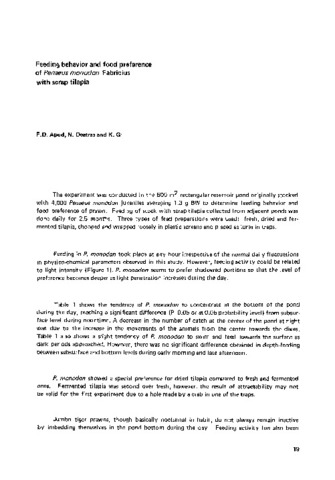
Feeding behavior and food preference of Penaeus monodon Fabricius with scrap tilapia
(Aquaculture Department, Southeast Asian Fisheries Development Center, 1980)The time of day during which P. monodon feeds at different depth levels in earthen ponds, and its preference for three types of tilapia feeds (dry, fresh and fermented) were determined. It was observed that P. monodon concentrated at the bottom beds during the day and along the periphery of dikes during night-time, with a slight tendency to swim and feed towards the surface as darkness increased. P. monodon showed special preference for dried tilapia compared to fresh and fermented tilapia. P. monodon also showed adaptability to the platform method of feeding, especially during night-time. -
Effects of water movement and aeration system on the survival and growth of hatchery bred sugpo (Penaeus monodon Fabricius) in earthen nursery ponds
(Aquaculture Department, Southeast Asian Fisheries Development Center, 1980)An experiment was conducted to determine the effects of water movement and airlift aeration on the survival and growth of P. monodon fry reared from P4P5 to P32P33 in earthen brackishwater ponds. The high survival rates obtained justify the need for aeration when using the earliest stages of fry (P4P5) at higher stocking densities. For older stages regardless of source and at lower stocking densities, nursery operations based on traditional methods could also achieve better survival rates. -
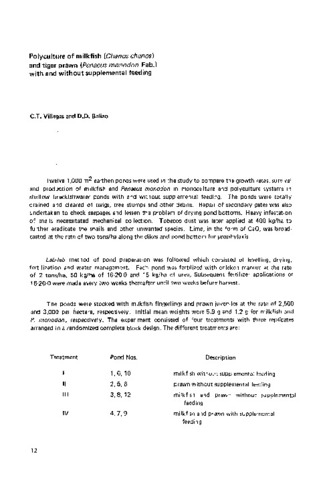
Polyculture of milkfish (Chanos chanos) and tiger prawn (Penaeus monodon Fab.) with and without supplemental feeding
(Aquaculture Department, Southeast Asian Fisheries Development Center, 1980)Twelve 1,000 m2 earthen ponds were used to compare the growth rates, survival and production of milkfish (Chanos chanos) and prawn (Penaeus monodon) in monoculture and polyculture systems in shallow brackishwater ponds and without supplemental feeding. The low production and survival rates obtained were attributed to the lack of natural food; the high salinity during the first month of culture could be one of the causes of the high mortality of prawn observed in both mono and polyculture systems. Although the results of the trial were not ecouraging, it is possible that high yields may be obtained from the combination of the 2 species given enough natural food and favourable water conditions. -
Growth and survival of Penaeus monodon Fabricius zoeae on different diatom feeds
(Aquaculture Department, Southeast Asian Fisheries Development Center, 1980)A study was undertaken to determine the most suitable food for Penaeus monodon zoea out of mixed diatoms, Skeletonema costatum, Chaetoceros calcitrans and C. gracilis. Results indicate that mixed diatoms and C. gracilis are the better food. Addition of zooplankton, e.g.rotifers, is also recommended as early as Z3 since the larvae start to be omnivorous at this stage. -
Evaluation of milkfish (Chanos chanos Forskal) and prawn (Penaeus monodon Fabricius) in polyculture systems
(Aquaculture Department, Southeast Asian Fisheries Development Center, 1980)The growth, survival and profitability of C. chanos and P. monodon grown in 5 different combinations for 100 days in 500m2 brackish water ponds were assessed. Differences in the growth and production of prawns cultured singly or in combination with milkfish at increasing stocking density strongly suggests that the presence of milkfish exerts some negative effect on prawn. However, growth production and competition index data suggest that the presence of prawn do not significantly affect milkfish. While the maximum production of prawn can be attained in monoculture, its polyculture with 2000 milkfish/ha is also economically feasible. -
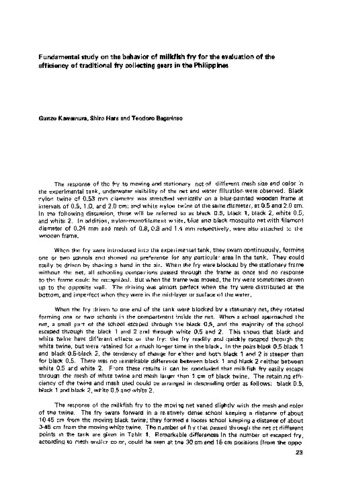
Fundamental study on the behavior of milkfish fry for the evaluation of the efficiency of traditional fry collecting gears in the Philippines
; ; Bagarinao, Teodora (Aquaculture Department, Southeast Asian Fisheries Development Center, 1980)
The response of Chanos chanos fry to moving and stationary nets of different mesh size and colour, underwater visibility of the nets and water filtration were studied. Results indicate that milkfish fry may be driven by nets of mesh size larger than that presently used; larger mesh size decreases the net resistance in the water so that collectors may move the equipment easily. The large mesh nets should be of a dark colour, preferably black for effective driving; bowever white mosquito net is best for the core end, since the fry are more easily visible on a white background.
(Aquaculture Department, Southeast Asian Fisheries Development Center, 1980)
The response of Chanos chanos fry to moving and stationary nets of different mesh size and colour, underwater visibility of the nets and water filtration were studied. Results indicate that milkfish fry may be driven by nets of mesh size larger than that presently used; larger mesh size decreases the net resistance in the water so that collectors may move the equipment easily. The large mesh nets should be of a dark colour, preferably black for effective driving; bowever white mosquito net is best for the core end, since the fry are more easily visible on a white background.