SEAFDEC/AQD Institutional Repository: Recent submissions
2001-2020 / 4221
-
Effect of substrate types on fecundity and nauplii production of ablated Penaeus monodon Fabricius
; Primavera, Jurgenne ; (Aquaculture Department, Southeast Asian Fisheries Development Center, 1980)
Experiments were undertaken to assess the survival, spawning, fecundity and nauplii production of ablated P. monodon females reared in flow-through broodstock tanks with white coralline and black sand substrate for 62 days. The similar trend observed in mortality rates in both substrates suggests that variation in substrate material for broodstock tanks is not a likely cause of prawn mortality. There were also no significant differences observed between rematurtion rates, i.e. number of spawnings, under the different treatments. Singnificantly higher nauplii production were observed in females in tanks with white substrates. At present, the land-based broodstock tanks in SEAFDEC utilize white coralline substrates due to higher hatching rate of eggs and nauplii production, convenience in siphoning out debris and excess food that tend to accumulte in the tank, and contrast provided by the white substrate during nightly observations of ovaries.
; (Aquaculture Department, Southeast Asian Fisheries Development Center, 1980)
Experiments were undertaken to assess the survival, spawning, fecundity and nauplii production of ablated P. monodon females reared in flow-through broodstock tanks with white coralline and black sand substrate for 62 days. The similar trend observed in mortality rates in both substrates suggests that variation in substrate material for broodstock tanks is not a likely cause of prawn mortality. There were also no significant differences observed between rematurtion rates, i.e. number of spawnings, under the different treatments. Singnificantly higher nauplii production were observed in females in tanks with white substrates. At present, the land-based broodstock tanks in SEAFDEC utilize white coralline substrates due to higher hatching rate of eggs and nauplii production, convenience in siphoning out debris and excess food that tend to accumulte in the tank, and contrast provided by the white substrate during nightly observations of ovaries. -
Identification of the postlarval Penaeus (Crustacea, Decapoda, Penaeidae) appearing along shore waters
(Aquaculture Department, Southeast Asian Fisheries Development Center, 1980)Diagnostic characters for the identification of postlarval Penaeus appearing along the coastal waters of the Philippines are reviewed and categorized, based on materials from the wild and laboratory. Presently there are 7 adult known species belonging to the genus Penaeus around Panay Island and its adjacent waters, namely: P. monodon, P. semisulcatus, P. merguiensis, P. indicus, P. japonicus , P. canaliculatus, and P. latisulcatus. -
A statistical index of growth condition in an aquaculture experiment
(Aquaculture Department, Southeast Asian Fisheries Development Center, 1980)A simple statistical index, for evaluating the condition of growth in an aquaculture experiment and indicating the extent of effect of any plausible rival hypothesis, is presented. -
Attractants in purified diets
(Aquaculture Department, Southeast Asian Fisheries Development Center, 1980)Juvenile Penaeus monodon were reared on purified diets containing different attractants used to gelatinize the cornstarch: plain water, shrimp, mussel, squid or trash fish extract. The highest survival rate was observed in the group given the shrimp attractant, followed by mussel, fish and squid. However growth appeared best in the diet containing mussel extract. Mussel extract apparently can be used to enhance the attractability of purified diets. -
A comparative study of various extenders of milkfish, Chanos chanos (Forsskal) sperm preservation
(Aquaculture Department, Southeast Asian Fisheries Development Center, 1980)Four chemical extenders in 7 different concentrations (potassium chloride, sodium chloride, glucose, sodium citrate, Ringer s solution, cow serum and milkfish (Chanos chanos) serum) were compared in the preservation of milkfish sperm. Results showed milkfish serum to be the most suitable of the various extenders tested. This may be attributed to suitable osmotic potential and/or presence of proteins which may have directly or indirectly influenced sperm viability. The effects of milkfish serum on the motility and fertilizing capacity of sperm at different durations of storage however need to be investigated. -
Growth phases of cultured algae used as larval food
(Aquaculture Department, Southeast Asian Fisheries Development Center, 1980)A study was undertaken to determine the onset and duration of the growth phases of cultured algae commonly used as larval food (Skeletonema costatum, Chaetoceros calcitrans, Tetraselmis chuii, Chlorella vulgaris, Isochrysis galbana) so as to predict the time of harvest at the desired stage to suit various needs and purposes. -
Studies on the egg quality of Penaeus monodon Fabricius based on morphology and hatching rates
Primavera, Jurgenne; (Aquaculture Department, Southeast Asian Fisheries Development Center, 1980)
Eggs of P. monodon are classified into 5 different types on the basis of morphological criteria and hatching rates: A1 eggs, which undergo normal development with 58% hatching rate; A2 eggs, which show delayed and/or abnormal development with 32% hatching rate; B eggs, which are unfertilized and characterized by irregular cytoplasmic formation; C eggs, which are unfertilized and show no change in appearance; and D eggs, which are unfertilized and show extensive bacterial presence. The establishment of a highly linear relationship between percent A1 eggs and hatching rate provides a useful tool to aid the hatchery technician in determining which spawnings to reject outright and which to rear through the larval and post-larval stages. -
Developmental and ecological stages in the life history of milkfish Chanos chanos Forsskal
(Aquaculture Department, Southeast Asian Fisheries Development Center, 1980)Seven stages in the life history of the milkfish C. chanos , are recognized and suggested: A, embryonic; B, yolksac larval; C, larval; D, postlarval; E, juvenile; F, subadult; G. adult. An outline is presented of the life history. It is concluded that the milkfish, throughout the known stages of their life history are well adapted and equipped for optimal survival. High swimming performance, broad flexibility in feeding habits, high adaptability to a wide range of physicochemical conditions of the environment are but a few of the adaptations. The main driving force in all developmental stages is the evolutionary response to food distribution and availability followed by predation pressure. -
Ipil-ipil (Leucaena leucocephala) leaves as a plant protein source in prawn diets
(Aquaculture Department, Southeast Asian Fisheries Development Center, 1980)Penaeus monodon juveniles were fed diets containing fish meal, shrimp head meal and ipil-ipil leaves soaked and unsoaked, local and peruvian varieties. Mean weight gain at the end of 8 wk was significantly highest among those given the diet containing commercial ipil-ipil leaves. Gain in length followed the same pattern as mean weight gains. Among the diets containing ipil-ipil leaves there was a direct relationship in the amount of mimosine in the diet and the survival rate, the lower the amount of mimosine (due to soaking) the higher the survival rate. The Results thus indicate the beneficial effect of the addition of commercial ipil-ipil leaves to the diets of prawns, providing the mimosine content is kept low by soaking. A reduce in costs is also obtained, since 1kg of shrimp head meal or fish costs more than 2 or 4 tons, respectively, than that of ipil-ipil foliage. -
Diel fluctuations in catch of the postlarval Penaeus japonicus group
(Aquaculture Department, Southeast Asian Fisheries Development Center, 1979)Experiments were undertaken in order to measure the diel fluctuations in the catch of the post-larvae of P. japonicus in relation to the tidal cycles, light conditions and water temperature. The fluctuations are discussed comparing them with other post-larvae Penaeus species appearing along shore waters in the Philippines. -
Culture experiments on the copepod, Tisbintra elongata MORI, and evaluation of that species as food organism for milkfish larvae
(Aquaculture Department, Southeast Asian Fisheries Development Center, 1979)Five types of food were used to culture T. elongata: rice bran, cow dung, bread, cow dung, bread yeast, fermented fish solubles and Spirulina. Bread yeast was found to give the highest densities. An evaluation was also made of the effectivity of rice bran and fermented fish solubles for the outdoor mass culture of T. elongata . A comparative study on the growth and survival rate of milkfish fry (Chanos chanos) fed with T. elongata and Artemia showed there to be no significant differences between the diets. -
Viability of frozen algae used as food for larval penaeids
(Aquaculture Department, Southeast Asian Fisheries Development Center, 1979)Freezing with added chemicals as flocculants and protectants was assessed as a means of preserving stock cultures of 4 algal species used for larval penaeid food Chaetoceros calcitrans, Skeletonema costatum, Tetraselmis chuii and Isochrysis galbana . The maximum storage effectability of the preservation techniques for each species was also determined. -
The effect of various salinity levels and stocking density manipulation methods on the survival of milkfish fry (Chanos chanos Forsskal) during storage
(Aquaculture Department, Southeast Asian Fisheries Development Center, 1979)Results of the study indicate that the survival rate and increase in body weight did not differ significantly at different salinity levels or at different stocking density manipulation methods. A significant interaction between salinity and stocking density manipulation could not be demonstrated statistically. There apparently is no need to reduce the salinity of the water used in storing milkfish Chanos chanos fry in order to attain higher survival as commonly believed. Sufficient food and maintenance of good water quality are more important than salinity for higher survival of fry during storage. -
The skull of milkfish, Chanos chanos Forsskal
(Aquaculture Department, Southeast Asian Fisheries Development Center, 1979)The skull of the milkfish, C. chanos, is described so that it may be used as a tool in identifying the effect of artificial propagation in terms of skeletal malformations. -
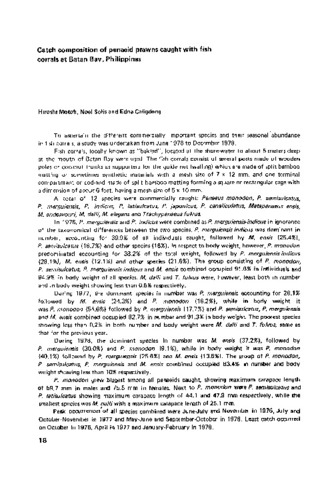
Catch composition of penaeid prawns caught with fish corrals at Batan Bay, Philippines
(Aquaculture Department, Southeast Asian Fisheries Development Center, 1979) -
Survival, maturation, fecundity and hatching rates of unablated and ablated Penaeus indicus H.M. Edwards from brackishwater ponds
Primavera, Jurgenne; ; (Aquaculture Department, Southeast Asian Fisheries Development Center, 1979)
Penaeus indicus harvested after three months of rearing in brackishwater ponds and averaging 6.9 g for females and 5.6 g for males were stocked in two 12 cu m flowthrough ferrocement tanks at 240 females and 200 males per tank. The females were ablated on one eyestalk in one tank and remained unablated in the other tank; all males were unablated. Ablated females spawned up to 7 times per female; unablated females spawned up to only 3 times during the two month duration of the experiment. Ablated females produced a total number of 17.5 x 10⁶ eggs, 6.6 x 10⁶ nauplii, and an average of 23,480 eggs/spawning and 37.8% hatching rate from a total of 757 spawnings. Unablated females produced a total of 2.0 x 10⁶ eggs, 1.1 x 10⁶ nauplii, and an average of 26.990 eggs/spawning and 53.9% hatching rate from a total of 74 spawnings. Survival of ablated females was 53.5% compared to 69.4% for unablated females; males in both tanks averaged more than 90% survival. -
Studies on the fungal diseases in crustaceans I. Lagenidum scyllae sp. nov. isolated from cultivated ova and larvae of the mangrove crab (Scylla serrata)
(Aquaculture Department, Southeast Asian Fisheries Development Center, 1979) -
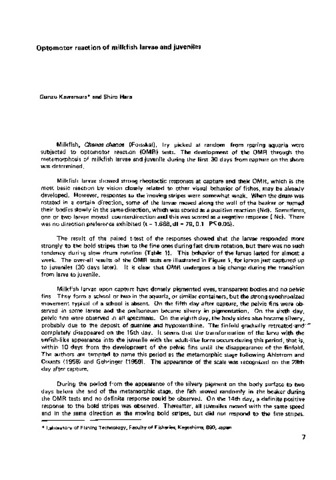
Optomotor reaction of milkfish larvae and juveniles
(Aquaculture Department, Southeast Asian Fisheries Development Center, 1979) -
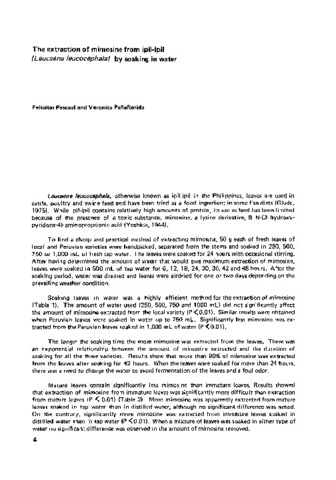
The extraction of mimosine from ipil-ipil (Leucaena leucocephala) by soaking in water
(Aquaculture Department, Southeast Asian Fisheries Development Center, 1979) -
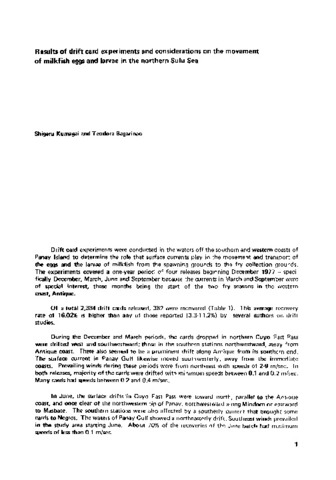
Results of drift card experiments and considerations on the movement of milkfish eggs and larvae in the northern Sulu Sea
; Bagarinao, Teodora (Aquaculture Department, Southeast Asian Fisheries Development Center, 1979)
For a period of one year beginning December 1977, drift card experiments were conducted off the western and southern coasts of Panay Island to determine the surface currents in the area. Of a total 2,384 drift cards released during the study, 382 (16.02%) were recovered, 92% of them within 30 days following dispatch. The surface currents in the study area are strongly influenced, in direction and speed, by the prevailing monsoon winds. During the NE monsoon period, the surface currents move away from the coast; during the SW monsoon, toward and/or parallel to the coast. Based on the results, the probable movement and transport of milkfish (chanos chanos) eggs and larvae from the spawning ground to the fry collection ground are also discussed.