SEAFDEC/AQD Institutional Repository: Recent submissions
2221-2240 / 4221
-
Series: Aquaculture extension manual; No. 21
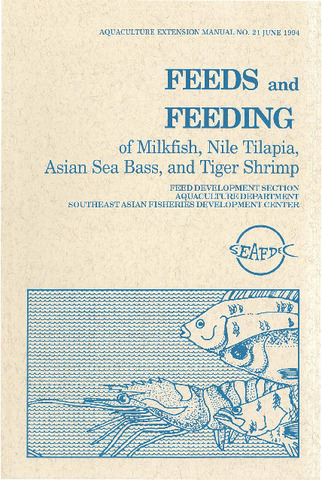
Feeds and feeding of milkfish, Nile tilapia, Asian sea bass, and tiger shrimp
(Aquaculture Department, Southeast Asian Fisheries Development Center, 1994)A 97-page manual that discusses the nutrient requirements, sources and characteristics of feedstuffs, feed formulation, practical feed formulation, processing and preparation, storage and quality control and feeding ... -
Mudcrab pen culture in mangroves
(Society of Aquaculture Engineers of the Philippines, Inc., 1998)Over the years, commercial production of mudcrab, Scylla spp, has been undertaken only in bamboo or net-fenced brackishwater ponds. Its feasibility was proven through series of verification trials conducted in commercial ponds by SEAFDEC/AQD researchers and is now being practiced elsewhere in the country. Of late, the introduction of using net enclosure to grow mudcrabs in mangroves or tidal zones offers a bright prospect in aquasilviculture. Using mangroves as natural resource, paves the natural way of creating livelihood among fisherfolk in the coastal areas. While this method is by far not very popular in the Philippines, the same has been carried out for quite some time in Indonesia, Malaysia, Viet Nam and China. The advantages of this method include low investment cost, ease of construction, environment-friendly and this project can be operated quickly. -
The economics and marketing of cage-raised finfish and pen-raised mudcrab
(Society of Aquaculture Engineers of the Philippines, Inc., 1998)As part of the technology verification exercise for technologies developed through research, the economics and marketing aspects were investigated before such technologies can be extended to industry practitioners. These were done for groupers raised in marine fishcages, tilapia raised in fishcages set in farm reservoirs, and for mudcrabs raised in pens set in mangroves. -
Quality of hatchery-reared juveniles for marine fisheries stock enhancement
; ; ; Lebata, J. H. ; ; (Elsevier, 2007)
The potential for stock enhancement by release of hatchery-reared juveniles continues to be a topic of interest to researchers and fisheries managers. While, in many studies, the focus has tended to be on the technology for production of juveniles, the need for a more multidisciplinary approach is now becoming accepted. Ideally, this includes studies of population dynamics and recruitment-limitation of wild stocks, environment–stock interactions, habitat availability, genetic studies of wild and released stocks and integration with appropriate fisheries management. While it may be relatively straightforward to culture large numbers of seed animals, the quality of hatchery-reared juveniles may limit the effectiveness of any release programme. The quality of juveniles may be defined either by their ability to attain the age and size to recruit to a commercial fishery or their fitness to survive to contribute to the spawning stock. Many factors will inevitably influence batch–batch variability in the viability of hatchery-reared juveniles and their ability to recruit and compete in the wild. Some effects of nutrition and environment in the hatchery are well-known or at least recognised and their manipulation offers the potential for improvement of survivorship of juveniles post-release. The choice and utilisation of broodstock also represent a crucial stage in enhancement programmes, and considerations of bottleneck effects arising from reduced effective population size due to skewed parental and family contributions must be given careful consideration. A broodstock design that encompasses sufficient numbers of animals that reflect the genetic, and preferably ecological, identity of the stocks to be enhanced should be adopted. In addition, environmental conditions and husbandry practices within the hatchery as well as broodstock and larval nutrition can all influence the quality of offspring. Further conditioning and/or selection during nursery culture may also be critical in maximising the physiological and behavioural fitness of hatchery juveniles post-release. Although evaluation of long-term performance of individual batches of juveniles requires considerable effort or may be impossible in some cases, this type of quantification is likely to be an important component in the determination of the effectiveness of release programmes. This paper reviews the effects of hatchery and nursery practice on larval and juvenile fitness for stock enhancement and presents examples of comparisons of the quality of wild and hatchery-reared juveniles and the effect of pre-release conditioning on subsequent survival and growth.
; ; (Elsevier, 2007)
The potential for stock enhancement by release of hatchery-reared juveniles continues to be a topic of interest to researchers and fisheries managers. While, in many studies, the focus has tended to be on the technology for production of juveniles, the need for a more multidisciplinary approach is now becoming accepted. Ideally, this includes studies of population dynamics and recruitment-limitation of wild stocks, environment–stock interactions, habitat availability, genetic studies of wild and released stocks and integration with appropriate fisheries management. While it may be relatively straightforward to culture large numbers of seed animals, the quality of hatchery-reared juveniles may limit the effectiveness of any release programme. The quality of juveniles may be defined either by their ability to attain the age and size to recruit to a commercial fishery or their fitness to survive to contribute to the spawning stock. Many factors will inevitably influence batch–batch variability in the viability of hatchery-reared juveniles and their ability to recruit and compete in the wild. Some effects of nutrition and environment in the hatchery are well-known or at least recognised and their manipulation offers the potential for improvement of survivorship of juveniles post-release. The choice and utilisation of broodstock also represent a crucial stage in enhancement programmes, and considerations of bottleneck effects arising from reduced effective population size due to skewed parental and family contributions must be given careful consideration. A broodstock design that encompasses sufficient numbers of animals that reflect the genetic, and preferably ecological, identity of the stocks to be enhanced should be adopted. In addition, environmental conditions and husbandry practices within the hatchery as well as broodstock and larval nutrition can all influence the quality of offspring. Further conditioning and/or selection during nursery culture may also be critical in maximising the physiological and behavioural fitness of hatchery juveniles post-release. Although evaluation of long-term performance of individual batches of juveniles requires considerable effort or may be impossible in some cases, this type of quantification is likely to be an important component in the determination of the effectiveness of release programmes. This paper reviews the effects of hatchery and nursery practice on larval and juvenile fitness for stock enhancement and presents examples of comparisons of the quality of wild and hatchery-reared juveniles and the effect of pre-release conditioning on subsequent survival and growth. -
Second International Conference on the Culture of Penaeid Prawns and Shrimps: Proceedings of an International Conference held at Iloilo City from 13-17 May 1996
(Elsevier, 1998)Abstracts of the papers presented at the conference are cited individually. -
Culture of finfish in netcages
(Society of Aquaculture Engineers of the Philippines, Inc., 1998)This report consists of two parts, the first deals on the cage culture of grouper, and the second on cage culture of tilapia. The culture of groupers is done in netcages set in marine waters, while tilapia is raised in netcages set in freshwater ponds, reservoirs or in lakes. -
Fish farming in marine pens and cages in the Philippines: appropriate technology?
Bagarinao, TeodoraContributed as Discussant in Technical Session 3 on Environmental Impacts of Marine Fishcage Farming, 12th Annual Meeting of the Society of Aquaculture Engineers of the Philippines, Inc. (SAEP), held at the BFAR-National ... (Society of Aquaculture Engineers of the Philippines, Inc., 1998)
-
The genus Gracilariopsis (Rhodophyta, Gracilariales) in the Philippines: morphological and taxonomic confirmations
(University of San Carlos, 1998)Reports of the economically-important agarophytic seaweed genus Gracilariopsis Dawson from Philippine waters are verified for the first time. Cystocarpic, spermatangial and tetrasporic materials collected from various localities in eastern Panay and northwestern Negros islands conform to the circumscription of this recently reinstated genus. Materials are referred to Gracilariopsis heteroclada Zhang & Xia after morphological comparisons with type materials from southern China. In addition, a discussion of the complicated nomenclatural history of this species is included. Another putative Gracilariopsis species is reported from Zamboanga City based on cystocarpic materials alone. This species differs from G. heteroclada with its smaller gonimoblast cells and larger height:width ratio of the gonimoblast mass. Vegetatively, the thallus is smooth, devoid of fine, determinate branchlets observed in G. heteroclada. -
Resistance to antibiotics of Vibrio spp. and Aeromonas spp. isolated from fish and shrimp tissues and rearing water in Panay island, Philippines
(University of the Philippines Visayas, 1998)A survey on the resistance patterns to selected antibiotics of bacterial pathogens of fish and shrimps in Panay Island, Philippines was conducted. One hundred and sixteen (116) bacterial isolates were collected from fish (Chanos chanos, Epinephelus sp. and Lates calcarifer) and shrimp (Penaeus monodon and P. indicus) tissues and rearing water. Among these isolates, only seven were identified as Aeromonas spp., the rest (109 isolates) were Vibrio spp., 42% of which were luminous Vibrio. Results of the sensitivity tests showed that all Aeromonas spp. isolates were resistant to streptomycin, oxytetracycline, and trimethoprim/sulphamethoxazole. Most of the Vibrio spp. isolates (94.5%) were resistant to streptomycin. Multiple resistance to two or more antibiotics was observed in 17 isolates of Vibrio spp. and all isolates of Aeromonas spp. -
A parasitological survey of slipper-cupped oysters (Crassostrea iredalei, Faustino, 1932) in the Philippines
(National Shellfisheries Association, 2010)This paper describes the first screening in the Philippines of slipper-cupped oysters (Crassostrea iredalei) for the presence of parasites. Slipper-cupped oysters were sampled at 2 sites in Ivisan, Capiz, from September to December 2007. Macroscopical and histological analyses were carried out in oyster tissues. Histological examination showed gregarine protozoan Nematopsis sp. as the most prevalent parasite (71.33% and 65.0%) at 2 sites with a moderate intensity of infection. Tylocephalum sp. cestode was found in the connective tissue around the digestive gland, with a prevalence of 60% and 52.3% in 2 sites, with a moderate intensity of infection. Digenean trematodes had a 37.80% prevalence at site 1 and a 22.45% prevalence at site 2. Ciliates were also observed with a prevalence of 18.75% (site 1) and 13% (site 2). The observed infection of oysters had no apparent effect on oyster production at these sites maybe due to low infestation levels or to the fact that the parasites have no pathological effect. -
The morphology and life cycle of the gill monogenean (Pseudorhabdosynochus lantauensis) on orange-spotted grouper (Epinephelus coioides) cultured in the Philippines
(European Association of Fish Pathologists, 2010)The morphology of Pseudorhabdosynochus lantauensis is described. It is the most numerous parasite recovered from the gills of cultured orange-spotted grouper Epinephelus coioides in the Philippines and is smaller compared with similar species reported in Hong Kong, Malaysia and Indonesia. This species is characterized by having an overlapping dorsal bar and short copulatory organ. The life cycle of the gill monogenean is also described. One mature parasite lays at least 10-22 eggs/day. Eggs are oval (0.021-0.120 mm) with a spiral filament attached to one end. Eggs hatch into free-swimming larvae (oncomiracidia) within 2-6 d at 30°C and 30 ppt. The rate of hatching of various eggs is highly variable, that is, some eggs hatch in 2 d while others take 6 d. The oncomiracidium can attach to the grouper host within 8 h. Upon attachment, the oncomiracidium metamorphoses to an adult parasite in 4-7 d. The parasite becomes fully mature and delivers eggs in 7 d. Without a host, the life span of oncomiracidium is only 4-8 h. The life cycle is complete in 13-20 days (eggs to oncomiracidium 2-6 d; oncomiracidium to adult parasite 4-7 d; adult to fully mature and egg delivery parasite 7 d). This is the first report on the morphology and life cycle of P. lantauensis from the Philippines. -
Nutritional evaluation of mysids Mesopodopsis orientalis (Crustacea:Mysida) as live food for grouper Epinephelus fuscoguttatus larvae
(Elsevier, 2010)The potential of mysids Mesopodopsis orientalis as live food source for grouper Epinephelus fuscoguttatus larvae was investigated. In comparison with Artemia biomass, a common live food source in larviculture, mysids contained significantly higher levels of protein, total lipid, eicosapentaenoic acid (EPA, C20:5n−3), and docosahexaenoic acid (DHA, C22:6n−3). DHA was not detected in Artemia biomass. Grouper larvae fed mysids from 35 to 55 days after hatching (DAH) had 2-fold and 3-fold higher specific growth rates and survival, respectively, than those fed Artemia biomass. DHA levels increased 6-fold while EPA levels remained constant in mysid-fed grouper larvae. In contrast, DHA and EPA significantly decreased in Artemia biomass-fed grouper larvae. Furthermore, the specific activities of amylase, lipase and protease generally significantly increased (P< 0.05) in both mysid-fed and Artemia biomass-fed grouper larvae from 35 to 55DAH. A marked increase in the specific activity of amylase was seen in mysid-fed than in Artemia biomass-fed grouper larvae. Results of the nutritional evaluation suggest that mysids are superior live food organisms than Artemia biomass for grouper larvae and could significantly improve production of grouper juveniles in the nursery phase. -
Size measurement and nutritional condition evaluation methods in sandfish (Holothuria scabra Jaeger)
; ; ; Lebata-Ramos, Maria Junemie Hazel; (Wiley, 2012)
The aims of this study were to establish an accurate size measurement method and a nutritional condition evaluation method of Holothuria scabra (Jaeger). Although 0.5% KCl and 0.05% MgSO4 did not induce anaesthesia, 2% menthol–ethanol for 20 min was found to be effective and harmless. The anaesthetization significantly reduced the coefficient of variation of the mean body length and weight by 68% and 43% respectively. During starvation, body size and weight decreased concomitantly, resulting in an unchanged condition factor (body weight/volume), suggesting that the condition factor cannot be used as an index of nutritional condition. Protein, cholesterol and carbohydrate concentrations in the body fluid were analysed to study the relationship with starvation. As the protein and cholesterol concentrations initially increased and then decreased during the starvation period, it is difficult to use them as an index of nutritional condition. The carbohydrate concentration showed a gradual one-fold increase during 10 days of starvation, and it may be used as a proxy for nutritional condition; however, further physiological studies are needed. Body fluid density and volume relative to body size gradually increased and decreased, respectively, during starvation. These methods may be used to correctly monitor the conditions of H. scabra in studies for aquaculture and stock enhancement techniques. -
Effect of different mangrove-to-pond area ratios on influent water quality and WSSV occurrence in Penaeus monodon semi-intensive farms using the greenwater culture technique
Tendencia, Eleonor; ; Primavera, Jurgenne ; (Elsevier, 2012)
White spot syndrome virus (WSSV) has been affecting the shrimp industry worldwide for two decades now. It continues to bring economic losses to affected farms. Despite the many studies on its epidemiology, there is no proven treatment or control measure. Diseases, like the WSSV, results from the interaction of three factors: host, pathogen and environment. The environment plays an important role in disease development and determines the health or the immune capacity of the shrimp. High mangrove-to-pond area ratio (MPR) is reported as a protective factor against WSSV. This study investigates if mangroves affect the physicochemical properties of the water and soil as well as the prevalence of infectious agents like the WSSV by monitoring farms with different MPR (0:1, 1:1, 4:1). Results showed that quality of influent water was not significantly better in farms with high MPR. Significantly higher available sulfur was observed in MPR-4; significantly higher percentage green vibrios in the soil in MPR-0. WSSV was detected in farms with MPR-1 and MPR-4 but did not result in an outbreak, suggesting that the presence of mangroves could prevent WSSV outbreak. -
Effect of three innovative culture systems on water quality and whitespot syndrome virus (WSSV) viral load in WSSV-fed Penaeus monodon cultured in indoor tanks
Tendencia, Eleonor; ; (Elsevier, 2012)
White spot syndrome virus is the most important among the shrimp diseases. It has been devastating the shrimp industry for more than 3 decades. Previous studies reported that greater percentage of yellow colonies on thiosulfate citrate bile salt sucrose agar (yellow vibrios) in the rearing water, abundant supply of natural food such as Chlorella, and the use of the greenwater technology (GW) are some ecological ways of preventing WSSV outbreak. The aim of this study was to investigate the efficiency of the 3 systems against WSSV. Shrimp, experimentally infected with WSSV by feeding with WSSV positive shrimp carcass, was cultured in tanks using three treatments: with tilapia to simulate the GW, seeded with Chlorella, and with molasses added to enhance growth of yellow vibrios. Shrimp cultured in seawater served as the control. Survival was recorded and shrimp were analyzed for WSSV quantification using qPCR upon termination. Analysis showed no significant differences in shrimp survival at 120 h post infection in all treatments and the control. However, from the original viral load of 1.40 × 101 WSSV/mg sample, WSSV decreased and was significantly lowest in shrimp cultured using GW (7.0 × 100), compared to the control (4.82 × 10⁵) and the other treatments (3.66 × 10⁵ for molasses added and 4.64 × 10⁵ for Chlorella seeded) in which viral load increased 4–5 times. Shrimp survival was highest in Chlorella seeded treatment and lowest in GW. Nitrogenous waste concentrations were lowest in molasses added water and highest in GW. Results suggest that the GW culture technology provides protection against WSSV while addition of molasses lowers nitrogenous waste concentration. The use of GW in combination with the addition of molasses for shrimp culture is suggested. -
Broodstock transplantation: An approach for stock enhancement of the 'kapis' shell Placuna placenta along Panay Gulf, central Philippines
(College of Agriculture, University of the Philippines Los Baños, 2012)The Panay Gulf in central Philippines once supported a substantial ‘kapis’ Placuna placenta (Linnaeus) population that was among the six major sources for this species. However, stock depletion began in the late 1980s because of overexploitation and destructive fishing practices. To recover the declining ‘kapis’ fishery along the Gulf, a broodstock transplantation program was initiated in 1999. Results from a survey of the Gulf prior to this program confirmed reports of resource depletion. Four (4) transplantation sites (S) with natural soft-muddy substrata in adjacent coastal towns, namely, Tigbauan (S1 and S2), Guimbal (S3) and Oton (S4) were established and stocked with 3200 (1:1 male to female ratio) sexually mature ‘kapis’ broodstock collected from nearby Negros Island in March–October 1999. Transplant survival along the sites ranged 80–100%. Spontaneous spawning by ‘kapis’ transplants occurred from March 1999 (15 d after first stocking) through May 2000. Larvae (5 larvae per L) began to appear at S1 15 d after transplantation and progressively increased in density to 23 larvae per L in November 1999. During this period, local divers reported big patches of ‘kapis’ juveniles [shell length (SL), 38 ± 11 mm] at S4. Sex ratio of recruits was 3:2 (male: female). Larvae became abundant off the nearby coasts with a strong recruitment pulse at 160 larvae per L at S4 by January 2000. Likewise, transplants taken to the laboratory were induced to spawn by photochemical method, and thus validated the spawning that occurred in transplantation sites. Juvenile recruits were of variable sizes, indicating that spawning was not simultaneous. Sexually mature juvenile recruits (40% female, 90% male) were already observed in January–February 2000. The recruitment apparently resulting from these transplants was local, dispersion ranging from zero to a few kilometers distance from transplantation sites. ‘Kapis’ harvest began in 2007 for local market consumption while commercial harvest was done in 2010 with approximately 600 tons. The repopulation of ‘kapis’ along Panay Gulf after a decade indicated the success of the restocking program which was attributed to the suitability of the species, reproduction of transplants and the proper management of the newly established resource by the coastal fishers who are members of a local organization (FARMC) with the support of local government units (LGUs). -
Netcage rearing of the Asian seabass Lates calcarifer (Bloch) in brackishwater pond: The technical and economic efficiency of using high protein diets in fingerling production
(College of Agriculture, University of the Philippines Los Baños, 2012)Intensification in the grow-out culture of high-value fish requires a large quantity of quality fingerlings. Fingerling production is a component of fish farming that comprises nursery and grow-out culture, and may be a commercial enterprise option for fish farmers with limited pond area. The nursery rearing of the Asian seabass Lates calcarifer (Bloch) was conducted in netcages inside a brackishwater pond. The fish were fed with two isocaloric, high-protein diets formulated at the Southeast Asian Fisheries Development Center (SEAFDEC/AQD) and a control treatment: diets A (40.40% crude protein, CP) and B (46.17% CP), and trashfish (TF) as control. Hatchery-bred seabass early juveniles of two size groups (S1, 4.0 ± 0.2 g; S2, 2.40 ± 0.03 g) were stocked at 75–100 fish per m3 and given diets A or B at 6–10% of average body weight (ABW) d-1, or TF at apparent satiation. Seabass given the formulated diets attained the desired size (≥ 20–40 g) after 45 d but not the fish fed with trashfish. Size and treatments showed significant effects on final ABW, although no significant interaction between these factors was shown to affect body weight. As expected, S1 fish attained a significantly higher ABW (30.7 ± 18 g) compared with S2 fish (20.7 ± 11 g) regardless of diet treatment. Seabass fed with trashfish exhibited significantly lower final ABW (6.6 ±1.6 g) than those fed Diet A (33.4 ± 6.5 g) or Diet B (37.1 ± 9.4 g). Fish size did not have any significant effect on specific growth rate (SGR), but diet treatments did. SGR was significantly better when either Diet A (5.2 ± 0.30) or B (5.4 ± 0.20) was used compared with the SGR of seabass fed with trashfish (1.7 ± 0.5). Although size and treatment did not show significant interaction on fish survival, the use of bigger seabass resulted in higher survival (89 ± 11%) compared with smaller seabass (80 ± 11%). Regardless of size, similar survival was attained in seabass fed Diet A (89 ± 6%) or B (95 ± 5%), significantly higher than that in seabass given trashfish (72 ± 6%). An interaction between size at stocking and diet treatment significantly affected protein efficiency ratio (PER). When S1 fish was used, diets A and B gave similar PER. However, when S2 fish was used, diet A gave significantly higher PER (2.49 ± 0.02) among the treatments (P < 0.05). Regardless of size, significant differences (P ≤ 0.05) were observed in the mean production cost, revenue and income among the three diet treatments. Moreover, post hoc analysis using Tukey’s HSD test further showed that use of diet B resulted in significantly higher revenue (PhP25,132.80) and income (PhP12,597.47) compared with the two other treatments. Trashfish treatment gave the least revenue (PhP 9,525.60) and negative income (- PhP 1,798.40). Production cost was not significantly different between diets A and B. Hence, diet B is the most economically viable and productive diet treatment. The low break-even price of fingerlings obtained for diet B showed that selling price can still be reduced to lower production cost in grow-out farming. -
Diet composition and feeding periodicity of the seahorse Hippocampus barbouri reared in illuminated sea cages
Garcia, Luis Maria; ; ; ; (Elsevier, 2012)
The zooplankton prey composition and feeding periodicity of juvenile and adult seahorses Hippocampus barbouri reared in illuminated and non-illuminated sea cages were compared. Mean frequency of occurrence (%FO), prey composition (%N), and gut fullness of seahorses were calculated from analyses of gut contents. Compared with juvenile seahorses, adults consumed more variety of prey consisting of copepods, larvae of decapods, polychaetes and fish, and euphausid shrimps. Calanoid copedods were found in the gut of more juvenile (%FO = 47) and adult (%FO = 64) seahorses in illuminated cages but harpacticoid copepods were ingested by more juvenile fish (%FO = 50) in non-illuminated cages. Decapod larvae (%N = 66) in illuminated cages dominated the diet of juvenile seahorses, whereas in non-illuminated cages harpacticoid copepods (%N = 59) did. Calanoid copepods and decapod larvae (%N = 91–97) comprised the bulk of ingested prey among adult seahorses in all experimental cages. The gut of caged seahorses was generally full during daytime but declined in the evening, becoming almost empty at midnight, particularly among juveniles. Cage illumination commencing at midnight increased the number of filled guts at dawn (0400 h) among juvenile and adult seahorses. Unlike adult seahorses over a 24-h period, the overall incidence of filled guts among juveniles was not different between those in non-illuminated and illuminated cages. These results provide an alternative to growing caged H. barbouri on cultured live food, particularly copepods attracted by night illumination. -
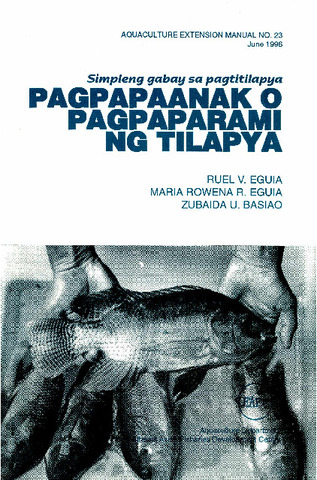
Series: Aquaculture extension manual; No. 23
Pagpapaanak o pagpaparami ng tilapya
; Eguia, Maria Rowena R.; Basiao, Zubaida U. (Aquaculture Department, Southeast Asian Fisheries Development Center, 1996)
The manual discusses spawning tilapia (Oreochromis spp) in concrete tank hatcheries, hapa hatcheries in ponds and in lakes in the Philippines. Also included in the manual are a list of agencies involved in tilapia research, a glossary of technical terms, and useful references. -
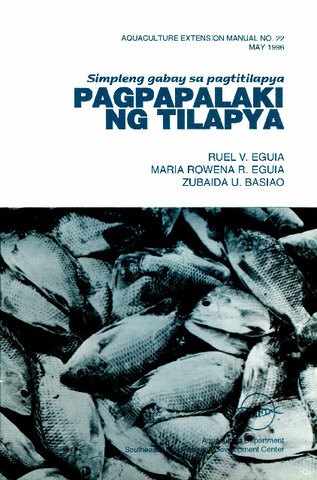
Series: Aquaculture extension manual; No. 22
Pagpapalaki ng tilapya
; Eguia, Maria Rowena R.; (Aquaculture Department, Southeast Asian Fisheries Development Center, 1996)
The manual discusses tilapia culture methods in concrete tanks, netcages, and fishponds. It details the species of tilapia cultured in the Philippines, which include Oreochromis nilotucus, O. mossambicus, O. aureus. It covers the following: site selection; construction of netcages and its modules; fishpond construction and pond preparation; criteria for fry selection; stocking; netcage and pond management including water quality management; and harvest. The manual also lists the agencies involved in tilapia research and development in the Philippines; defines some technical terms in a glossary, and lists some useful references.