SEAFDEC/AQD Institutional Repository: Recent submissions
2821-2840 / 4221
-
Isolation, identification of causative agent of "red boil disease" in grouper (Epinephelus salmoides) and its possible control by vaccination
(Aquaculture Department, Southeast Asian Fisheries Development Center; International Development Research Centre, 1979)This report presents the initial results of studies on the isolation and identification of the causative agent as well as possible immunization of the estuary groupers. It is hoped that by a vaccination programme, fish could be made immune to such disease. Results indicate: (1) Vibrio parahaemolyticus is pathogenic to estuary grouper (2) that the vaccines did not seem to protect the fish against the vibrio when challenged one week after vaccination, but that this was due to slow antibody production of the fish as salmonids challenged about 30-35 days after vaccination reported good protection against Vibrio anguillarum and other bacterial diseases. Experiments are now in progress to challenge the vaccinated groupers at a later stage. -
Fish cage culture in the town of Jambi, Indonesia
(Aquaculture Department, Southeast Asian Fisheries Development Center; International Development Research Centre, 1979)This paper discusses the floating cage fish culture in Jambi, its present status and its constraints to further development. The report is based mainly on interviews with fish farmers. To accelerate further development, a series of research programmes related to floating cage fish culture is recommended. -
Experiments on raising quality fish seed in floating nurseries and its role in aquaculture in India
(Aquaculture Department, Southeast Asian Fisheries Development Center; International Development Research Centre, 1979)Observations on experiments carried out on raising quality fish seed in floating nurseries and raising fish of marketable size in cages at Allahabad are reported. The experiments proved successful in terms of (1) rearing carp spawn to fry stages; (2) rearing carp fry in floating nurseries (cages) in lentic waters to fingerling stage. -
Development of aquaculture in Sierra Leone with a brief reference to oyster culture
(Aquaculture Department, Southeast Asian Fisheries Development Center; International Development Research Centre, 1979)Aquaculture research on oyster culture in Sierra Leone was started in 1974. The purpose of the research was to increase the yield of mangrove oysters and establish a practical and economic system for their cultivation. This paper briefly describes the work actively being pursued in this research project. -
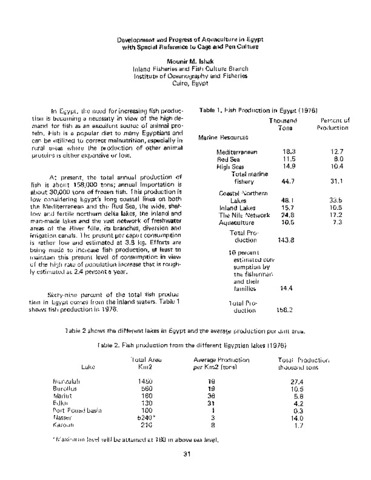
Development and progress of aquaculture in Egypt with special reference to cage and pen culture
(Aquaculture Department, Southeast Asian Fisheries Development Center; International Development Research Centre, 1979)After a brief review of Egypt's present annual production of wild fish, the idea of increasing this production by means of cage and pen culture is discussed, as it would utilize vast aquatic areas of good water quality. A preliminary experiment on cage culture of the carp, Cyprinus carpio is briefly reported. -
Culture of fishes in cages and pens along the coastal waters of India
(Aquaculture Department, Southeast Asian Fisheries Development Center; International Development Research Centre, 1979)The results of culture attempts of milkfish, Chanos chanos, Mugil spp., prawn Penaeus indicus and crab Scylla serrata in enclosures of bamboo splits (thatti), fixed in shallow inshore waters at Tuticorin, are summarized. -
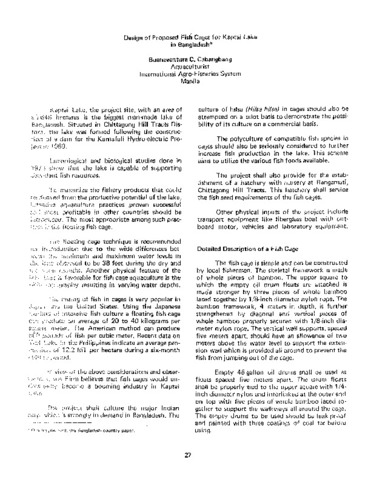
Design of proposed fish cages for Kaptai lake in Bangladesh
(Aquaculture Department, Southeast Asian Fisheries Development Center; International Development Research Centre, 1979)After a brief introduction dealing with the prospects of fish farming in cages in Kaptai Lake (Karnafuli Reservoir), a detailed description of a fish cage, which can be constructed by local fishermen, is given. -
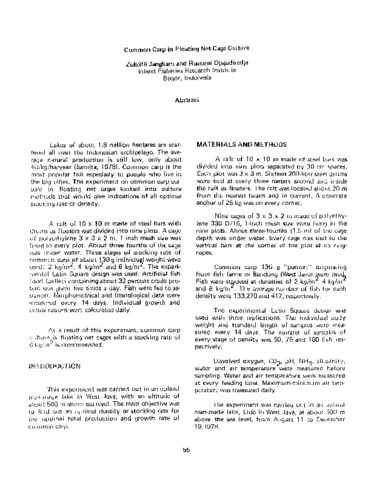
Common carp in floating net cage culture
(Aquaculture Department, Southeast Asian Fisheries Development Center; International Development Research Centre, 1979)The main objective of this experiment was to determine the optimal density or stocking rate for the optimal total production and growth rate of common carp, Cyprinus carpio . A raft of 10 x 10 m made of steel bars with drums as floaters was divided into nine plots. A cage of polyethylene 3 x 3 x 2 m, 1 inch mesh size was hung in every plot. About three fourths of the cage was under water. Three stages of stocking rate of common carp of about 130 g individual weight were used: 2 kg/m2, 4 kg/m2 and 6 kg/m2. The experimental Latin Square design was used. Artificial fish food (pellet) containing about 32 percent crude protein was given five times a day. Fish were fed to satiation. Morphometrical and limnological data were measured every 14 days. Individual growth and actual rations were calculated daily. As a result of this experiment, common carp culture is floating net cages with a stocking rate of 6 kg/m2 is recommended. -
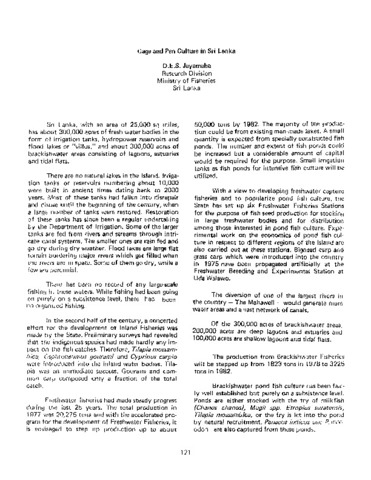
Cage and pen culture in Sri Lanka
(Aquaculture Department, Southeast Asian Fisheries Development Center; International Development Research Centre, 1979)Sri Lanka has about 300,000 acres of fresh water bodies in the form of irrigation tanks, hydropower reservoirs and flood lakes and about 300,000 acres of brackish water areas. This paper briefly describes present aquaculture development and future prospects with regard to pen and cage culture in Sri Lanka. -
Cage culture in Thailand
(Aquaculture Department, Southeast Asian Fisheries Development Center; International Development Research Centre, 1979)This paper briefly describes cage fish culture in Thailand with reference to the design and construction of cages and the species used in cage culture. -
Cage fish culture in Nepal
(Aquaculture Department, Southeast Asian Fisheries Development Center; International Development Research Centre, 1979)This paper describes briefly cage fish culture in Nepal with reference to (1) the construction and design of cages; (2) the species used; (3) cage culture practices and results; (4) the economics of cage culture. -
Cage culture of tilapia in the Philippines
(Aquaculture Department, Southeast Asian Fisheries Development Center; International Development Research Centre, 1979)A brief description of the cage culture of Tilapia is presented. References are made to: (1) the Tilapia species cultured; (2) the design and construction of floating cages; (3) the management and production of cages; (4) the economic analysis of cage culture systems; (5) prospects and problems. -
Aquaculture and prospects of cage and pen culture in Nigeria
(Aquaculture Department, Southeast Asian Fisheries Development Center; International Development Research Centre, 1979)After a brief description of present day acquaculture in Nigeria, the prospects of cage and pen culture are discussed. It is concluded that with the availability of natural rivers, lakes, dams, construction materials, culturable species and ready market for fish, the prospect of cage and pen culture is quite bright in Nigeria. -
A review on the present state of fish cage culture in the Baram District of Sarawak
(Aquaculture Department, Southeast Asian Fisheries Development Center; International Development Research Centre, 1979)The state of the cage culture art in the district is in a very primitive condition, and it is likely to remain so without any significant change within the forseeable future despite its theoretical potential. Before any serious interest in improvements can be generated among the people, a practical and economically viable fish cage operation will have to be demonstrated to them. -
Series: Aquaculture extension manual; No. 16
Diseases of penaeid shrimps in the Philippines
; ; ; Tendencia, Eleonor ; (Aquaculture Department, Southeast Asian Fisheries Development Center, 2000)
The manual provides information on the diseases that affect the 3 major species of shrimps cultured in the Philippines: Penaeus monodon, P. merguiensis and P. indicus. It includes the common name of the disease, causative agent, species affected, stages affected, gross signs, effects on the host and methods of prevention and treatment. This revised edition includes newly discovered diseases. It is hoped that the manual will be of considerable help to shrimp farmers in identifying the disease and lead to prevention or early disease diagnosis and control.
; (Aquaculture Department, Southeast Asian Fisheries Development Center, 2000)
The manual provides information on the diseases that affect the 3 major species of shrimps cultured in the Philippines: Penaeus monodon, P. merguiensis and P. indicus. It includes the common name of the disease, causative agent, species affected, stages affected, gross signs, effects on the host and methods of prevention and treatment. This revised edition includes newly discovered diseases. It is hoped that the manual will be of considerable help to shrimp farmers in identifying the disease and lead to prevention or early disease diagnosis and control. -
Bacterial microbiota of eggs from cage-reared and tank-reared grouper, Epinephelus coioides
Tendencia, Eleonor (European Association of Fish Pathologists, 2004)
At SEAFDEC AQD, opaque spawned grouper eggs are observed during collection in cage-reared brood stock; while opaque and multi-colored eggs are often observed in tank-reared fishes. This study aimed to investigate the occurrence of these opaque and multicolored eggs and at the same time to compare the bacterial microbiota of eggs from brood stock reared in cages, to those from fish reared in concrete tanks. Grouper eggs from brood stocks reared in cages and tanks were processed for bacterial count and identification. Results showed that total bacterial count (on MA) and presumptive Vibrio count (on TCBS) of eggs from brood stock reared in concrete tanks were lower than those from cage-reared fishes. Aeromonads (for tank-reared) and Pseudomonads (for cage-reared) were the dominant bacteria in the good eggs; while Vibrios were dominant in the bad eggs for both egg sources. Total bacterial count of the egg-incubating medium from the brood stock tanks (104 cfu/ml) was lower than the total bacterial count of water from the cages (107 cfu/ml). Presumptive Vibrio counts of water from the tanks (102 cfu/ml) were lower than those from the cages (106 cfu/ml). The Aeromonads dominated the water from the tanks; while Vibrios dominated those from the cages. Good eggs that did not hatch, turned yellow after 3 days, and pink after 5 days. -
Bacterial flora of milkfish, Chanos chanos, eggs and larvae
; Tendencia, Eleonor; ; (Japanese Society of Fish Pathology, 1996)
Aerobic bacterial flora of eggs and larvae of milkfish, Chanos chanos, was investigated. Microflora in the incubating water of egg, rearing water of larvae, water source, and larval food was also analyzed. Aerobic bacterial flora of milkfish eggs was largely influenced by the bacterial flora in the incubating water. Both in eggs and in the incubating water Pseudomonas species were the dominant bacteria. During milkfish larval rearing, intestinal aerobic bacterial flora was examined at days 1, 3, 7, 10, 15, 18, and 21. Bacterial number in the larvae and rearing water significantly increased during the culture period up to day 18 but dropped significant at day 21. Pseudomonas species were detected from yolk-sac larvae (day 1) as the dominant bacteria, similarly to the normal flora in the rearing water. However, intestinal bacteria were predominated with Vibrio species when the yolk-sac was absorbed on day 3. Larval rearing water, water source, and larval food contained predominantly Pseudomonas species. -
Effect of rainfall and atmospheric temperature on the prevalence of the whitespot syndrome virus in pond-cultured Penaeus monodon
Tendencia, Eleonor; ; ; (Blackwell Publishing, 2010)
-
Iodine disinfection of grouper Epinephelus coioides eggs
Tendencia, Eleonor (European Association of Fish Pathologists, 2003)
In this study, the developmental stage, iodine concentration and exposure time that will reduce the bacterial load without decreasing the hatching rate for the disinfection of grouper (Epinephelus coioides) egg were established. Results of the study showed that the best stage to disinfect grouper egg is at late neurula stage where the embryo shows twitching movement. The effective and safe concentration that will reduce bacterial load but will not decrease hatching rate for the disinfection of grouper egg is 7.5 ppm free iodine for 10 min. Total bacterial count of eggs disinfected with 7.5 ppm free iodine for 10 min (8.99 x 10² cfu/20 eggs) is significantly lower than the unrinsed/undisinfected eggs (1.99 x 10⁷ cfu/20 eggs). -
Series: Aquaculture extension manual; No. 15 | NACA technology series; No. 5
An improved traditional shrimp culture technique for increasing pond yield
(Network of Aquaculture Centres in Asia, 1986)Details are given of the technology required for an improved method of extensive shrimp (Penaeus monodon) culture, describing the following: grow out facilities, seed supply, pond preparation and management, harvesting and yield. A financial analysis is also included.