SEAFDEC/AQD Institutional Repository: Recent submissions
3501-3520 / 4221
-
Some limnological features of the northern shore areas of Volcano Island, Lake Taal
(Aquaculture Department, Southeast Asian Fisheries Development Center; Philippine Council for Aquatic and Marine Research and Development (PCAMRD), Department of Science and Technology; Bureau of Fisheries and Aquatic Resources, 2001)Physico-chemical and biological features of the northern shore areas of Volcano Island, Lake Taal observed at monthly intervals from four stations during the period 1994 and 1996 indicate varied microhabitats inhabited by a variety of plants and animals. Physico-chemical characteristics of surface waters were: temperature, 28-35°C; dissolved oxygen content, 3.5-6.2 ppm; pH, 7.5-8.9; salinity, 0-24 ppt; and conductivity, 1.6-4.3 S cm-1. Substratum types were mainly sandy with pebbles or rocks or sandy-muddy. Characteristic submerged plants were the eelgrass Vallisneria gigantea and filamentous green algae. In the eelgrass region, atyid shrimps, mostly Ciridina gracilirostris, commonly occur. Snails such as Melanoides costellaris and Terebia granifera were the most abundant benthic animals collected. Other invertebrates identified from core samples were Corbicula manilensis, annelids, crustaceans and chironomid larvae. -
Mechanisms for lake formation in the Philippine archipelago
(Aquaculture Department, Southeast Asian Fisheries Development Center; Philippine Council for Aquatic and Marine Research and Development (PCAMRD), Department of Science and Technology; Bureau of Fisheries and Aquatic Resources, 2001)Topographic depressions, which when filled with water become lakes, can originate in a number of ways as a result of volcanic processes and activities, crustal and fault movements, stream processes, dissolution of rocks, downslope or mass movements, shoreline processes, glaciation, acolian processes, organic or animal activity and meteorite impacts. Man has also made both intentionally and unintentionally artificial depressions and dams that give rise to man-made lakes. But the mechanisms of formation of most Philippine lakes remain unknown although those of some are well established. Examples are cited in this paper. Lakes with similar mechanisms of formation may possess similar geomorphological, geological, and physico-chemical characteristics. Directions for Philippine lacustrine research should cover issues on 1) the still unknown origin of most Philippine lakes, 2) assessment of lake-related hazards and risk mitigation in order to reduce disasters, 3) history of climate change as recorded in lacustrine sediments, and 4) policies and strategies for better utilization and development of lake resources which must recognize the truth that lakes are but ephemeral features of the landscape and do not last forever. -
Assessment of local government's implementation of open access policy in Taal Lake, Philippines: Effects on lake conservation and management
(Aquaculture Department, Southeast Asian Fisheries Development Center; Philippine Council for Aquatic and Marine Research and Development (PCAMRD), Department of Science and Technology; Bureau of Fisheries and Aquatic Resources, 2001)The effects of local government's implementation of the current national policy on open access in municipal fisheries are assessed in terms of their impact on the fishery resources of Taal Lake. Local officials and fisherfolk were interviewed and their responses were analyzed for trends in perceptions on how local open access policies affect fishing practices and productivity in the lake. A policy matrix containing certain areas of concern of local governments related to sound decisionmaking on lake fishery was designed. The study shows that local government implementation of open access policy in Taal Lake tends to have negative effects on the lake's fisheries. Open access allows for the unregulated entry of fishing practices like fish cage culture which tend to increase the pollution load in the lake. Pollution due to fish farming in cages seems to even exceed loads from domestic wastes and agricultural runoff. While fish cages flourished in the lake, the income of small fisher folk has declined because of dwindling catch from capture fisheries. It is recommended that national government agencies (e.g., Department of Agriculture, Bureau of Fisheries and Aquatic Resources, Department of Environment and Natural Resources) should forge an agreement with local government units for a continuing assessment of the fishery resources in Taal. This needs to be coupled with technical assistance to undertake sustained efforts to improve the conservation, productivity and management of the lake's aquatic resources. There is also a need to increase the budgetary allocations for new research and extension activities to address problems and issues of the fishery sector in the lake and for upgrading the capability of local and sectoral policy and decision makers on the lake's fisheries. -
Stock assessment of commercially important fishes in Naujan Lake
(Aquaculture Department, Southeast Asian Fisheries Development Center; Philippine Council for Aquatic and Marine Research and Development (PCAMRD), Department of Science and Technology; Bureau of Fisheries and Aquatic Resources, 2001)The study aimed to assess the capture fisheries of Naujan Lake with emphasis on commercially important fish species and to determine the extent of their exploitation. Four major fish landing centers in the municipalities of Socorro, Pola, Victoria and Naujan were surveyed from May 1995 to December 1996. Eight types of fishing gear had been recorded. The most commonly used was gill net or 'pante', followed by fish pot 'bubo', fish corral 'baklad', spear 'salapang', spear gun 'pana', fish trap 'patanga', encircling net 'takilis' and long line 'kitay'. Tilapia comprised 61% of the total fish production of the lake, followed by therapon (16%), goby (4%) and mudfish (2%). The other species caught were 'pla salid', catfish, mullet, carp, milkfish and shrimp, which contributed 17% to the total production. Migratory fishes like the mullet and milkfish, on the other hand, showed a declining trend in production. -
Fish culture in cages in Lake Danao, Cebu
(Aquaculture Department, Southeast Asian Fisheries Development Center; Philippine Council for Aquatic and Marine Research and Development (PCAMRD), Department of Science and Technology; Bureau of Fisheries and Aquatic Resources, 2001)Lake Danao is a picturesque inland body of water having an area of 685 ha located in the municipality of San Francisco in Pacijan Island, Camotes, Cebu. At the middle of the lake is a circular islet with an area of one acre. This lake is a potential area for cultivation of fishes in pens and cages. To date there are only two agencies which use the lake for fish production, namely; the Department of Agriculture Regional Office No 7 Carmen-Lake Danao Fishery Complex Research Outreach Station and the CSCST-Fishery and Industrial College, San Francisco, Cebu. The following are the ranges of selected water quality parameters: salinity, 0-0.5 ppt; water temperature, 27-29 °C; pH, 8.5-9. The lake has no definite inlet and outlet of water and is free from pollutants. The water is clear with assorted vegetation. The soil is coarse, silty and sandy. The present study has shown the feasibility of growing tilapia in cages in Lake Danao. -
Translocation of the clupeid Sardinella tawilis to another lake in the Philippines: A proposal and ecological considerations
(Aquaculture Department, Southeast Asian Fisheries Development Center; Philippine Council for Aquatic and Marine Research and Development (PCAMRD), Department of Science and Technology; Bureau of Fisheries and Aquatic Resources, 2001)The dwindling commercial catch of Sardinella tawilis (Clupeidae), locally known as 'tawilis', reported in recent years by local fisher folk in Lake Taal, Batangas, Philippines, could be a result of the interaction of factors such as over fishing, destructive fish-capture techniques, changes in water quality, and others. Like the rest of the handful of endemic freshwater fish species in the Philippines, S. tawilis is threatened with depletion of its stocks, if not with extinction in the near future. A conservation strategy that could be considered is the translocation of 'tawilis' to another lake in the Philippines, whose ecological features closely resemble those of Lake Taal and where 'tawilis' would receive socio-economic and cultural acceptability. Cases of clupeid introductions - natural and man-made, successes and failures - are presented from published literature. Special attention is given to the case of a well-planned trans-country (Thailand-to-Indonesia) attempt to introduce a clupeid fish. The broader questions of biodiversity, endemicity, conservation, and fish community structure in Lake Taal (and elsewhere) must be underpinned by sound basic taxonomy and ecology. -
The status of tilapia aquaculture in Lake Sebu, South Cotabato
(Aquaculture Department, Southeast Asian Fisheries Development Center; Philippine Council for Aquatic and Marine Research and Development (PCAMRD), Department of Science and Technology; Bureau of Fisheries and Aquatic Resources, 2001)Tilapia culture in Lake Sebu started in the early 1970's and is now considered the backbone of the economy and major driving force of the development of the Municipality of Lake Sebu. About 19% of Lake Sebu's 354 ha water area is used for aquaculture. The present tilapia production system is not as intensive as in other lakes in the country. The daily 3-ton tilapia harvest is marketed in the different towns within the province and in neighboring provinces. Municipal Ordinance 01, Series of 1994 regulates fish cage establishment within the lake. The local government unit launched a semi-annual 'Oplan Linis', a clean up operation to remove floating debris, water hyacinth, and other vegetation along the lakeshore. Reforestation has been implemented as part of the watershed management program. For centralized marketing and effective collection of revenues, a fish port was opened in January 1997. The tilapia industry in Lake Sebu is now confronted with several setbacks. Poor-quality seeds require a longer culture period and, despite higher inputs, still result in low production. Fish kills, locally termed 'kamahong', are becoming more frequent and devastating. Market competition is another problem. Producers of intensively fed tilapia from Lake Sebu have to contend with a large volume of unfed and low priced tilapia from Lake Buluan (Lutayan area). -
Managing 'sinirapan' Mistichthys luzonensis Smith in Lake Buhi, Camarines Sur: Insights from its biology and population dynamics
(Aquaculture Department, Southeast Asian Fisheries Development Center; Philippine Council for Aquatic and Marine Research and Development (PCAMRD), Department of Science and Technology; Bureau of Fisheries and Aquatic Resources, 2001)The population dynamics and related aspects of the biology of 'sinarapan' Mistichthys luzonensis Smith, the world's smallest commercial fish, are used as basis in formulating management strategies for this goby in Lake Buhi, Camarines Sur. Mesh size limit (4.1mm) and catch limit, estimated through length-based analytic fishery methods, are proposed. Yield-per-recruit analysis using length-frequency data for 11 months provided the quantitative indices used in estimating fishing limits. Closed season for 'sinarapan' was established from temporal pattern of recruitment and the reproductive biology of the species. Much of the data on 'sinarapan' came from studies in Lake Manapao. To improve the recruitment success of 'sinarapan', a habitat enhancement scheme in Lake Buhi is hereby recommended. -
Parasitic crustaceans in fishes from some Philippine Lakes
(Aquaculture Department, Southeast Asian Fisheries Development Center; Philippine Council for Aquatic and Marine Research and Development (PCAMRD), Department of Science and Technology; Bureau of Fisheries and Aquatic Resources, 2001)Parasitic crustaceans are among the most harmful parasites of fishes. Certain species cause disease outbreaks and mortalities in aquaculture, facilities, and sometimes in natural systems, resulting in serious economic losses. Edible fishes from some Philippine lakes also show infestation by parasitic crustaceans. The branchiuran, Argulus indicus Weber, and the copepod, Lernaea cyprinacea Linnaeus, were recovered from the skin and base of the dorsal fin, respectively, of the mudfish Channa striata from Laguna de Bay. L. cyprinacea was also found on the white goby Glossogobius giurus in Naujan Lake. In La Mesa Reservoir, the gills of wild populations of tilapias Oreochromis niloticus and Tilapia zillii, white goby, and silvery theraponid Therapon plumbeus were infected with the copepod, Ergasilus philippinensis Velasquez. An isopod, Alitropus typus Edwards, was recovered from the buccal and gill cavities of several fishes from Lake Taal, namely; the mud gudgeon Ophiocara aporos, cardinal fish Apogon thermalis, silvery theraponid, and cage cultured Oreochromis niloticus. Previous reports and above finding indicate wide host specificity of the parasites. Of these four parasites, only Ergasilus philippinensis has not been reported to cause mass mortality in cultured fishes. Measures should be undertaken to prevent their introduction to other water bodies in which they do not yet occur. -
Bathymetry and hydrobiology of Lake Mahagnao, Leyte
(Aquaculture Department, Southeast Asian Fisheries Development Center; Philippine Council for Aquatic and Marine Research and Development (PCAMRD), Department of Science and Technology; Bureau of Fisheries and Aquatic Resources, 2001)Lake Mahagnao in Burauen, Leyte (10° 52.15' N and 124° 51.32' E) lies 26 m above sea level. It is surrounded by a mountain range that includes a dormant twin volcano. A bathymetric survey established 122 sampling stations using Global Positioning System. The stations formed transect lines across the lake. A bathymetric map of Lake Mahagnao was generated with the use of the SURFER software. Lake Mahagnao has a shoreline of 15,590 m and surface area of 15.75 ha. The deepest portion of the lake is 18.75 m. The mean pH of the water is 6.58; water surface temperature, 27oC; and water visibility, 1.64 m. Eighty-one species were identified as primary producers. Station 5, the deepest portion of the lake, had the highest phytoplankton density at 4,716 cells/ml and Station 2 had only 634 cells/ml. Cyanobacteria were the most abundant in all the sampling stations. -
Zooplankton diversity in Philippine Lakes
(Aquaculture Department, Southeast Asian Fisheries Development Center; Philippine Council for Aquatic and Marine Research and Development (PCAMRD), Department of Science and Technology; Bureau of Fisheries and Aquatic Resources, 2001)Sustainable fisheries development partly depends on the availability of adequate zooplankton as principal food items of early life history stages of economically important fish species as well as of the adults of some species such as clupeids (e.g., Sardinella tawilis of Lake Taal in Batangas). The broad characteristics of the composition of freshwater zooplankton (Rotifera, Cladocera and Copepoda) of natural and man-made lakes in the Philippines are compared with those of the Oriental Region, in particular, and other tropical regions, in general. Two species of calanoid copepods are endemic, a somewhat remarkable occurrence considering that calanoids are represented by only five known species in the Philippines and absent in many large tropical lakes. Daphnia, which almost invariably influences food-web interactions and structures of plankton communities in temperate lakes, still has to be recorded. -
Sustainable development of Philippine lake resources: An agenda for research and development
(Aquaculture Department, Southeast Asian Fisheries Development Center; Philippine Council for Aquatic and Marine Research and Development (PCAMRD), Department of Science and Technology; Bureau of Fisheries and Aquatic Resources, 2001)There are 59-70 lakes in the Philippines. With the exception of Laguna de Bay and Lake Taal, little is known about Philippine lakes although they contribute as much as 15% to the total annual fisheries production of the country. There is need for an integrated basin approach for the sustainable management of Philippine lake resources. Among the research strategies recommended for sustainable management of Philippine lakes are: (1) studies on lake fisheries resources - fish stock assessment, effects of fishing and other human activities on lake productivity, the biology of major aquatic species, and the carrying capacity of lakes; and (2) lake management studies - the rational use of lakes, strengthening management, enforcement and institutional mechanisms, and socio-economics focused on the users of lakes. -
Lake Lanao: Its past and present status
(Aquaculture Department, Southeast Asian Fisheries Development Center; Philippine Council for Aquatic and Marine Research and Development (PCAMRD), Department of Science and Technology; Bureau of Fisheries and Aquatic Resources, 2001)Geographically located in Central Mindanao, Lake Lanao is the second largest lake in the Philippines. The lake is famous locally for its various uses and internationally for its endemic cyprinids. This paper intends to inform the local leaders and the national planners about Lake Lanao's dwindling fisheries resources, the extinction of some endemic cyprinids, and the current interventions as well as suggested action plans to increase fish production and to conserve the remaining species in the lake. The past and present studies on the lake are also reviewed. Early and latest statistics on the lake's fisheries production are presented to invite the interest of all sectors in coming up with the integrated approach to protect, conserve and increase its fisheries production. Local and national interventions to conserve and increase fisheries production are discussed. These include the setting up of BFAR Fisheries Station in Kialdan, Marantao; the establishment of a fish hatchery in Poona, Marantao by Southern Philippines Development Authority; the formation of Save Lake Lanao Movement by the local leaders; the creation of Lake Lanao Research and Development Council; the current concern of Philippine Council for Aquatic and Marine Research and Development-DOST; and the extension and research and development thrusts of the Mindanao State University, College of Fisheries in Marawi City. -
Aquaculture practices and their impact on Philippine Lakes
(Aquaculture Department, Southeast Asian Fisheries Development Center; Philippine Council for Aquatic and Marine Research and Development (PCAMRD), Department of Science and Technology; Bureau of Fisheries and Aquatic Resources, 2001)The rapid progress and development in the aquaculture sector during the past years has made an important contribution to the overall fish production in the Philippines. In 1996, 35.4% of the total fish production or 980,857 mt came from the aquaculture sector. Although milkfish from brackishwater ponds comprise the bulk of the produce, tilapia production from freshwater aquaculture in lakes, ponds and reservoirs is increasing annually. Fish cages and fish pens proliferate in most inland waters. The operation of such structures as livelihood for the coastal inhabitants has been recognized as a profitable venture. Many have gone into tilapia culture in ponds and small experimental cages in lakes and reservoirs in the 1980's. The success of tilapia culture in cages in the Bicol Region and Magat Dam in Isabela triggered the interest of other enterprising businessmen to expand the practice to other inland waters. However, problems of mass fish kill caused by deteriorating water quality have been reported. There is a need to strictly regulate the aquaculture practices; otherwise, more problems in the aquatic environment will be encountered. As freshwater aquaculture production is intensified, negative impact on the environment is also magnified. Under the Local Government Code, the management of inland waters is within the jurisdiction of the local government units with the assistance of the national government. For the proper management and sustainable use of inland water resources, this paper highlights the positive and negative impact of aquaculture practices on the aquatic environment. -
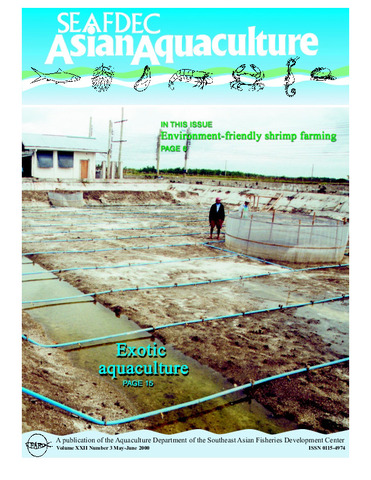
SEAFDEC Asian Aquaculture Volume 22(3) May - June 2000
(Aquaculture Department, Southeast Asian Fisheries Development Center, 2000)Surtida, Marilyn B. -
SEAFDEC Asian Aquaculture Volume 22(6) November - December 2000
(Aquaculture Department, Southeast Asian Fisheries Development Center, 2000)Surtida, Marilyn B. -
SEAFDEC Asian Aquaculture Volume 22(5) September - October 2000
(Aquaculture Department, Southeast Asian Fisheries Development Center, 2000)Surtida, Marilyn B. -
SEAFDEC Asian Aquaculture Volume 23(1-2) January - April 2001
(Aquaculture Department, Southeast Asian Fisheries Development Center, 2001) -
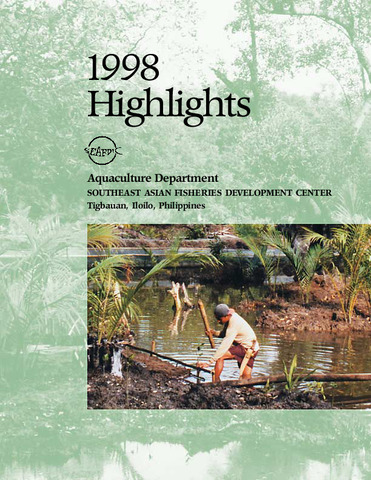
1998 highlights
(Aquaculture Department, Southeast Asian Fisheries Development Center, 1999)The SEAFDEC Aquaculture Department is mandated to: 1) promote and undertake aquaculture research relevant and appropriate for the region; 2) develop human resources for the region; and, 3) disseminate and exchange information on aquaculture. The document provides highlights of activities of the Department during the year 1998. -
1999 highlights
(Aquaculture Department, Southeast Asian Fisheries Development Center, 2000)AQD continued to pursue its considerable research efforts into mudcrab, tiger shrimp, milkfish, grouper and snapper, tilapia and bighead carp, marine ornamental fishes, seaweeds, and abalone. The seed production and grow-out ...