SEAFDEC/AQD Institutional Repository: Recent submissions
3921-3940 / 4221
-
The hematological changes in snakehead (Ophicephalus striatus) affected by epizootic ulcerative syndrome
(Asian Fisheries Society, 1994)Selected hematological parameters were studied in snakehead from Laguna de Bay (Philippines) affected with different stages of epizootic ulcerative syndrome (EUS). For comparison, normal (from a non-endemic area) and apparently normal fish were also studied. The hematocrit values of normal and apparently normal fish, 45.04 ± 0.71 and 47.20 ± 1.03%, respectively, were significantly higher (P<0.05) than severely affected fish (29.30 ± 2.34%). The same trend was observed for serum protein (7.09 ± 0.11 and 6.35 ± 0.27 g/100 ml for normal and apparently normal fish, respectively, against 4.68 ± 0.42 g/100 ml for severely affected fish) and hemoglobin (9.80 ± 0.26 and 9.70 ± 0.26 g/100 ml against 4.67 ± 0.42 g/100 ml) concentrations. The granulocyte counts of normal and apparently normal fish, 26.2 and 60.3, respectively were significantly lower than severely affected fish (210.0). This general hemodilution could be attributed to loss of body fluids and depression of hematopoietic tissues in the spleen and kidney. -
Studies on the nursery rearing of seabass, Lates calcarifer (Bloch) fry in illuminated floating net cages
(Ministry of Agriculture and Water; King Abdulaziz City for Science and Technology; Riyadh Chamber of Commerce and Industry, 1994)The feasibility of rearing seabass, Lates calcarifer, fry for fingerling production in illuminated floating nursery cages was determined. In experiment 1, seabass fry of 20.0 mm mean TL were stocked at 600 and 1200 in 1 m3 illuminated cages and reared without supplemental feeding. Control fish were stocked at same densities in non-illuminated cages and fed minced trash fish. After 42 days, fish held in illuminated cages at either density had higher specific growth rates (SGR) and percent survival (20-38%) than those of fish reared in non-illuminated cages. Mean number of zooplankton trapped inside the illuminated cages was significantly higher than those found in the non-illuminated cages which was dominated by Copepods such as the Calanoid, Cyclopoid and Harpacticoid and their nauplii. In experiment 2, minimum body size of seabass fry at stocking in illuminated cages was determined. Seabass fry of 7.35, 11.30, 18.73 and 20.71 mm total length (TL) were stocked at three replicates in illuminated cages and reared for 30 days. Percent survival was significantly higher for fish stocked at an initial size of 11.30 mm TL than the other size groups. Number of “shooters” (range = 6-9%) was significantly higher among fish with initial size of 7.35 mm and 20.71 mm than in other groups. SGR of 8.28%/day was highest for fish with mean stocking size of 7.35 mm TL. Feeding incidence (FI) ranging from 13.16 ± 6.7% to 54.9 ± 4.2% was similar for all size groups during the first week of rearing and significantly increased towards the end of rearing period except for fish stocked at 7.35 mm initial TL. Results showed that nursery rearing seabass fry in illuminated cages is feasible. Natural zooplankton were attracted into the cages by artificial illumination sufficiently served as food to fish. Minimum stocking size of seabass fry is from 10-15 mm TL for better survival. Early transfer of fry in nursery cages and availability of natural zooplankton through artificial illumination can be a cost-effective method of nursing seabass fry. -
Agar from Gracilariopsis heteroclada from Panay Island, Philippines
(Philippine Council for Aquatic and Marine Research and Development, 1994)This paper aims to determine the optimum NaOH pretreatment strength and duration and also the monthly variations in gel strength, agar yield and sulfate content of agar from Gracilariopsis heteroclada (Zhang et Xia) Zhang et Xia. Samples collected from Leganes, Iloilo, Philippines were pretreated with NaOH at different strengths (1,3 and 5%) and duration (30 min and 60 min) at 85-90°C. Agar extractions were done by the method of Nelson et al. (1983) Agar yield was calculated based on Santos (1980). Gel strength and sulfate content were determined using the methods of Aguilar-Santos and Doty (1978) and Jackson and McCandless (1978), respectively. Agar gelling and melting temperatures were analyzed in triplicate (Whyte and Englar, 1976). Viscosity in cps, moisture and ash contents in per percent, were determined using standard methods. Analysis of variance and Duncan’s multiple range test were used to compare the gel strength for the NaOH pretreatment experiment and the different monthly samples. Correlation analysis was carried out to determine the relationship between the different parameters analyzed. Highest gel strength (641 gm cm-2 ) and lowest sulfate content (7.66 gm/mg SO4) were obtained following alkaline pre-treatment with 5% NaOH for 30 min with agar yield of 32.4 per cent. Gelling and melting temperatures of agar with the highest gel strength were 40°C and 80°C, respectively, while specific viscosity, moisture and ash contents were 7.5 cps, 12.2% and 4.32%, respectively. Agar yield was negatively correlated with NaOH pre-treatment (P<0.05). Sulfate content was negatively correlated with gel strength (P<0.05). Gel strength, agar yield and sulfate content showed monthly variation. Sulfate was highly correlated with gel strength (P<0.05). Agar yield was positively correlated with month, while it is negatively correlated with gel strength (P<0.05). The results showed that agar from Gracilariopsis heteroclada has a very good potential for use as raw material for the production of food, drug and industrial grades of agar because of its superior gel strength. -
Response of Penaeus monodon juveniles to aflatoxin B1 dietary contamination
(Asian Fisheries Society, 1994) -
Leaf meals as protein sources in diets for milkfish Chanos chanos (Forsskal)
(Asian Fisheries Society, 1994)The protencial of partial replacement of fish meal protein with protein indigenous leaf meals in practical diets for milkfish, Chanos chanos (Forsskal) was studied. Five isocaloric (375 kcal/100 g diet), isonitrogenous (40% protein), and isolipidic (10%) diets were formulated to contain leaf meals from either swamp cabbage (kangkong, Ipomea reptans), sweet potato (kamote, Ipomea batatas), ipil-ipil (Leucaena leucocephala), and cassava (kamorng kahoy, Manihot esculenta), or a combination of swamp cabbage, sweet potato and cassava. The control diet contained fish meal and soybean meal as sources of protein while thw test diets contained fish meal, soybean meal, and leaf meals erplacing 15% of the fish meal protein. The protein sources were incorporated in levels that gives optimal essential amino acid patterns to the diets. Each diet was fed to reiplcate groups of fish (about 0.3 g) maintained at 20 ppt salinity and 29oC in a recirculating system for twelve weeks. Growth, feed conversion ratio (FCR), protein efficiency ratio (PER), and survival of fish fed the diet contaning cassava leaf meal showed the best groth FCR, PER and survival. the data sugest that these leaf meals can be used to partially replace fish meal in a diet for juvenile milkfish if the requirments for essential amino acids are met. -
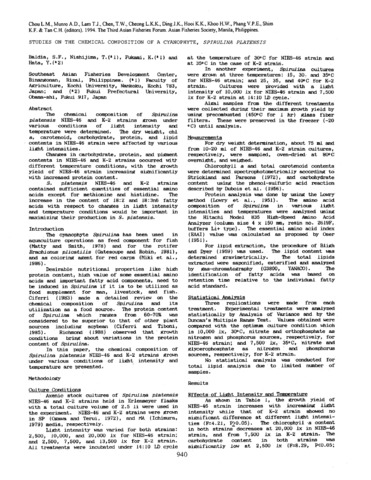
Studies on the chemical composition of a cyanophyte, Spirulina platensis
(Asian Fisheries Society, 1994)The chemical composition of Spirulina platensis NIES-46 and K-2 strains grown under varios condition of hight intensity and temperature were determined. The dry weight, chla, carotenoid, carbohydrate, protein, and lipid content in INES-46 strain were affected by various light intensities. Changes in carbohydrate, protein, and pigment content in INES-46 and K-2 strains occurred with different temperature condition, with the growth yield of NIES-46 strain increasing significantly with increased protein content. S. platensis NIES-46 and K2 strains contained sufficient quantities of essential amino acid except for methionine and histidine. The increase in the content of 18:2 and 18:2n6 fatty acids with respect to changes in light intensity and temperature would be important in maximizing their in S. platensis. -
The role of women in aquaculture in the Philippines: obstacles and future options
(Gender and Development Studies, School of Environment Resources and Development, Asian Institute of Technology, 2001) -
Problems encountered in the implementation of a community-based fishery resources management project
(International Center for Living Aquatic Resources Management, 1994)The article highlights the SEAFDEC Aquaculture Department's (Philippines) Community-based Fishery Resource Management Project activities. Several problems encountered in project implementation and the suggested ways in dealing these problems are also presented. -
Review of social and economic research in the fishery sector of the Philippines: a country paper
(Asian Fisheries Society, 1994)The problems confronting the fishery sector have received varying degree of attention from the government sector over time. In the past two decades the main thrust was to increase productivity through technology generation. In the late 1980s, however, the worsening problem of inequity in fisheries shifted the concern to the socioeconomic issues of sustainability and equity. This reorientation in emphasis is largely attributable to the contribution of social scientists. The study reviews completed and ongoing socioeconomic research in the fishery sector. This relates the focus of the studies in the sector. Research gaps and researchable areas were determined to identify future research directions. Moreover, this review aims to find out whether social scientists have responded to the needs and urgent issues of the sector. -
Fish health research at SEAFDEC/AQD
(Aquaculture Department, Southeast Asian Fisheries Development Center, 1993)Fish pathology as a discipline was of relatively minor importance in the early years of SEAFDEC/AQD because technologies for producing aquaculture commodities were still being developed and high-density fish rearing activities were minimal. With fast adaptation of technologies developed locally and elsewhere and their modification to suit industry needs, disease problems started to occur. Disease develops through the interaction of three important factors: the host, the pathogen or disease agent, and the environment. In most high-density aquaculture rearing units, the environment exerts pressure on the host and favors the pathogen. When the host's defenses are overwhelmed, a disease condition is created which may result in death. Mortalities are often equated to economic losses, and research in fish diseases then becomes significant. Research has the ultimate aim of preventing disease occurrence. -
Training and information activities and accomplishments of the SEAFDEC Aquaculture Department, 1988-1991
(Aquaculture Department, Southeast Asian Fisheries Development Center, 1993)One of the mandates of the SEAFDEC Aquaculture Department is the development of human resources and dissemination and exchange of information in aquaculture to promote the aquaculture industry in Southeast Asia. The Department receives trainees from SEAFDEC Member Countries (Thailand, Malaysia, Singapore) and other countries for short-term training programs. AQD also disseminates and exchanges information on aquaculture research and technology through symposia, seminars, workshops, video programs, and publications. -
Research on nutrition and feed development at SEAFDEC/AQD
(Aquaculture Department, Southeast Asian Fisheries Development Center, 1993)The Feed Development Section at SEAFDEC/AQD conducts research on the nutritional requirements and the development of costeffective practical diets for regionally important fishes (milkfish, tilapia, carp, and sea bass) and shrimp (Penaeus monodon). Macronutrient requirements for protein, lipid, carbohydrate, energy, and optimum dietary protein to energy ratio have been defined. Essential fatty acids required by each species have been identified. Requirement levels for the ten essential amino acids in milkfish and tilapia have been established. In shrimp, requirements for other essential nutrients like phospholipid and cholesterol are known. Dietary calcium and phosphorous requirements of shrimp have been determined. Requirement for water-soluble vitamins and bioavailability of stable forms of vitamin C are being evaluated. However, much work remains to be done on the vitamin and mineral requirements of cultured species. The major digestive enzymes, proteases, carbohydrases, and lipases in milkfish have been studied. Further, the apparent digestibility of commonly used feedstuffs were determined in-vivo and in-vitro for milkfish, and presently, for shrimp and sea bass. In diet development, the formulation of supplemental grow-out feeds from inexpensive indigenous materials has been emphasized. Likewise, artificial diets for larvae and broodstock are being developed. Effects of feed additives like chemo-attractants and antioxidants were studied. In addition, studies on feed and feedstuff quality control and application of proper processing techniques are being pursued. At present, there are supplemental grow-out diets for the fishes that are commercially viable. Diets for all life stages (grow-out, larval, and broodstock) of shrimp are available. Improvement of these diets will continue as more information on the nutrient requirements are known. -
Shrimp seed production at SEAFDEC/AQD
(Aquaculture Department, Southeast Asian Fisheries Development Center, 1993)Broodstock management and seed production techniques have evolved from laboratory and verification tests that are conducted to increase survival and growth rates of cultured fish species. The present methods of induced maturation and hatchery rearing of shrimp (Penaeus monodon) used at the SEAFDEC Aquaculture Department are examples. -
Marine fish broodstock development at SEAFDEC/AQD: status and advances
Garcia, Luis Maria (Aquaculture Department, Southeast Asian Fisheries Development Center, 1993)
The success of a fish culture operation depends, in part, on adequate supply of seed for hatchery and grow-out. The culture and husbandry of many of Southeast Asia's marine fish species are constrained by the unreliability of seed supply which are seasonally gathered from coastal areas. To augment the natural seed supply and decrease the dependence on wild catch, SEAFDEC/AQD has undertaken studies to develop a captive source of breeders for some of the economically important marine fish species in the region. This paper presents a brief update of the status and recent advances in marine fish broodstock development undertaken by SEAFDEC/AQD.
(Aquaculture Department, Southeast Asian Fisheries Development Center, 1993)
The success of a fish culture operation depends, in part, on adequate supply of seed for hatchery and grow-out. The culture and husbandry of many of Southeast Asia's marine fish species are constrained by the unreliability of seed supply which are seasonally gathered from coastal areas. To augment the natural seed supply and decrease the dependence on wild catch, SEAFDEC/AQD has undertaken studies to develop a captive source of breeders for some of the economically important marine fish species in the region. This paper presents a brief update of the status and recent advances in marine fish broodstock development undertaken by SEAFDEC/AQD. -
The environmental effects of aquaculture with emphasis on the intensive prawn farming in the Philippines.
Primavera, Jurgenne (The Economic Society of Thailand, 1993)
-
Hormonal, environmental, and dietary manipulation of milkfish broodstock to enhance egg production
(International Foundation for Science, 1993)The insufficient supply of milkfis fry severely limits the expanion of milkfish aquaculture. While natural spamning and hatchery production of milkfish fry have been attained recently, there is sitll a need to incease egg production from available broodstock. A number of studies geared towards this concern are currently conducted at SEAFDEC Aquaculture Department with moderate success. Chronic administration of estradiol-17B and 17A-hydroxy-progesterone to femaleand male milkfish broodstock increased maturation and rematuration rates. Milkfish kept under constant long phtoperiod (16L:8D) appeared to have prolonged gonadal development than thoes of milkfish reared under long to normal to short photoperiod. Ffrmulated diet containing 6% liquid that is feed to milkfish broodstock at a daily ration 4% of total body weight appeared sufficient for maintaning sexual maturation andspawning. Refinements in these areas canensure a better management technique that can provide maximum number of good quality eggs required by hatcheries. -
Metabolism of cysteine to taurine by rat hepatocytes.
(Plenum Press, 1992)During the past two decades, many investigators have assumed that the major locus of regulation of cysteine catabolism is the partitioning of cysteinesulfinate between its decarboxylation and transamination pathways. Hepatic cysteinesulfinate decarboxylase activity correlates well with the capacity of animals to synthesize taurine1–4, and low cysteinesulfinate decarboxylase activity in the cat has been associated with its nutritional requirement for dietary taurine5. More recent studies in our laboratory have indicated that cysteinesulfinate-independent pathways also play a major role in cysteine metabolism6,7. In contrast to cysteinesulfinate-dependent metabolism of cysteine, which leads to both taurine and sulfate production, the cysteinesulfinate-independent pathways all result in release of reduced inorganic sulfur and its subsequent oxidation to sulfate. This evidence revealing a contribution of cysteinesulfinate-independent pathways to cysteine catabolism suggested that partitioning of cysteine between cysteinesulfinate formation and metabolism by cysteinesulfinate-independent pathways may also be important in the regulation of cysteine metabolism to taurine. -
Larviculture of marine fishes at SEAFDEC/AQD
(Aquaculture Department, Southeast Asian Fisheries Development Center, 1993)The recent glut in the world market for shrimp dealt a heavy blow to the aquaculture industry. It is thus apparent that fish farmers should not depend on only a single species for culture. The popularity and market demand for grouper, sea bass, and snapper make them obvious choices as alternative culture species. On the other hand, milkfish and rabbitfish are cheaper sources of protein and they already contribute substantially to fish production from aquaculture--56.2% from milkfish for example (Rabanal 1988). However, culture and production of marine fishes are hindered by the unpredictable and seasonal seed supply. Research on larviculture at SEAFDEC/AQD are geared towards hatchery production of fry to augment supply from the wild. -
Pond culture of mud crab (Scylla serrata): an economic analysis.
(1992)The study compares the profitability of mud crab pond culture with existing crab fattening practices in Iloilo, Philippines. Monoculture of Scylla serrata at stocking densities of 5,000, 10,000, 15,000 and 20,000 pcs/ha are compared for economic feasibility. Highest return on investment, return to equity, and shortest payback period were obtained from a stocking density of 5,000/ha. Production cost ranged from 35.78/kg at 5,000/ha stocking density to 55.05 P/kg at 20,000 stocking density. Partial budgeting showed that no incremental benefit accrued from increasing the stocking density to 10,000/ha. Discounted economic indicators, such as net present value, benefit-cost ratio and internal rate of return, were also highest at 5,000/ha stocking density. -
Aeromonas hydrophila in the epizootic ulcerative syndrome (EUS) of snakehead, Ophicephalus striatus, and catfish, Clarias batrachus: quantitative estimation in natural infection and experimental induction of dermo-muscular necrotic lesion
; ; Tendencia, Eleonor (1992)
Snakehead (Ophicephalus striatus) and catfish (Clarias batraclus) with the Epizootic Ulcerative Syndrome (EUS) were sampled for bacteria. Total bacterial counts of skin and muscle/dermal lesions revealed mean colony forming units (CFU) per gram tissue of 1.22 x 10³, 1.40 x 10⁵, 5.31 x 195 and 1.14 x 10⁷ in apparently normal, slightly lesioned, moderately lesioned and severely lesioned snakehead samples, respectively. In catfish, mean CFU per gram tissue were 4.30 x 10⁴ and 2.00 x 10⁵ in apparently normal and slightly lesioned specimens, respectively. Kidney samples likewise revealed the presence of bacteria. Bacteria isolated on trypticase soy agar and Rimler-Shotts medium were predominantly Aeromonas hydrophila occurring in 90% of snakeheads and in 33% of catfish specimens. Infection experiments of A. hydrophila injected intramuscularly into healthy snakehead and catfish induced dermo-muscular necrotic lesions. A dose of at least 106 cells of A. hydrophila was required to induce EUS-like lesions in snakehead and catfish at 21-25 degree C in 24-96 h.