SEAFDEC/AQD Institutional Repository: Recent submissions
Now showing items 3901-3920 of 4221
-
Supplementation of grouper (Epinephelus coioides) weaning diet with different sources of phospholipids
(European Aquaculture Society, 2001)In a rapidly growing fish, phospholipid requirements are high due to rapid membrane development. At an early stage, larvae cannot synthesize large amounts of phospholipids for membrane development, which should therefore be supplemented into the diet to attain maximum growth. This study determines the effect of supplementation of different sources of phospholipids on the growth and survival of 30 days post hatched (dph) grouper, Epinephelus coioides. -
Series: Special Publication; No. 24
Reproductive performance of wild-caught mangrove red snapper, Lutjanus argentimaculatus
(European Aquaculture Society, 1995)Interest in the culture of snappers, belonging to the family Lutjanidae, is increasing in Southeast Asia due to their relatively high market price. However, the fry needed for culture still comes exclusively from the wild. The anticipated demand for snapper fry has stimulated studies to develop methods of supplementing the natural fry supply. This paper evaluates the reproductive performance of wild-caught mangrove red snapper broodstock induced to spawn as part of a project to establish seed production techniques at SEAFDEC Aquaculture Department. -
The ecological impact of tilapia cage culture in Sampaloc Lake, Philippines
(Asian Fisheries Society, 1994)Sampaloc lake showed imminent biological death as a consequence of intensive tilapia farming in floating net cages. The progressive disappearance of dissolved oxygen in the entire water column may be an irreversible trend due to continuous feeding. The high amount of BOD5 and the near toxic concentration of total ammonia and total sulphides are ominous signs. Other ecological changes in the lake are the non-appearance of Microcystis bloom, change in phytoplankton composition, number, and species diversity. -
Conflict in small-scale fisheries: a case study of Malalison Island, Philippines
(Asian Fisheries Society, 1994)This paper provides a framework of conflict in small-scale fisheries and presents a case study of an island community in central Philippines. The following sources of conflict were identified: destruction of fishing gears, destructive fishing practices, and encroachment of commercial fishers into municipal waters. Mechanisms for resolution were found at the individual, group, village, and municipal levels. -
LHRHa and pimozide-induced breeding in the catfish, Clarias macrocephalus (Gunther).
(1994)Clarias macrocephalus is endemaic yet dwinding freshwater foodfish in the Philippines. Induced breeding protocol was developed after a series of studies which determined the appropriate egg size, proper time of stripping females, effective dose combination of luteinizing hormone-releasing hormone analogue (LHRHa) and pimozide (PIM), and their effects on egg quality. Based on its similar osmotic pressure with catfish plasma, eggs were fixed in 1% phosphate-bufferedd formalin. Catfish eggs with a mean diameter of 1.40 - 1.60 mm were responsive to hormonal treatment and increased to 1.50 - 1.70 mm at ovulation. Oocyte maturation, indicated by eggs in the germinal vesicle breadown (GVBD) stage, was observed at least 13 h pst-injection, followed by ovulation 4 h thereafter. Techniques developed in these studies showed a simsle, convenient, and effective way to induce spawning of C. macrocephalus. A simultaneous injetion of 0.05 ųg LHRHa + 1 ųg PIM/g BW at 1800 - 1900 h, followed by stripping at 16 - 20 h post-injection has consistently resulted in 100% ovulation, high fertilization and hatching rates. -
Evaluation of free essential amino acid in muscle of Nile tilapia (Oreochromis niloticus), as a basis of amino acid requirement for growth.
(Asian Fisheries Society, 1994)The free essential amino acid levels in muscle of young Nile tilapia (Oreochromis niloticus) after feeding graded amounts of a corresponding test amino acid were measured in 9 separate experiments to determine if free amino acids indicate requirements for growth. Data were analyzed by the broken line regression method. Breakpoints for free threonine and free isoleucine were near the threonine and isoleucine requirements for growth. Breakpoints for free lysine, free histidine, and free valine were much higher than the lysine, histidine, and valine requirements for growth, respectively. Levels of other free essential amino acids in muscle behaved erratically or increased linearly as the dietary test amino acid increased. Amino acid requirements as estimated by levels of free essential amino acids in muscle did not consistently confirm amino acid requirements for growth of Nile tilapia. -
Aeration system at the Tigbauan Research Station of the Southeast Asian Fisheries Development Center, Aquaculture Department (SEAFDEC/AQD)
(ASEAN/UNDP/FAO Regional Small Scale Coastal Fisheries Development Project, 1986)Roots blowers are used to meet aeration requirements at the Tigbauan Research Station (TRS) of the SEAFDEC Aquaculture Department in Iloilo. Air is delivered through a system of PVC pipes and plastic tubing attached to air cocks. Water depth aerated ranges from 0.15 m to 2.1 m. Diffuser aerators and air lift circulators are commonly used. Improvements made since the system was set up in 1974 include burying of PVC lines to prevent rapid deterioration from direct exposure to sunlight and adoption of a closed loop pipe system to achieve even pressure distribution. The aeration system is working well at present, but some improvements and modifications are being worked out. Studies and revisions proposed to further improve the aeration system are: determining rates of oxygen transfer occurring in culture tanks, segregating small tanks from big ones, installation of suitable air filters to eliminate contaminants, and exercise of vigilance in spotting leaks and defective outlets. -
Growth and external reproductive parameters in pond-reared Penaeus monodon
Primavera, Jurgenne ; (Marine Science Institute, University of the Philippines, 1994)
Pond-reared Penaeus monodon males and females were sampled regularly over a 4 month period of length and weight measurments to the body and external reproductive organs; joining of the petasmata and the presence of sperm in the spermatophores and thelyca were also noted. Astrong linear relationship exists between body weight and length parameters, and between size of thelycum/petasma and carapace length (CL). Both the unification of petasmal endopodites and sperm presence in the spermatophores in males were first observed at Day 121 from stocking (CL 26.4 mm) while sperm was first noted in the thelycum of females at Day 125 (CL 28.6 mm). Male P. monodon with unified petasmata. In general, size were not significantly different between males and females over the culture period.
; (Marine Science Institute, University of the Philippines, 1994)
Pond-reared Penaeus monodon males and females were sampled regularly over a 4 month period of length and weight measurments to the body and external reproductive organs; joining of the petasmata and the presence of sperm in the spermatophores and thelyca were also noted. Astrong linear relationship exists between body weight and length parameters, and between size of thelycum/petasma and carapace length (CL). Both the unification of petasmal endopodites and sperm presence in the spermatophores in males were first observed at Day 121 from stocking (CL 26.4 mm) while sperm was first noted in the thelycum of females at Day 125 (CL 28.6 mm). Male P. monodon with unified petasmata. In general, size were not significantly different between males and females over the culture period. -
Occurrence of aberrant spermatids in the freshwater sculpin, Cottus nozawae Snyder
(Asian Fisheries Society, 1994)Light and electron microscopic investigation were conducted on the spermatogenic cell in the testis of the freshwater sculpin, Cottus nozawae. Light microscopic examination showed that two types of spermatids, normal and aberrant, qxisted in the seminal lobule during the regular testicular activity. Both spermaids were mononucleate but the aberrant spermatids ha mor basophilic nucleus than the normal. Aberrant spermatids enlarged and were than released into lumen of the seminal lobules. Ultrastucturally, highly electron-bense granules occurred in the nuclear chromatin of aberrant spermatids. These increased in size becoming the core of chromatin globules which then filled the enlargeed nucleus. The aberrant spermatids when released into the lobule lumen underwent further degeneration. -
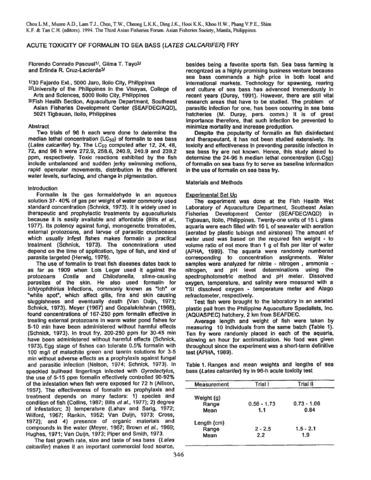
Acute toxicity of formalin to sea bass (Lates calcarifer) fry
(Asian Fisheries Society, 1994) -
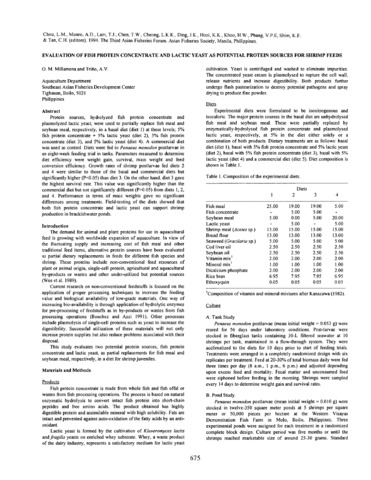
Evaluation of fish protein concentrate and lactic yeast as protein sources for shrimp feeds
(Asian Fisheries Society, 1994)Protein sources, hydrolyzed fish protein concentrate and plasmolyzed lactic yeast, were used to partially replace fish meal and soybean meal, respectively, in a basal diet (diet 1) at these levels; 5% fish protein concentrate + 5% lactic yeast (diet 2), 5% fish protein concentrate (diet 3), and 5% lactic yeast (diet 4). A commercial diet was used as control. Diets were fed to Penaeus monodon postlarvae in an eight-week feeding trial in tanks. Parameters measured to determine diet efficiency were weight gain, survival, mass weight and feed conversion efficiency. Growth rates of shrimp postlarvae fed diets 2 and 4 were similar to those of the basal and commercial diets but significantly higher (P<0.05) than diet 3. On the other hand, diet 3 gave the highest survival rate. This value was significantly higher than the commercial diet but not significantly different (P>0.05) from diets 1, 2, and 4. Performance in terms of mass weights gave no significant differences among treatments. Field-testing of the diets showed that both fish protein concentrate and lactic yeast can support shrimp production in brackishwater ponds. -
Survival and growth of milkfish (Chanos chanos Forsskal) larvae reared on larval feeds as supplement to live food
(Asian Fisheries Society, 1994) -
Toxicity of four botanical insecticides to fingerlings of Nile tilapia and common carp
(Asian Fisheries Society, 1994)Static bioassay test was done to determine the toxicity of four botanical insecticides (BI) - Blumea balsamifera leaves, Vitex negundo leaces, Azadirachta indica seeds, Tinospora rumphii stems to fingerlings (0.8 - 1.5g) nile tilapia (Oreochromis niloticus) and common carp (Cyprinus carpio). Median lethal concentration (g/1) obtained at 96 - hour of exposure for O. niloticus and C. carpio, respectively, were 1.54 and 137 (B. balsamifera), 4.95 and 3.53 (V. negundo), 1.59 and 0.55 (A.indica), and, 0.77 and 2.13 (T. rumphii). Analysis on the levels of toxicity of each BI showed that A. indica was the most toxic to O. niloticus to C. carpio, at 24 - h of exposure. At 96 - h, however, B. balsamifera and T. rumphii appeared to be the most toxic to O. niloticus while T. rumphii to C. carpio. V. negundo was the least toxic to both test species. Results of this study could be used as basis for field application rates of the test botanicals as piscicide in ponds and as insecticide in pest management rice-fish farming. -
Serum steroid hormones, reproductive and larval performance of the Asian catfish Clarias macrocephalus (Gunther) during the off- and peak reproductive seasons
(Institute of Zoology, Academia Sinica, Taipei, Taiwan, R.O.C., 2001)Serum samples were taken from gravid female catfish 0 to 24 h after injection of luteinizing hormone releasing hormone analogue (LHRHa) and pimozide (PIM) to monitor the serum steroid hormone levels during the off seasons (February) and the peak of the natural breeding period (August). A parallel study was also conducted to compare egg production, fertilization, hachuring and larval rates upon yolk resorption from spawn’s of hormone-treated fish. Serum E2 levels were significantly different only with varying times after injection (PI); a marked increase occurred at 13 h, but the elevation was higher in fish induced to ovulate during the peak (16.8 ng/ml) than off season(7.7ng/ml). Hormone-treated fish showed higher serum testosterone (T) levels during the peak season (17-23 ng/ml) than those injected during the off season (10-20 ng/ml) at 4-12 h PI. Serum 17¤, 20ß-dihydroxy-4-pregnene-3-one (DHP) levels og hormone-treated fish during the off season were only about half the level (0.29 and 0.52ng/ml) of those treated with the same hormones during the peak season (0.54 and 0.9 ng/ml) at 8 and 12 h PI, respectively. Initial eggs size was larger in fish induced to spawn in August (1.54 mm) than in fish induced in February (1.49 mm). All fish ovulated when induced to spawn during the peak of the natural breeding period, but ovulation rate was only 60% when were injected during the off season. Egg production, fertilization, hatchery and survival rates were similarly much higher when gravid females were induced to spawn in August (88 eggs/g body weight, 97%, 73%, and 95%, respectively) than those spawned in February (20 eggs/g BW,36%, 20%, and 47%, respectively). Results indicate that more eggs and of better quality, higher levels of T and DHP were produced during the peak season. -
Larval intervals of the sea bass, Lates calcarifer, based on the development of swimming and feeding functions.
(Asian Fisheries Society, 1994)Developmental sequences of characters concerned in swimming and feeding function were examined on laboratory-reared seabass larvae. Based on a scheme of development events constructed in this study, the early life hisory of the species can be divided into the following five phases. A (to about 2.5 mm TL): larvae have no noticeable skeletal structure concerned in swimming and feeding function. B (to about 4.5 mm TL): principal elements of swimming-related characters appear and start to develop; jaw and pharyngeal teeth strt to develop. C (to about 6.0 mm TL): position of the greatest body depth begins to shift bacward; dorsal and anal fin-rays attain to adult commplements; serration-like upper jaw teeth decrease in number and finally disappear. D (to 7.0 - 7.5 mm TL): notochord end flection is completed; conical spper jaw teeth start to develop, replacing the serration-like teeth. E (beyond 7.0 - 7.5 mmTL): larvae can be regarded as reaching juvenile stage in this phase from the view-point of functional morphology, although the first larvae with completely develop fin-ray counts was 10.25 mm TL in this study. -
Growth rate of Gracilariopsis heteroclada (Rhang et Xia) Zhang et Xia (Rhodophyta) in floating cages as influenced by Lates calcarifer Bloch
(Philippine Council for Aquatic and Marine Research and Development, 1994)Fragments of Gracilariopsis heteroclada weighing 10 g each were inserted in a polypropylene rope, suspended at different depths (25 cm, 50 cm and 100 cm below the water surface) and cultured with Lates calcarifer fingerlings (22-25 cm long and 158-252 g) in floating net cages from April to October. After seven months of culture, the specific growth rate of G. heteroclada was found to be influenced significantly (p ≤ 0.05) by the interaction of three factors: sea bass, water depth, and month of culture. Highest growth rate of Gracilariopsis heteroclada was recorded at 25 cm below the water surface during the month of April unaffected by the presence or absence of sea bass; while the lowest growth rale was observed at 100 cm during the months of September and October in the absence of sea bass. Approximately, 172 (dry) g m-2 mo-1 is produced from this culture system. The average length and weight of Lates calcarifer at the end of seven-month culture period was 35-39 cm and 565-741 g, respectively. Percentage weight gain/cage was 195-258, survival rate was 92-100%, and total fish production per cage was 6,780-9,637 g. -
Cage culture of Kappaphycus alvarezii (doty) doty and Epinephelus sp.
(Marine Science Institute, University of the Philippines, 1994)Kappaphycus alvarezii seedlings were cultured in cluster, vertically and horizontally using nylon monofilament rope attached to a bamboo raft installed inside a 5 x 5 m floating cage. Juveniles of Epinephelus sp. were stocked as biological control to grazers. Specific growth rate (% increase in weight day-1) and production (g m-1 line-1) of Kappaphycus were determined every 45 days and production of Epinephelus was determined after 120 days. Specific growth rate of Kappaphycus alvarezii was significantly affected by the culture technique used. An average specific growth rate of 3.7 %, 3.8 % and 5.3 % was recorded when K alvarezii was cultured in clusters, vertically and horizontally in that order. Horizontal technique of culturing K alvarezii was significantly different from vertical and cluster techniques (DMRT = 0.05). Production (g m-1 line-1) of K. alvarezii ranged from 766 to 1,970, (in clusters), 1,110 to 1975 (vertically) and 1,204 to 1,533 (horizontally). These values were significantly affected by the culture month but insignificantly affected by culture technique (DMRT = 0.05). After 120 days of culture, mean weight of Epinephelus sp. was 297 g; % weight gain cage-1 was 233; survival rate = 68 %; fish production = 5 kg; and FCR = 6. -
Sea bass (Lates calcarifer Bloch) reproduction in captivity: a research update
Garcia, Luis Maria (Asian Fisheries Society, 1994)
Recent advaces in the spontaneous and hormoneinduced breeding of caged sea bass (Lates calcarifer bloch, Family Centropomidae) are reviewed. Spontaneous spawnings follow a semilunar rhythm, with most spawings accurring in the evening of quarter moon. Independent of the Lunar-associatd rhythm, mature sea bass which have attained the critical oocyte size of 0.40 mm spawns after an injecton or implantation of luteinizing hormone-releasing hormone analogue (LHRHa) Pelleted LHRHa along together with methyltestosterone can advance sexual maturation and spawning in April-May, ahead of peak breeding in July-August. Depending on the pelleted or injected LHRHa dose, mature female sea bass spawns singly or consecutively over 4 evenings. LLHRHa-induced egg release peaks during the first day of a multiple spawning bout. Daytime injection of LHRHa stimulates spawning in the evening until dawn, while fish injected LHRHa at night induces spawning at daytime and releases fewer eggs compared to nighttime spawning. these results optimize the use of LHRHa to stimulate gonad maturation and spawning so that sea bass seed are made available for hatchery rearing and grow-out. -
Current status of prawn farming and prawn health management in the Philippines.
(Aquatic Animal Health Research Institute, 1994) -
Bacterial studies of epizootic ulcerative syndrome (EUS) outbreak in the Philippines
(Aquatic Animal Health Research Institute, 1994)Epizootic ulcerative syndrome (EUS) is a disease of wild and cultured freshwater fishes in Asia and IndoPacific (Roberts et al., 1986; Lilley et al., 1992). In the Philippines, the first confirmed EUS outbreak is reported in Laguna de Bay in December 1985 to February 1986 (Llobrera and Gacutan, 1987). Since then, EUS has been observed annually in the lake during the coldest months of the year - December to February or March. The disease has spread throughout Luzon, affecting wild and cultured fishes in lakes, ponds, paddy fields, and rice fish systems (Bondad-Reantaso et al., 1992). In September to December 1990, EUS was recorded among brackishwater and marine fishes from a lagoon in northern Luzon (Reantaso, 1991). Although EUS is recognized as a regional problem, no definite primary causative agent has been established. Virus, fungi, bacteria, and parasites have been isolated in EUS-positive fishes, but none has been implicated as the primary pathogen (Roberts et al., 1993a & 1993b). Among the bacteria associated with EUS, Aeromonas hydrophila is consistently isolated in affected fishes from the Philippines (Llobrera and Gacutan, 1987; Torres et al., 1990; Lio-Po et al., 1992). This paper reviews the work done on the bacterial aspects of EUS in the Philippines.