SEAFDEC/AQD Institutional Repository: Recent submissions
Now showing items 2161-2180 of 4221
-
Series: ACIAR Proceedings; No. 136
Overview of sea cucumber aquaculture and sea-ranching research in the South-East Asian region
(Australian Centre for International Agricultural Research, 2012)South-East Asia has traditionally been the global centre of production of tropical sea cucumbers for Chinese markets. Early research into culture methods took place outside this region, notably in India, the Pacific region and China. However, recent investment in Holothuria scabra (sandfish) culture has led to some significant advances within this region. The Philippines and Vietnam have been at the forefront of recent efforts, with involvement from substantial national programs and local institutions as well as international donors and scientific organisations. Smaller programs are ongoing in Thailand, Malaysia and Indonesia. Recent advances and simplifications in hatchery techniques are a major step forward, having promoted the development of experimental-scale sea-ranching ventures, and given rise to a small, commercial pond-based culture industry in Vietnam. Technology developments in nursery systems are likely to provide opportunities for culture enterprises in a broader range of environments than is now possible. A major research thrust in the Philippines towards developing cooperative sea-ranching enterprises has demonstrated good potential, and institutional/legislative arrangements to ensure adequate property rights have been tested. Rotational culture with shrimp is proving successful in Vietnam, while the possibility of proximate co-culture of sandfish and shrimp has largely been ruled out. Small-scale experiments in the Philippines raise the possibility of co-culture in ponds with a number of finfish species. Current research directions are looking at diversifying technology to increase success in a range of coastal conditions, better understanding the social and biophysical conditions required for success, and finding ways of effectively scaling-out developed systems and technology. -
The pressing challenges of mangrove rehabilitation: Pond reversion and coastal protection
Primavera, Jurgenne ; ; (Academic Press, 2011)
The 2004 Indonesia tsunami as well as the increasing storm frequency and intensity associated with climate change–sea-level rise have highlighted the coastal protection function, among the many goods and services that mangrove forests provide. This wider awareness of mangroves has increased national and international rehabilitation efforts, given only 15 million ha remaining and yearly rates of 1–3% loss. Rehabilitation programs employ two strategies: seafront planting and pond reversion. Seafront planting is necessary because coastal populations will not move to safer ground by choice, or cannot move due to poverty, and is also preferred because the sites are open access with no tenurial conflicts. However, former sites of fringing mangroves are difficult to rehabilitate as their lower intertidal–subtidal levels are not optimal for mangroves (due to frequent inundation and wave action). Planting in tidal flats and seagrass beds is also ecologically misguided. This chapter evaluates the relevant mainstream and gray literature (on site and species selection, propagule sources, nursery protocols, outplanting techniques, biophysical/anthropogenic threats, and novel interventions, e.g., integrated approaches using barriers) to improve the low survival rates of seafront planting. However, this strategy should not preclude the long-term relocation of coastal communities to safer ground and the politically difficult option of pond reversion. Given thousands of hectares of underutilized and abandoned brackish water ponds in Southeast Asia, this option holds greater potential for rehabilitation of wide areas of mangroves and greater species diversity. It is ecologically easier as it merely requires restoring hydrology (by breaking pond dikes); mangrove recruitment and succession naturally follow (if propagule sources are present) in these ponds located at mid-upper intertidal levels where mangroves naturally occur. The Philippines, with its long history of mangrove–pond conversion and problematic enforcement of laws that mandate mangrove reversion of idle ponds, is examined as a case study. The chapter assesses the Fishpond Lease Agreement (FLA) system by which vast expanses of mangroves were transferred from the public domain (government-leased ponds) to private ownership and recommends ways to improve the FLA system.
; ; (Academic Press, 2011)
The 2004 Indonesia tsunami as well as the increasing storm frequency and intensity associated with climate change–sea-level rise have highlighted the coastal protection function, among the many goods and services that mangrove forests provide. This wider awareness of mangroves has increased national and international rehabilitation efforts, given only 15 million ha remaining and yearly rates of 1–3% loss. Rehabilitation programs employ two strategies: seafront planting and pond reversion. Seafront planting is necessary because coastal populations will not move to safer ground by choice, or cannot move due to poverty, and is also preferred because the sites are open access with no tenurial conflicts. However, former sites of fringing mangroves are difficult to rehabilitate as their lower intertidal–subtidal levels are not optimal for mangroves (due to frequent inundation and wave action). Planting in tidal flats and seagrass beds is also ecologically misguided. This chapter evaluates the relevant mainstream and gray literature (on site and species selection, propagule sources, nursery protocols, outplanting techniques, biophysical/anthropogenic threats, and novel interventions, e.g., integrated approaches using barriers) to improve the low survival rates of seafront planting. However, this strategy should not preclude the long-term relocation of coastal communities to safer ground and the politically difficult option of pond reversion. Given thousands of hectares of underutilized and abandoned brackish water ponds in Southeast Asia, this option holds greater potential for rehabilitation of wide areas of mangroves and greater species diversity. It is ecologically easier as it merely requires restoring hydrology (by breaking pond dikes); mangrove recruitment and succession naturally follow (if propagule sources are present) in these ponds located at mid-upper intertidal levels where mangroves naturally occur. The Philippines, with its long history of mangrove–pond conversion and problematic enforcement of laws that mandate mangrove reversion of idle ponds, is examined as a case study. The chapter assesses the Fishpond Lease Agreement (FLA) system by which vast expanses of mangroves were transferred from the public domain (government-leased ponds) to private ownership and recommends ways to improve the FLA system. -
Recent developments in the study and surveillance of koi herpesvirus (KHV) in Asia
(Fish Health Section, Asian Fisheries Society, 2011)Koi herpesvirus infection causes significant mortalities in common carp (Cyprinus carpio carpio), koi carp (Cyprinus carpio koi) and ghost carp (common x koi cross, Cyprinus carpio koi). Outbreaks have been reported in many countries worldwide i.e. UK, Germany, Israel, USA, Belgium, South Africa, Switzerland, The Netherlands, France, Denmark, Austria, Italy, Luxemburg and Poland. The first outbreaks attributed to KHV in Asian countries were reported from Hong Kong in 2001; Indonesia in 2002; Taiwan in 2002; Japan in 2003; Thailand in 2005; and Singapore in 2005. Thereafter, research studies embarked on KHV focused on pathogenicity, cell line susceptibility, fish size susceptibility, predilection to fish organs, persistence in fish, vaccine development and application, surveillance and gene sequence analyses of KHV strains. To date, annual active surveillance of the virus in Cambodia, Lao PDR, Myanmar, the Philippines and Vietnam showed that these countries were free of KHV from 2004 to 2007. Several strains of KHV apparently affect koi and common carp in this region indicating that transboundary movement of the virus has occurred not only in Asia but also from Europe and the Americas. The extensive international trade in live ornamental koi fish has largely contributed to the global spread of KHV. Hence, KHV disease (KHVD) was recently added to the list of notifiable diseases of the World Organisation of Animal Health or the Office International des Epizooties (OIE), an indication of the global significance of this viral infection. -
Series: Cellular Origin, Life in Extreme Habitats and Astrobiology; 15
A review of Kappaphycus farming: prospects and constraints
(Springer Netherlands, 2010)A review of Kappaphycus (broadly including Eucheuma) farming is presented, including the current possibilities and challenges with the goal of contributing to sustainable mariculture management practices. -
Milkfish marketing in the Philippines
(National Taiwan University; The Fisheries Society of Taiwan; Asian Fisheries Society; World Aquaculture Society, 2010)Milkfish produced from aquaculture is one of the most traded fish in local markets and it also provides export earnings for the Philippines. Annual per capita consumption of milkfish among Filipinos is 4 kg which comprise the major portion of the 25 kg annual intake of all types of fresh fish. Increasing milkfish production from aquaculture constitutes the strategies for securing fish food supply, especially for the growing middle- and low-income households. However, there are diverging analyses and criticisms on the effectiveness and performance of the milkfish industry in improving access to fish and protein sources among the poor in the Philippines. The generally increasing volumes of milkfish production due to improved technologies are indeed desirable. But higher levels of production does not guaranty the availability and access to fish food supply, especially in geographically dispersed production and consumption centers around the archipelago. Efficiency in marketing perishable fishery products is a crucial factor to ensure availability of safe and fresh milkfish in deficit areas. This review of milkfish marketing literature showed that meeting the milkfish demand-supply gaps, in geographic and temporal sense, is an immediate market objective for the Philippines. The spatial and inter-temporal variations in production volumes influence investment decisions on infrastructures and other public support systems. There is enormous challenge for the industry in view of the declining productivity of capture fisheries, the emerging preference for organic food and value-added forms arising from socio-cultural transformations and lifestyle changes among consumers. This chapter elaborates on the potentials of the milkfish industry by presenting the challenges for traders who should deal with the issues on the demand side of the market; and the challenges for milkfish farmers and processors who should act on the supply side. The constraints and corresponding strategies to meet potentials are also discussed. -
Milkfish aquaculture in the Philippines: An overview
(National Taiwan University; The Fisheries Society of Taiwan; Asian Fisheries Society; World Aquaculture Society, 2010)Milkfish farming has been, and will remain the backbone of Philippine aquaculture. To date, over 260,000 ha of brackishwater ponds, 6, 700 ha of freshwater pens and about 500 ha of marine pens and cages are used to culture this fish. Average milkfish annual production since 1990 is 206,840 mt valued at over ten billion pesos. Annual per capita consumption of milkfish is about 2 kg or 7. 5 % of the total fish (26. 8 kg/per capita) consumed by every Filipino. By the year 2020, the population is predicted to reach 112 million and will require 224,000 mt of milkfish. If production growth rate is maintained at 2.3%, an estimated 400,000 mt will be produced by the year 2020 generating surplus production of close to 200,000 mt. The development of value-added products from the surplus produce will be needed to enhance acceptability of milkfish in the export market and the changing food preference of younger generations. This paper presents a brief overview of the current status of the milkfish industry in the Philippines. Details of, breeding and hatchery technologies, farming systems, marketing, value-added products and research and development are in the various chapters of this book. -
Milkfish hatchery and nursery production in the Philippines
(National Taiwan University; The Fisheries Society of Taiwan; Asian Fisheries Society; World Aquaculture Society, 2010)Milkfish is the most important farmed fish species in the Philippines. In the last 5 years, milkfish production has been increasing. Culture of milkfish in brackishwater ponds still contributes most to milkfish production, although production from marine cages has been on the rise, recently. To sustain milkfish production, a reliable supply of good quality seeds is imperative. Following the spontaneous spawning of milkfish in floating net cages in 1979, protocols for broodstock management, breeding and seed production were developed and these have been continuously refined over the years. Compared to Indonesia and Taiwan, however, commercialization of milkfish seed production in the Philippines, took a long time to take off. Currently, there are a number of government-run and private milkfish hatcheries in operation. In contrast, milkfish fingerling production in brackishwater ponds has long been practiced in the Philippines and is an industry in itself. Traditionally, milkfish fry were from catch from the wild. Recently, more and more come from local hatcheries as well as fry imported from neighboring countries like Indonesia and Taiwan. Prospects for the milkfish hatchery and nursery industries are discussed in light of the Philippine government initiatives to increase fish production, including milkfish, through mariculture as well as by improving production efficiency in other traditional culture systems. -
Milkfish R&D in the Philippines
(National Taiwan University; The Fisheries Society of Taiwan; Asian Fisheries Society; World Aquaculture Society, 2010)Culture of milkfish in brackish water ponds has been practiced for many years in the Philippines and recently its culture has expanded to fish cages in marine waters. Following the spontaneous spawning of milkfish in floating net cages in 1979, protocols for its seed production were developed. Studies to determine sustainable culture techniques in ponds and cages were conducted. Studies on nutritional requirements of milkfish at different developmental stages were done to reduce dependence on live prey organisms during hatchery operations and optimize feed formulations for nursery and grow-out cultures. In recent years, research geared towards the environmental impact of milkfish culture and ways to mitigate the negative effects of intensive farming practices. Prospects for the milkfish industry are discussed in light of the recent advances in milkfish R&D and Philippine government initiatives to increase fish production by mariculture. -
Early ossification and development of the cranium and paired girdles of Chanos chanos (Teleostei, Gonorynchiformes)
; Bagarinao, Teodora (Science Publishers, 2010)
In this chapter, we provide new data on the timing of ossification of cranial and paired girdle elements, and compare our results, when it is possible, with previous work on early ossification development of Chanos chanos. This is particularly important because of the basal phylogenetic position of Chanos among living ostariophysans and among extant gonorynchiforms as well (see Fig. 3.1). We describe the normal cranial and girdle patterns of ossification in Chanos chanos and evaluate to what extent the cranial development is consistent, or whether some intraspecific differences occur in comparison to previous results by Taki et al. (1987) and Kohno et al. (1996a) based on ontogenetic series grown in the same Aquaculture Department as the specimens used in this study. We assess previously published developmental work in a few ostariophysans and test some previous hypotheses on heretochrony and patterns of diversification. [A study of chondrification versus ossification processes in Chanos chanos is outside the scope of this paper, but it is the subject of a separate paper (Arratia and Grande, in preparation).] -
Sociocultural factors influencing fishers’ participation in coastal resource management in Anini-y, Antique, west central, Philippines
(Asian Rural Sociology Association, 2010)Fishing is the only source of livelihood in the coastal communities. This is the reason why poverty persists in these areas. The lack of other alternative livelihood activities results to overfishing and eventual degradation of fishery resources, thus, forming a vicious cycle of poverty and resource degradation. Recognizing the importance of promoting healthy and sustainable fisheries, SEAFDEC/AQD collaborated with the local government of Anini-y to develop a sustainable utilization of natural marine resources within the marine protected area at Nogas Island, Anini-y, Antique. This study determined the fishers’ sociocultural characteristics and how these variables influence their participation in the community’s coastal resources management activities. Primary data were collected from household survey using semi-structured questionnaire, focus group discussion and in-depth interview with key informants. Means and frequencies were used to describe the fishers’ sociocultural and demographic characteristics while logistic regressions run by SPSS program was used to determine significance of relationships between sociocultural variables and extent of participation in coastal resources management. Results showed that age, gender, household size, distance from the shoreline, perceptions about coastal resources and fishers’ willingness to leave fishing did not significantly influence fishers’ participation in coastal resources management while fishers’ economic well being, attitude towards coastal resources and awareness level to fishery regulations showed significant influence. -
Updates on the nervous necrosis virus and the koi herpesvirus in Southeast Asia
(Veteran Council I.R.IRAN, 2009)In Southeast Asia, the Viral Nervous Necrosis (VNN) or Viral Encephalopathy and Retinopathy (VER) and the Koi herpesvirus (KHV) infection are currently economically-important diseases of fishes. The VNN affects groupers (Epinephelus akaara, E. coioides, E. tauvina, E. fuscogutatus, E. septemfasciatus, E. malabaricus, E. moara and Cromileptes altivelis), Asian sea bass (Lates calcarifer), mangrove red snapper (Lutjanus argentimaculatus) and milkfish (Chanos chanos) in Thailand, Taiwan, Indonesia, Brunei, Malaysia, Singapore, Philippines and Vietnam. The Piscine nodavirus of the genus Betanodavirus, genotype red-spotted grouper nervous necrosis virus (RGNNV) is predominantly involved. Research on fish species pathogenicity, optimum temperature, cell susceptibility, organ predeliction, pathology, virus reservoirs, experimental infection, vaccination and diagnosis have been reported. The Koi herpesvirus (KHV) infection causes significant mortalities in common carp (Cyprinus carpio carpio), koi carp (Cyprinus carpio koi) and ghost carp (common x koi cross, Cyprinus carpio goi). Outbreaks have been reported among koi in Hongkong in 2001; common carp in Indonesia, in 2002; koi in Taiwan in 2002; and common carp in Japan, in 2003. A dramatic spread of the disease was subsequently observed among most prefectures in Japan, with outbreaks that eventually involved koi carp. In Thailand, KHV was first diagnosed in March 2005 while in Singapore, in Sept 2005. By Feb 2006, two batches of Thai koi exported to Singapore, tested KHV PCR positive from which the virus was successfully isolated on KF-1 cells. In Malaysia, no KHV outbreak was reported but the presence of the virus was detected among koi carp exported to UK in 2000 and in 2001. In 2004, koi carp in Malaysia tested positive for KHV by nested PCR. To date, annual active surveillance of the virus in Cambodia, Lao PDR, Myanmar, Philippines and Vietnam from 2004 to 2008 showed these countries are free of KHV. Recent developments on research of KHV focused on pathogenicity, cell line susceptibility, fish size susceptibility, predilection to fish organs, persistence in fish, vaccine development and application, surveillance and gene sequence analyses of KHV strains. The extensive international trading of live ornamental koi fish has largely contributed to the global spread of KHV. Hence, KHV was recently added to the list of notifiable diseases to the World Organisation of Animal Health or the Office International des Epizooties (OIE). -
Grouper aquaculture R&D in the Philippines
(Asian Fisheries Society; World Aquaculture Society; The Fisheries Society of Taiwan; National Taiwan Ocean University, 2008)Culture of groupers in ponds and floating net cages has been practiced for many years in the Philippines. Unsustainable culture practices such as dependence on wild caught seeds, use of trash fish, use of high stocking densities, and unregulated expansion and proliferation of fish cages, have led to the "boom and bust" cycle of grouper aquaculture in the Philippines. The drastic decrease in grouper aquaculture production in the late 90's was mainly attributed to environmental deterioration and diseases outbreaks. To sustain grouper production, research on the breeding, seed production and culture of groupers started in the mid 1980s. As a regional inter-government R&D organization, the Aquaculture Department of the Southeast Asian Fisheries Development Center (SEAFDEC/AQD) followed the recommendations of the 1987 Seminar-Workshop on Aquaculture Development in Southeast Asia on grouper R&D. Research activities initially focused on market survey of grouper species in the Philippines and Southeast Asia, assessment of fry and availability in traditional fishing grounds, and development of broodstock management techniques. Following the spontaneous spawning of Epinephelus coioides in concrete tanks and floating net cages in 1990's, protocols for the seed production of milkfish and sea bass were adapted and modified. Parallel studies to determine sustainable culture techniques in ponds and net cages were conducted. Studies on the nutritional requirements of grouper at various developmental stages were done to reduce dependence on live prey organisms and trash fish as feeds. Research geared towards health management started in the in late 90's to early 2000's. Prospects for grouper aquaculture are discussed in the light of recent advances in grouper R&D and the Government of the Philippines initiatives to increase fish production by mariculture. -
Mud crab culture: challenges and opportunities
Quinitio, Emilia T.; (The Marine Products Export Development Authority, 2008)
-
Inventory of aquatic fauna of Agusan marsh with notes on introduced species and their potential impacts on biodiversity
; ; Primavera, Jurgenne (UNESCO Jakarta Office, Philippine Council for Aquatic and Marine Research and Development, 2008)
An important region of biodiversity in the country is the Agusan Marsh, located in northeastern Mindanao, southern Philippines. The Marsh aquatic fauna are not well studied and majority of available information is dispersed and sporadic. This study presents an updated systematic list comprising aquatic faunal species collected from seven Marsh localities during a 2006 survey. Of a total of 64 species of aquatic fauna distributed in 45 genera and 37 families, about 59.3% are fishes, 17.2% crustaceans, 14.1% molluscs, and 9.4% reptiles. Most of the aquatic fauna are native and migratory. Flowing rivers, lakes and creeks are the primary habitats of these organisms; majority of them thrive in lakes and upper streams. Fish species reported in earlier literature are also included. The Indigenous Knowledge System (IKS) was applied to integrate species known to the native Manobo, but not found in earlier studies nor the present survey. Fishery-related problems include the decline in fishery stocks, displacement of native species, and destruction of habitats. These problems are attributed to illegal fishing (e.g., electrofishing, use of chemicals and ichthyotoxic plants), overfishing, introduced or exotic or invasive alien species, pollution (e.g., heavy metal contamination), habitat degradation (e.g., conversion of marshland to agriculture), and human disturbance. The deliberate or accidental introductions of exotic species such as carps and the janitor fish now pose serious threats to species diversity. Conservation measures and strict enforcement of wildlife and environmental laws are needed to save the biodiversity of Agusan Marsh for future generations. -
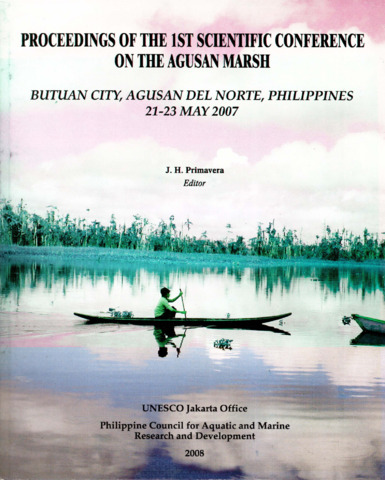
Proceedings of the 1st Scientific Conference on the Agusan Marsh: Butuan City, Agusan del Norte, Philippines, 21-23 May 2007
(UNESCO Jakarta Office, Philippine Council for Aquatic and Marine Research and Development, 2008) -
The Agusan marsh: A situationer with focus on scientific aspects
Primavera, Jurgenne; (UNESCO Jakarta Office, Philippine Council for Aquatic and Marine Research and Development, 2008)
The Agusan Marsh is an extensive floodplain in the middle of the Agusan River Basin in eastern Mindanao where rivers, creeks and tributaries mainly in the provinces of Agusan del Norte, Agusan del Sur and Compostela Valley converge and drain northward to the Agusan River and into Butuan Bay. The main habitats of the Marsh are the freshwater swamp forest (with Terminalia, peat swamp and sago palm forest subtypes), secondary scrub, herbaceous swamp, open water (oxbow/floodplain lakes, pools), and flowing water (rivers, streams). Peat forests have been confirmed in Bunawan and Caimpugan. Over 200 bird species have been known to spend at least part of the year in the Marsh, making it an important site for migratory birds from northern Asia and Siberia. As one of the Philippines' ecologically significant wetlands, the Marsh has been declared a protected site under NIP AS (1994), Presidential Proclamation 913 (1996), and RAMSAR (1999). The Agusan Marsh Wildlife Sanctuary covers -111,540 ha in 8 municipalities of Agusan del Sur. Recently the Agusan Marsh was placed high on the list of Philippine nominations to the World Heritage Natural Sites. Despite all these, very few scientific studies have been conducted on the Marsh but this has not stopped drainage and development for agriculture, construction of dams and reservoirs for irrigation, deliberate or accidental introductions of exotic species, e.g., tilapia, carps, janitor fish, and golden apple snail, and logging in the watershed areas. The latter have been legitimized by Integrated Forest Management Agreements despite the presence of primary forests. The latest proposed intervention is the Agusan River Basin Development Project. There is need for scientific research to provide baseline information on hydrology, sediment dynamics and ecology as prerequisite to any interventions and developments in the Agusan Marsh. -
Technology transfer of aquaculture technologies: framework and strategies
(Southeast Asian Fisheries Development Center, 2008) -
Understanding community-based aquaculture through participatory approaches
(Southeast Asian Fisheries Development Center, 2008) -
Community-based aquaculture and resource management: concepts and approaches
(Southeast Asian Fisheries Development Center, 2008) -
Business planning and management for sustainable small-scale rural aquaculture venture
(Southeast Asian Fisheries Development Center, 2008)