SEAFDEC/AQD Institutional Repository: Recent submissions
Now showing items 3581-3600 of 4221
-
AQD Matters 2006 February
Bagarinao, TeodoraA corrected version of the file was uploaded on May 29, 2025. The original version contained minor typographical errors. (Aquaculture Department, Southeast Asian Fisheries Development Center, 2006)
-
AQD Matters 2006 March
Bagarinao, TeodoraA corrected version of the file was uploaded on May 29, 2025. The original version contained minor typographical errors. (Aquaculture Department, Southeast Asian Fisheries Development Center, 2006)
-
AQD Matters 2006 January
Bagarinao, TeodoraA corrected version of the file was uploaded on May 29, 2025. The original version contained minor typographical errors. (Aquaculture Department, Southeast Asian Fisheries Development Center, 2006)
-
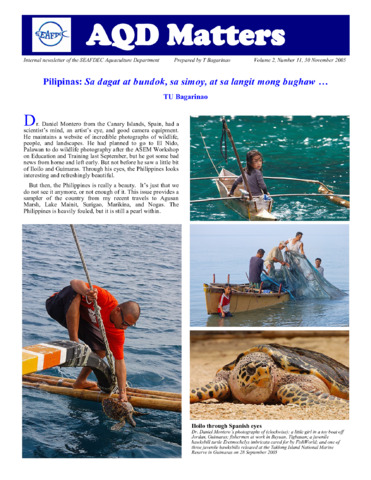
AQD Matters 2005 November
Bagarinao, TeodoraA corrected version of the file was uploaded on May 29, 2025. The original version contained minor typographical errors. (Aquaculture Department, Southeast Asian Fisheries Development Center, 2005)
-
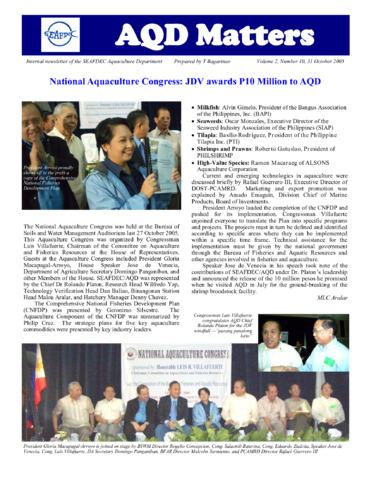
AQD Matters 2005 October
Bagarinao, TeodoraA corrected version of the file was uploaded on May 29, 2025. The original version contained minor typographical errors. (Aquaculture Department, Southeast Asian Fisheries Development Center, 2005)
-
AQD Matters 2004 June
Bagarinao, TeodoraA corrected version of the file was uploaded on May 29, 2025. The original version contained minor typographical errors. (Aquaculture Department, Southeast Asian Fisheries Development Center, 2004)
-
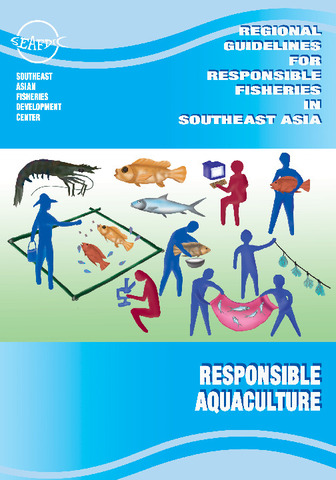
Regional guidelines for responsible fisheries in Southeast Asia: Responsible aquaculture
Bagarinao, TeodoraThis 43-page guidebook presents the code of conduct that has been re-written, expanded, clarified and annotated with definitions and examples to consider the fish farming industries in Southeast Asia. The source of the ... (Aquaculture Department, Southeast Asian Fisheries Development Center, 2005)
-
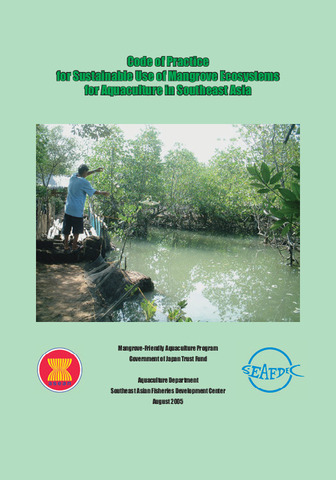
Code of practice for sustainable use of mangrove ecosystems for aquaculture in Southeast Asia
Bagarinao, TeodoraThis 47-page guidebook presents the 22 concepts, principles or policy statements that prescribe the preferred ways of doing and acting to ensure the sustainable use of mangroves for fish farming. It is annotated with ...; Primavera, Jurgenne (Aquaculture Department, Southeast Asian Fisheries Development Center, 2005)
-
Series: Aquaculture economics in developing countries: regional assessments and an annotated bibliography
Aquaculture economics in Asia and the Pacific: A regional assessment
(Rome: FAO, 1997)A broad overview is given of research and information on aquaculture economics in Asia and the Pacific. Following a description of the general state of aquaculture in the region, an examination is made of the available research and information on the various aquaculture systems: inland/freshwater aquaculture; brackishwater /coastal aquaculture; and, marine aquaculture/sea farming. Studies on post-harvest handling, processing, transportation and marketing, and market analysis and development are discussed. Environmental issues and concerns, social equity and women's issues, community-based coastal resources management, technology transfer and macro-economic policies and institutional structures are also analysed. Aquaculture economics research is also assessed, highlighting thrusts, priorities, constraints and needs. -
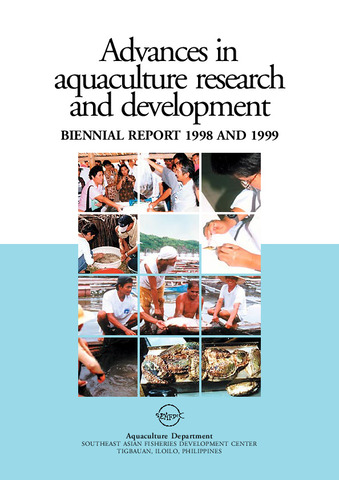
Advances in aquaculture research and development: Biennial report 1998 and 1999
(Aquaculture Department, Southeast Asian Fisheries Development Center, 2000)The report provides an account of the achievements of the SEAFDEC Aquaculture Department made in the period 1998-1999. During these 2 years, 4 critical areas of concern were addressed: poverty alleviation; food security; environment-friendly technology; and, export/cash crops. -
Molecular typing and antimicrobial susceptibility of Vibrio parahaemolyticus strains
(Fish Health Section, Asian Fisheries Society, 2008)The aim of the present study was to use three PCR-based techniques for the analysis of genetic variability among Vibrio parahaemolyticus strains isolated from the Philippines. Seventeen strains of V. parahaemolyticus isolated from shrimps and from the environments where these shrimps are being cultivated were analyzed by RAPD, ERIC and REP-PCR. Antimicrobial susceptibility of these strains to selected compounds was investigated using broth microdilution method. Results of this work and analysis of similarity among strains using Dice coefficient and unweighted average pair group method have demonstrated genetic variability within the V. parahaemolyticus strains. The RAPD, ERIC and REP-PCR were found to be suitable typing methods for V. parahaemolyticus. They have good discriminative ability and can be used as rapid means of comparing these strains for epidemiological investigation. However, the REP-PCR analysis yielded a relatively small number of products suggesting that the REP sequences may not be widely distributed in the V. parahaemolyticus genome. Results of antimicrobial susceptibility revealed that resistance among the strains was rare. In conclusion, RAPD, ERIC and REP-PCR techniques are useful methods for molecular typing of V. parahaemolyticus strains. To our knowledge this is the first study of this kind carried out on V. parahaemolyticus strains isolated from the Philippines. -
Experimental transmission of hepatopancreatic parvovirus (HPV) infection in Penaeus monodon postlarvae
(Fish Health Section, Asian Fisheries Society, 2005)Hepatopancreatic parvovirus (HPV) infection in penaeid shrimps was first reported in various countries of the Asia-Pacific region in mid-1980. The virus affects the hepatopancreas of postlarvae and juveniles, usually leading to slow growth and mortality during the early stage of culture. At present, there is no established experimental model of infection in Penaeus monodon, a susceptible species, since there has not been any report of successful HPV transmission under laboratory conditions. Therefore, experiments were undertaken to induce HPV infection by feeding P. monodon postlarvae (PL) with virusinfected PL. Postlarval P. monodon (PL-16), initially examined to be free from HPV, were found HPV-positive 24 hours after they were fed with the infected material. Percentage of infection was from 30% (day 1) to 100% (day 7) based on the examination of wet mounts of hepatopancreas (squashed tissue) stained with malachite green and through histopathology. This is the first report of a successful horizontal transmission of HPV in P. monodon PL. This infection model could be used to study the pathogen further and would permit controlled experiments to be undertaken in order to identify methods of prevention and control. -
Health Management in Aquaculture: Glossary
(Aquaculture Department, Southeast Asian Fisheries Development Center, 2001) -
Harmful and toxic algae
(Aquaculture Department, Southeast Asian Fisheries Development Center, 2001)The chapter provides basic facts about harmful and toxic algae. It also discusses the conditions that stimulate their occurrence, different types of harmful and toxic algal blooms and their effects to fish and marine environment. The different strategies in coping with the problem of harmful and toxic algal blooms are also discussed. -
Health Management in Aquaculture: Index
(Aquaculture Department, Southeast Asian Fisheries Development Center, 2001) -
Physical, environmental, and chemical methods of disease prevention and control
(Aquaculture Department, Southeast Asian Fisheries Development Center, 2001)Disease prevention is primary and cost-effective method in fish health management. It is more effective and economical than attempting to stop a disease that has already set in the recommendations given above will greatly reduce the possibility of disease outbreak. -
Immunological and molecular biology techniques in disease diagnosis
(Aquaculture Department, Southeast Asian Fisheries Development Center, 2001)The improvement of existing immunoassay techniques, development of monoclonal antibody technology and the development of new immunoassay approaches are all working together to provide new tools for the detection of disease-causing organisms in fish and crustaceans. Following the introduction of nucleic acid hybridization technique and PCR, it was recognized that the methods offered a sensitive approach to the detection and identification of specific microorganisms as in the case of a bacterial or viral infection in a variety of sample types. Potentially, a characteristic DNA sequence from a single virus particle or cell of a particular organism can be amplified to detectable levels within a short period of time. Conventional diagnostic methods that involve the culture of microorganisms can take days or weeks to complete or very tedious to perform. PCR offers a rapid, very sensitive, very specific and simple alternative. Further developments in immunodiagnostics and emerging technologies such as DNA-based tests will revolutionize the detection and identification of infectious disease agents. -
Immunity and biological methods of disease prevention and control
(Aquaculture Department, Southeast Asian Fisheries Development Center, 2001)The chapter deals with the barriers that prevent microbial entry and the various internal defense mechanisms that are part of the host's arsenal in combating in combating invading microbes. It also discusses some of the biological methods of disease prevention and control. -
Parasitic diseases and pests
(Aquaculture Department, Southeast Asian Fisheries Development Center, 2001)A wide variety of parasites have been identified as causing significant economic losses in fish and shrimp culture. Most of these parasites are difficult to control effectively with a single measure. The control of parasites is dependent on culture systems of the host fish, knowledge of the life cycle of the parasite, and the availability of effective treatment methods. -
Nutritional diseases
(Aquaculture Department, Southeast Asian Fisheries Development Center, 2001)Diagnosis of nutritional diseases is difficult because many signs exhibited by fish are non-specific and most nutritional deficiencies are hard to define. A compilation of data on feed composition and feeding management, as well as husbandry practices, are needed to define a case. Most of data on fish and shrimp nutritional diseases were gathered under experimental conditions. Under farm conditions, most of that definition would be clouded with errors in husbandry practices or secondary infection. Therefore, attempts to diagnose nutritional diseases should be carefully done using every available technique to define the case.