SEAFDEC/AQD Institutional Repository: Recent submissions
Now showing items 3601-3620 of 4221
-
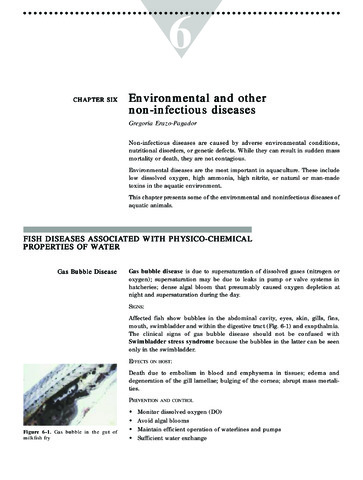
Environmental and other non-infectious diseases
(Aquaculture Department, Southeast Asian Fisheries Development Center, 2001)The chapter presents some of the environmental non-infectious diseases of aquatic animals. Non-infectious diseases are caused by adverse environmental conditions, nutritional disorders, or genetic defects. While they can result a sudden mass mortality or death, they are not contagious. Environmental diseases are the most important in aquaculture. This includes low dissolved oxygen, high ammonia, high nitrite, or natural or man-made toxins in the aquatic environment. -
Bacterial diseases
Tendencia, Eleonor ; (Aquaculture Department, Southeast Asian Fisheries Development Center, 2001)
Fish and crustaceans that are not weakened by poor environmental conditions, or by other causes, such as parasitic infestation, nutritional deficiency, handling stress, or chemical intoxication, are more resistant to bacterial infections. This is due to the presence of a large amount of bactericidal substances in the blood, which helps overcome infections. So, the best precaution against the occurrence of bacterial infections is to provide the fish with optimum environmental conditions, adequate amounts of the right kinds of food and avoidance of stress, including overcrowding. Vaccination/ immunization and genetic manipulation (i.e., the development of specific pathogen resistant fry) are also some ways of preventing bacterial diseases. The use of antibiotics should always be an option of the last resort.
; (Aquaculture Department, Southeast Asian Fisheries Development Center, 2001)
Fish and crustaceans that are not weakened by poor environmental conditions, or by other causes, such as parasitic infestation, nutritional deficiency, handling stress, or chemical intoxication, are more resistant to bacterial infections. This is due to the presence of a large amount of bactericidal substances in the blood, which helps overcome infections. So, the best precaution against the occurrence of bacterial infections is to provide the fish with optimum environmental conditions, adequate amounts of the right kinds of food and avoidance of stress, including overcrowding. Vaccination/ immunization and genetic manipulation (i.e., the development of specific pathogen resistant fry) are also some ways of preventing bacterial diseases. The use of antibiotics should always be an option of the last resort. -
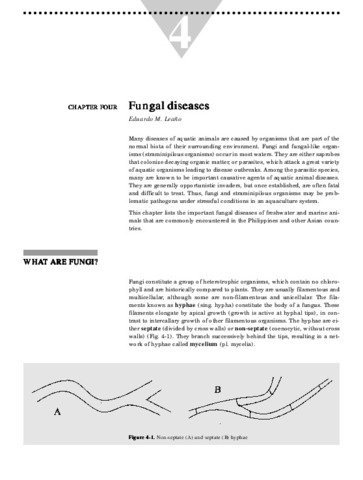
Fungal diseases
(Aquaculture Department, Southeast Asian Fisheries Development Center, 2001)Over the past 20 years, aquatic animal mycopathogens have become the focus of considerable research. The many known occurrences of fungal diseases in wild populations and the documented devastating disease outbreaks indicate that fungal and fungal-like pathogens are important in nature. Fungal diseases can act as major limitations on natural and cultured populations of aquatic animals. However, knowledge on fungal diseases is rudimentary consisting primarily of the identification and pathology of etiological agents. Detection of fungal infections relies only on the observation of gross pathology, histological examinations, and standard mycological isolation and identification procedures. As a result, there are some cases where the implicated fungal pathogen cannot be demonstrated as the primary cause of a particular disease. In such cases, the fungal pathogen is usually regarded as secondary invader. Continued research in basic mycology is still an essential resource for fish pathologists in diagnosing diseases caused by fungi. Although fungi reportedly affect very few species, fungal diseases, if not properly controlled or prevented, can still pose a threat to the aquaculture industry. -
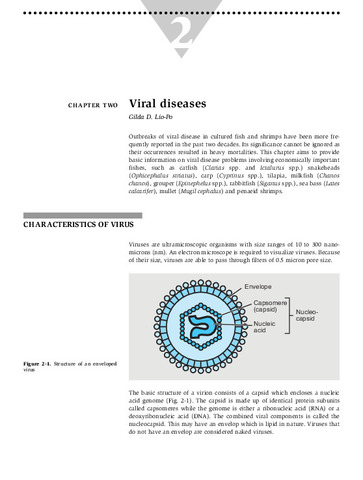
Viral diseases
(Aquaculture Department, Southeast Asian Fisheries Development Center, 2001)Outbreaks of viral infections can cause massive mortalities among cultured fishes or shrimps. Water temperature and age of the fish or shrimps are significant factors that influence the development of viral infections. Most fish viral infections occur at low water temperatures, hence, very few viral infections among fishes in warm water culture systems are reported. In addition, most viral infections occur among fry or fingerlings often causing severe mortalities, while older fish or shrimp develop resistance or are hardly affected. Stress from handling, poor water quality, high stocking density and poor nutrition also affect the severity of viral infections. Finally, aquaculturists should beware in importing non-indigenous fish or shrimps into the country as these are potential carriers of viral pathogens. -
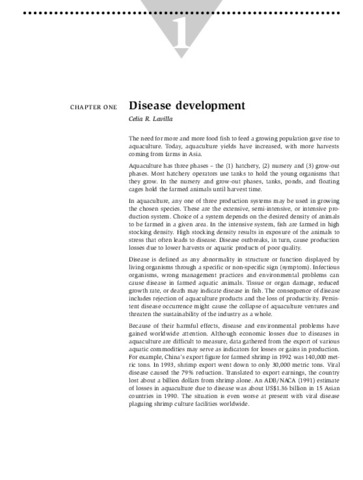
Disease development
(Aquaculture Department, Southeast Asian Fisheries Development Center, 2001)Disease occurrence is one of the biggest deterrents to sustainable production in aquaculture. It is therefore important to enhance awareness among various sectors of the importance of health management in the aquaculture industry. This can be done through education and information dissemination. Students in fisheries and veterinary medicine need to have adequate background information on the aquatic animal disease and health management to understand the problems and needs of a fast-growing aquaculture industry. Recognizing disease signs early and using mortality pattern as a clue to the disease agent involved will not only make diagnosis easier, but it will also prevent massive losses by timely implementation of remedial measures. -
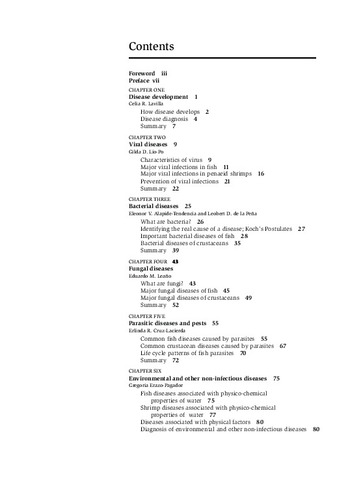
Health Management in Aquaculture: Table of contents
(Aquaculture Department, Southeast Asian Fisheries Development Center, 2001) -
Health Management in Aquaculture: Preliminary pages
(Aquaculture Department, Southeast Asian Fisheries Development Center, 2001) -
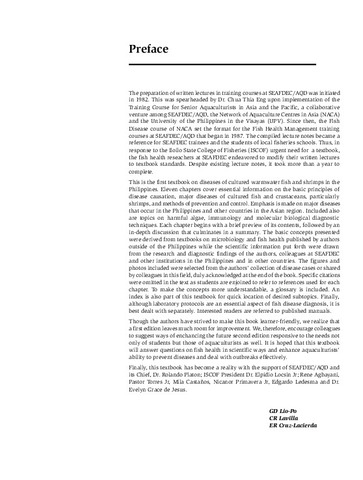
Health Management in Aquaculture: Preface
(Aquaculture Department, Southeast Asian Fisheries Development Center, 2001) -
Health Management in Aquaculture: Foreword
(Aquaculture Department, Southeast Asian Fisheries Development Center, 2001) -
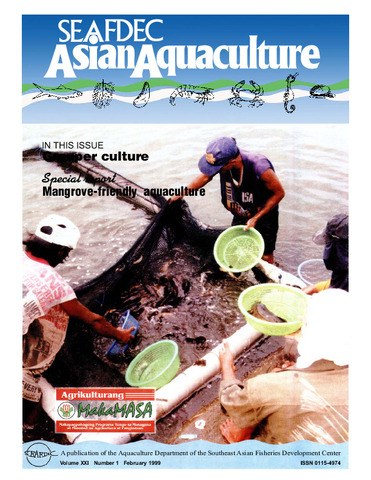
SEAFDEC Asian Aquaculture Volume 21(1) February 1999
(Aquaculture Department, Southeast Asian Fisheries Development Center, 1999)Special issue on grouper culture. -
Series: SAFIS manual; No. 22
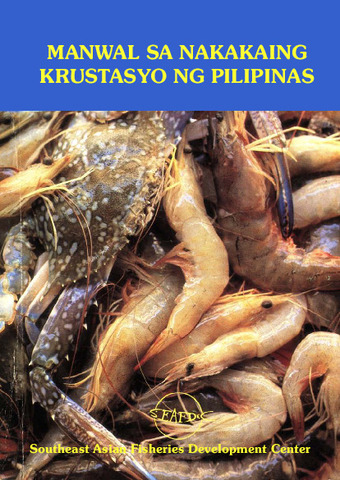
Manwal sa nakakaing krustasyo ng Pilipinas
(Aquaculture Department, Southeast Asian Fisheries Development Center, 1986)Text in Filipino. -
SEAFDEC resolution and plan of action
(Aquaculture Department, Southeast Asian Fisheries Development Center, 2005) -
Codes of conduct for aquaculture in mangroves
(Aquaculture Department, Southeast Asian Fisheries Development Center, 2005) -
Mangroves management and development in the Philippines.
(Aquaculture Department, Southeast Asian Fisheries Development Center, 2005)Filipinos whose main daily diet consists of fish and rice, are highly dependent on the coastal resources. The development of coastal resources in the Philippines has been traditionally exploitative in nature. Government policies, which dictated development in both the uplands and coastal areas, have been based mainly on abundant available resources without due consideration for sustainability. In the 1950s, vast tracts of mangroves were awarded to concessionaires and logged over for firewood and tanbarks. Mangrove woods were the preferred fuel source in coastal villages and most bakeries because of its high heating value, but a greater volume was exported to Japan as firewood but reportedly became the source of rayon. In the 1960s, the government adopted a policy aimed at increasing fish production by converting large areas of mangroves into fishponds for the culture of milkfish (Chanos chanos) and shrimps. Such policy was promoted by a government program, which classified mangrove timberland for fishpond development and opened loan windows in most government banks to finance fishpond development. It was only towards the end of the 1970s when the government realized the fishery value of mangroves. A National Mangrove Committee was formed in the then Ministry of Natural Resources, and a Mangrove Forest Research Center was created under the Forest Research Institute of the Philippines. The former was charged with the formulation of policies/recommendations for the conservation and sustainable management of the remaining mangrove forests in the country, while the latter worked for the generation of technology for the rehabilitation, production and sustainable management of mangroves. Not surprisingly, this “decade of awakening” was also significantly marked with an alarming decline in fish catch. The government then opened loans to fisherfolk for the purchase of motorized boats and improved fishing gear. The program ended with most fishers unable to payback their loans as their fish harvests and income continued to decline. The 1980s and 1990s were marked with significant efforts to rehabilitate destroyed mangroves and related coastal resources. In 1981, small islands indented by mangroves containing an aggregate area of 4,326 hectares were declared Wilderness Areas under Presidential Proclamation No. 2151. Also in the same year, Presidential Proclamation No. 2152 was issued declaring the entire island of Palawan and some parcels of mangroves in the country containing an aggregate area of 74,267 hectares as Mangrove Swamp Forest Reserves. In 1987, the Mangrove Forest Research Center was expanded to become nationwide in scope under the Freshwater and Coastal Ecosystems Section of the Ecosystems Research and Development Service of every regional office of the present Department of Environment and Natural Resources. Not long after, the Coastal Environment Program (CEP) and the Coastal Resource Management Project (CRMP) were launched in the regional offices of DENR in 1993 and in 1996, respectively. These programs promote community-based approaches to coastal resource management, making direct stakeholders partners of government in the sustainable development and management of mangroves, seagrass beds, coral reefs, and other coastal resources. -
Marine shrimp culture industry of Thailand: operating guidelines for shrimp farms.
(Aquaculture Department, Southeast Asian Fisheries Development Center, 2005)The marine shrimp industry in Thailand had developed a code of conduct for its operations. This code of conduct is a set of principles and processes that provides a framework to meet the industry’s goal for environmental, social, and economic responsibility. The foundation of the code of conduct is the following mission statement. The marine shrimp farming industry in Thailand is committed to producing high quality, hygienic products in a sustainable manner that provides for environmental, social, and economic benefits for the present and future generations. Policy statements have been formulated to outline actions that the industry will undertake to meet its commitments under the mission statement. These policy statements cover a broad range of topics, including: environmental protection, public consultation, regulatory compliance, location, quality and safety, continual improvement, efficiency, research and development, social responsibility, monitoring and auditing, education and training, international trade. The code of conduct is voluntary, but it has been signed by a wide variety of industry stakeholders. The code commits the signatories to specific actions, including the development of a series of operating guidelines and procedural manuals. These actions will aid the industry in carrying out its operations in a manner consistent with the objectives of the code of conduct. -
Sustainable production systems of aquatic animals in brackish mangrove areas: 2001-2005 (As of August 2004).
(Aquaculture Department, Southeast Asian Fisheries Development Center, 2005)Under the Memorandum of Understanding (MOU) between SEAFDEC (Southeast Asian Fisheries Development Center) and JIRCAS (Japan International Research Center for Agriculture Sciences) an agreement was forged to collaborate on a research study on the growth, prevention and control of diseases of aquaculture fishes. Several studies are now being conducted at SEAFDEC AQD in Iloilo, Philippines. Under the same project, JIRCAS also implemented a research study on sustainable aquaculture in Thailand, “Sustainable Production System of Aquatic Animals in Brackish Mangrove Areas.” Implemented from September 2003 to February 2004, the study aimed to determine the role of benthic organisms as food of marine resources, the shrimp farming areas and the number of shrimp farms. Using six shrimp ponds with an area of 40 m x 20 m where the potentials of closed and circulating systems to purify shrimp farm wastewater were compared. The shrimp culture in Thailand started in the mid 1970s and subsequently increased in mid 1980s with the intensification of production systems. The high inputs of intensification inversely resulted to the decrease of mangrove areas. In Samut Songharm Province which is situated in the Gulf of Thailand, mangrove areas decreased to almost 0 for the last 15-20 years (Fig. 1). Due to the concerted efforts of the residents in the community and in support of the Royal Princes of Thailand, mangrove tree planting was started in the coastal areas in 1999. Fig 1 shows the areas covered by mangroves in the Province of Samut Songharm that mark the decrease and increase of mangrove areas. -
Progress of the mangrove-friendly shrimp culture project as of August 2004.
(Aquaculture Department, Southeast Asian Fisheries Development Center, 2005)The Aquaculture Department (AQD) of the Southeast Asian Fisheries Development Center (SEAFDEC) implemented in 1998 a five-year Mangrove-Friendly Aquaculture Program covering the culture of various organisms (fishes, crustaceans and mollusks) that could have effects on the mangroves. Upon the recommendation of the 22nd SEAFDEC Program Committee in 1999, the Program was revised to focus on the effects of shrimp culture on mangroves and was placed under the FCG collaborative mechanism. Thus, starting in early 2000 the Program on the Promotion of Mangrove-Friendly Shrimp Aquaculture in Southeast Asia: Mangrove-Friendly Shrimp Culture Project was implemented giving due focus on shrimp and adopting the major approaches, namely verification and pilot demonstration, research, training, and information dissemination. The improved practices in shrimp culture in Thailand and in the Philippines served as basis for the technology verification and demonstration activities. These experiences were documented in the form of state-of-the-art manuals. -
Participants
(Aquaculture Department, Southeast Asian Fisheries Development Center, 2005) -
Message
(Aquaculture Department, Southeast Asian Fisheries Development Center, 2005) -
Mangroves and aquaculture in Southeast Asia.
Primavera, Jurgenne (Aquaculture Department, Southeast Asian Fisheries Development Center, 2005)
The history of brackishwater pond culture in the Philippines and elsewhere in Southeast Asia has been associated with mangrove loss because in earlier times, the larger society has viewed mangroves and other wetlands as wastelands to be developed. In a proactive move to address environmental concerns over shrimp aquaculture, the SEAFDEC Council in 1999 mandated the development of environment-friendly shrimp culture and the build-up of expertise in mangroves. This paper reviews the status of mangroves and their conversion to culture ponds in Southeast Asia, and the environmental impacts of aquaculture, aside from habitat loss. To improve the sustainability of brackishwater aquaculture, recommendations include an inventory of mangrove and pond culture areas in the region, zonation of mangrove areas within the context of integrated coastal zone management, aqua-silviculture and environmentfriendly aquaculture, rehabilitation of degraded mangroves, and enforcement of existing laws including the buffer zone/mangrove greenbelt requirement.