Exploring, harnessing and conserving marine genetic resources towards a sustainable seaweed aquaculture

Download URL
nph.onlinelibrary.wiley.comDate
2021-03-27Author
Page views
2,497ASFA keyword

Taxonomic term

Metadata
Show full item recordShare
Abstract
Seaweed cultivation is the fastest‐growing aquaculture sector, with a demonstrable potential to drive development in some of the poorest coastal populations worldwide. However, sustainable exploitation, fair access and equitable benefits from marine genetic resources, such as seaweeds have yet to be fully realised. Patchy fundamental knowledge on the genetic diversity and metabolic potential of algae limits their exploitation; scant practical skills and low investment in breeding restricts germplasm availability and the Nagoya protocol has only partially remediated insufficient governance. Further developments and the addressing of knowledge gaps in relation to biosecurity, breeders’ rights and conservation of genetic resources are needed for progress.
Suggested Citation
Brakel, J., Sibonga, R., Dumilag, R., Montalescot, V., Campbell, I., Cottier-Cook, E., Ward, G., Le Masson, V., Liu, T., Msuya, F., Brodie, J., Lim, P. E., & Gachon, C. (2021). Exploring, harnessing and conserving marine genetic resources towards a sustainable seaweed aquaculture. Plants, People, Planet , 3(4), 337-349. https://doi.org/10.1002/ppp3.10190
Type
ArticleISSN
2572-2611Collections
- Journal Articles [1266]

Except where otherwise noted, this item's license is described as Attribution 4.0 International (CC BY 4.0)
Related items
Showing items related by title, author, creator and subject.
-
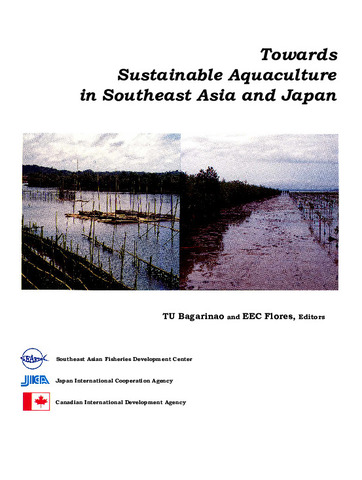
Towards sustainable aquaculture in Southeast Asia and Japan : proceedings of the Seminar-Workshop on Aquaculture Development in Southeast Asia, Iloilo City, Philippines, 26-28 July 1994
(Aquaculture Department, Southeast Asian Fisheries Development Center, 1995)Documents the presentations at ADSEA '94, the 3rd Seminar-Workshop on Aquaculture Development in Southeast Asia. ADSEA '94 includes reviews of the status of aquaculture development in Southeast Asia and Japan and of the researches conducted by Southeast Asian Fisheries Development Center, Aquaculture Department (SEAFDEC/AQD) to contribute to this development. Topics on responsible aquaculture, mollusc and seaweed culture, integrated farming, shrimp culture, diseases, and health management, and transgenic fish were also discussed. It also lists the research areas of 20 or so commodities prioritized for research at AQD for 1995-1997. -
Seaweed health problems: Major limiting factors affecting the sustainability of the seaweed aquaculture industry in the Philippines
Faisan, Jr., Joseph ; (Springer International Publishing, 2024)
The Philippines remains one of the top eucheumatoid seaweed producers worldwide. However, the reported seaweed health problems affecting farms have been one of the reasons for the decline in seaweed production in the country. Outbreaks of “ice-ice” disease (IID), epiphytic pests, and grazing problems have significantly reduced biomass yields and compromised carrageenan quality, directly affecting the livelihood of tens of thousands of families dependent on seaweed farming. In this chapter, we listed seaweed health problems based on type-association with the host seaweed plant and highlighted factors contributing to farm problems. Additionally, recommendations are presented that are relevant to the protection of the long-term sustainability of the eucheumatoid seaweed farming industry in the Philippines.
; (Springer International Publishing, 2024)
The Philippines remains one of the top eucheumatoid seaweed producers worldwide. However, the reported seaweed health problems affecting farms have been one of the reasons for the decline in seaweed production in the country. Outbreaks of “ice-ice” disease (IID), epiphytic pests, and grazing problems have significantly reduced biomass yields and compromised carrageenan quality, directly affecting the livelihood of tens of thousands of families dependent on seaweed farming. In this chapter, we listed seaweed health problems based on type-association with the host seaweed plant and highlighted factors contributing to farm problems. Additionally, recommendations are presented that are relevant to the protection of the long-term sustainability of the eucheumatoid seaweed farming industry in the Philippines. -
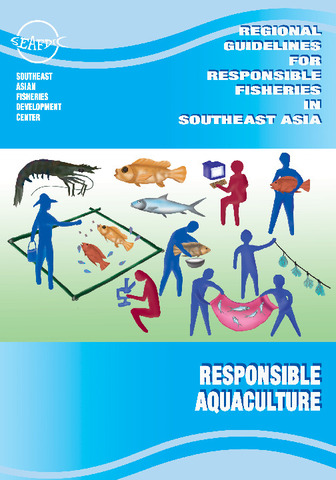
Regional guidelines for responsible fisheries in Southeast Asia: Responsible aquaculture
Bagarinao, TeodoraThis 43-page guidebook presents the code of conduct that has been re-written, expanded, clarified and annotated with definitions and examples to consider the fish farming industries in Southeast Asia. The source of the ... (Aquaculture Department, Southeast Asian Fisheries Development Center, 2005)