Training and information dissemination at SEAFDEC AQD


Share
Abstract
The SEAFDEC Aquaculture Department (AQD) is mandated to develop human resources and to disseminate and exchange information for aquaculture development in the region. In 1991-1994, a total of 294 participants attended 23 sessions of nine training courses. Many others participated in AQD's student practicum, internships, and summer work programs. AQD conducted seminarworkshops on aquaculture development in southeast Asia, fish breeding, feeds and feeding, and training needs. Information materials (newsletters, a monograph, two extension manuals, leaflets, and videos) were produced based on research at AQD. To assist fishfarmers and other sectors of the local aquaculture industry, AQD conducted on-site or outreach seminars, and provided resource persons during fairs and exhibits, seminars, and consultative meetings. The AQD Library is open to all users; in addition to the collection of printed materials, a CD-ROM reader is now available for fast retrieval of bibliographic information from computerized databases like ASFA.
Suggested Citation
Villegas, C. T. (1995). Training and information dissemination at SEAFDEC AQD. In T. U. Bagarinao & E. E. C. Flores (Eds.), Towards Sustainable Aquaculture in Southeast Asia and Japan: Proceedings of the Seminar-Workshop on Aquaculture Development in Southeast Asia, Iloilo City, Philippines, 26-28 July, 1994 (pp. 221-225). Tigbauan, Iloilo, Philippines: Aquaculture Department, Southeast Asian Fisheries Development Center.
Type
Conference paperISBN
971851127XKoleksi
- ADSEA '94 [21]
Related items
Showing items related by title, author, creator and subject.
-
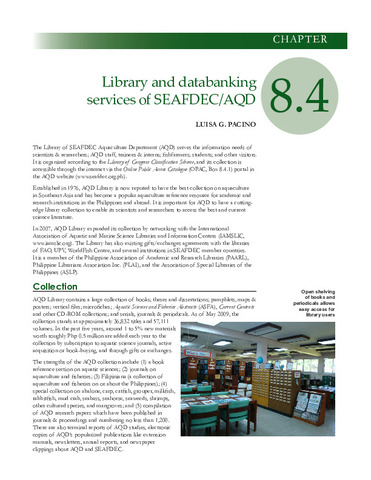
Library and databanking services of SEAFDEC/AQD
(Aquaculture Department, Southeast Asian Fisheries Development Center, 2009)The Library of SEAFDEC Aquaculture Department (AQD) serves the information needs of scientists & researchers; AQD staff, trainees & interns; fish farmers; students; and other visitors. It is organized according to the ... -
Unifying the art, science and business of aquaculture through the information resources and services of SEAFDEC Aquaculture Department Library
Alayon, Stephen ; Superio, Daryl ; ; Nemiz, Elvi S. (Secretariat, Southeast Asian Fisheries Development Center, 2013)
Established in 1973 in Tigbauan, Iloilo, Philippines, the Aquaculture Department (AQD) is one of four Departments of the Southeast Asian Fisheries Development Center (SEAFDEC). AQD is mandated to conduct scientific research to generate aquaculture technologies relevant and appropriate for the region; develop human resources; and produce, disseminate and exchange information on aquaculture. AQD is committed to sustainable development and the responsible stewardship of aquaculture resources through science-based research and the promotion of appropriate technologies and information relevant to the Southeast Asian region (SEAFDEC/AQD, 2009). The need to disseminate AQD’s research results is as important as the conduct of research in fisheries and aquaculture as referred to in the Code of Conduct for Responsible Fisheries (Wilkinson and Collins, 2007). In cognizance of the role that AQD should play with respect to its function of disseminating and exchanging information on aquaculture, the AQD Library was established to support the information needs of AQD scientists and staff. In addition, the Library also provides services to visiting researchers, local and international trainees and students, as well as the diverse users from AQD’s partner institutions. During the strategic planning workshop conducted by AQD in 2009, one of the goals identified was for AQD to strengthen the capacities of the aquaculture sector. Matching with such goal, the Library and Data Banking Services Section of the Training and Information Division identified its information dissemination and services target for 2012. Primarily, AQD Library aims to improve accessibility to archived and updated information, and to create a digital library collection of AQD publications and documents. In keeping up its goal of providing quality, current and relevant information, the Library continues to avail of quality print and non-print information resources, to ensure that it keeps abreast of the advancements in aquaculture and fulfil the diverse information needs of users. The Library also introduces innovations in its services with the purpose of unifying the art, science and business of aquaculture, and strengthens its local and international linkages for efficient sharing of knowledge and resources.
; Superio, Daryl ; ; Nemiz, Elvi S. (Secretariat, Southeast Asian Fisheries Development Center, 2013)
Established in 1973 in Tigbauan, Iloilo, Philippines, the Aquaculture Department (AQD) is one of four Departments of the Southeast Asian Fisheries Development Center (SEAFDEC). AQD is mandated to conduct scientific research to generate aquaculture technologies relevant and appropriate for the region; develop human resources; and produce, disseminate and exchange information on aquaculture. AQD is committed to sustainable development and the responsible stewardship of aquaculture resources through science-based research and the promotion of appropriate technologies and information relevant to the Southeast Asian region (SEAFDEC/AQD, 2009). The need to disseminate AQD’s research results is as important as the conduct of research in fisheries and aquaculture as referred to in the Code of Conduct for Responsible Fisheries (Wilkinson and Collins, 2007). In cognizance of the role that AQD should play with respect to its function of disseminating and exchanging information on aquaculture, the AQD Library was established to support the information needs of AQD scientists and staff. In addition, the Library also provides services to visiting researchers, local and international trainees and students, as well as the diverse users from AQD’s partner institutions. During the strategic planning workshop conducted by AQD in 2009, one of the goals identified was for AQD to strengthen the capacities of the aquaculture sector. Matching with such goal, the Library and Data Banking Services Section of the Training and Information Division identified its information dissemination and services target for 2012. Primarily, AQD Library aims to improve accessibility to archived and updated information, and to create a digital library collection of AQD publications and documents. In keeping up its goal of providing quality, current and relevant information, the Library continues to avail of quality print and non-print information resources, to ensure that it keeps abreast of the advancements in aquaculture and fulfil the diverse information needs of users. The Library also introduces innovations in its services with the purpose of unifying the art, science and business of aquaculture, and strengthens its local and international linkages for efficient sharing of knowledge and resources. -
Training programs of SEAFDEC Aquaculture Department
(Aquaculture Department, Southeast Asian Fisheries Development Center, 1988)With training as one of its three mandated functions, the SEAFDEC Aquaculture Department offered its first training course in 1974. Since then it has trained some 6 519 participants in various degree and non-degree programs. The degree courses are MS. Fisheries (Aquaculture) and M. Aquaculture in collaboration with the University of the Philippines in the Visayas. The non-degree programs include regular short-term courses, onsite seminars internship training and practicum for graduating students. The "hands-on" short-term courses cover Prawn Hatchery and Nursery, Marine Finfish Hatchery, Brackishwater Pond Culture, Sanitation and Culture of Bivalves, Freshwater Aquaculture, Aquaculture Management, Aquaculture Engineering, and Aquaculture for Social Scientists. A profile of 637 1982-1986 training participants show 82.3% from Southeast Asia, 79% male and 57.5% from government sector. The paper discusses planning and implementation of training programs, funding support (Japanese Government, International Development Research Centre of Canada, FAO Network of Aquaculture Centres in Asia), and future trends.