02 SEAFDEC/AQD Collaborative Publications: Recent submissions
Now showing items 96-100 of 453
-
Estimation of energy budget of sea cucumber, Holothuria scabra, in integrated multi-trophic aquaculture
; ; ; ; ; Lebata-Ramos, Ma. Junemie Hazel (Aquaculture Department, Southeast Asian Fisheries Development Center, 2015)
Continuous intensification of aquaculture production has brought about environmental issues associated with eutrophication worldwide. Environmental deterioration such as hypoxia and sulfide production due to water and sediment eutrophication originating from aquaculture effluents have been problematic, resulting to sporadic disease outbreaks and fish kills in the Philippines. Integrated multi-trophic aquaculture (IMTA) is one of the promising methods for sustainable aquaculture as it also provides a supplementary source of income to the fish farmers. IMTA is a polyculture system that integrates culturing of fed species (e.g. finfish) the main commodity, organic extractive species (e.g. deposit and filter feeding benthos) and inorganic extractive species (e.g. seaweed). In this study, IMTA techniques were established for small-scale coastal fish farmers in the Philippines, with sea cucumber (Holothuria scabra, commonly known as sandfish), as the key species. Sandfish commands the highest price in tropical sea cucumber species. Nitrogen (N) budget of sandfish in polyculture with milkfish (Chanos chanos) and Elkhorn sea moss (Kappaphycus alvarezii), both of which are commonly cultured in the Philippines, was estimated using a simple closed box model. Information on stocking density, stocking size, mortality, growth, feed ration, feed assimilation, NH4-N production and NH4-N absorption of these species was obtained from a series of experiments and existing literature. Culture conditions were as follows: 26 g milkfish were cultured in a 5 x 5 x 4 m cage at an average stocking density of 36.7 ind/m3 (i.e. usual practice in the Philippines) with an initial feeding ration of 10% of body weight which was gradually decreased to 4% over time; 10 g sandfish were cultured in a 5 x 5 x 0.3 m cage hung under the milkfish cage to trap particulate N waste (i.e. feces and leftover feed) from milkfish culture at a stocking density of 35 ind/m2; the stocking weight of Elkhorn sea moss line culture was 10 kg. The culture period was 200 days. It was estimated that milkfish culture under the above-mentioned schemes cumulatively produced 145 kg of particulate N, and milkfish and sandfish together excreted 60 kg of NH4-N in 200 days of culture. Daily assimilation rate of the particulate N by sandfish ranged from 3.4 to 12.4%, and 6.4% of the particulate N was estimated to be removed by sandfish during the entire 200 days of culture. Daily absorption rate of NH4-N by Elkhorn sea moss increased exponentially with time and reached 100% at 125 days of culture. Cumulative NH4-N from milkfish and sandfish excretion was estimated to be depleted by 162 days of culture. For complete utilization of particulate N by sandfish by the end of milkfish culture period (i.e. zero emission), sandfish stocking density should be 805 ind/m2, which is 200 times as high as that in existing sandfish aquaculture operations in countries such as Viet Nam and New Caledonia. The purpose of sandfish culture in IMTA should be emphasized in terms of its economic advantages and not very much on environmental integrity. Cages for sandfish culture should be designed in such a way where only a small fraction of organic matter from milkfish culture (i.e. about 6% in this culture scheme) enters it to avoid sediment quality deterioration and possible death of sandfish. Elkhorn sea moss on the other hand seems very efficient in bioremediation capability.
(Aquaculture Department, Southeast Asian Fisheries Development Center, 2015)
Continuous intensification of aquaculture production has brought about environmental issues associated with eutrophication worldwide. Environmental deterioration such as hypoxia and sulfide production due to water and sediment eutrophication originating from aquaculture effluents have been problematic, resulting to sporadic disease outbreaks and fish kills in the Philippines. Integrated multi-trophic aquaculture (IMTA) is one of the promising methods for sustainable aquaculture as it also provides a supplementary source of income to the fish farmers. IMTA is a polyculture system that integrates culturing of fed species (e.g. finfish) the main commodity, organic extractive species (e.g. deposit and filter feeding benthos) and inorganic extractive species (e.g. seaweed). In this study, IMTA techniques were established for small-scale coastal fish farmers in the Philippines, with sea cucumber (Holothuria scabra, commonly known as sandfish), as the key species. Sandfish commands the highest price in tropical sea cucumber species. Nitrogen (N) budget of sandfish in polyculture with milkfish (Chanos chanos) and Elkhorn sea moss (Kappaphycus alvarezii), both of which are commonly cultured in the Philippines, was estimated using a simple closed box model. Information on stocking density, stocking size, mortality, growth, feed ration, feed assimilation, NH4-N production and NH4-N absorption of these species was obtained from a series of experiments and existing literature. Culture conditions were as follows: 26 g milkfish were cultured in a 5 x 5 x 4 m cage at an average stocking density of 36.7 ind/m3 (i.e. usual practice in the Philippines) with an initial feeding ration of 10% of body weight which was gradually decreased to 4% over time; 10 g sandfish were cultured in a 5 x 5 x 0.3 m cage hung under the milkfish cage to trap particulate N waste (i.e. feces and leftover feed) from milkfish culture at a stocking density of 35 ind/m2; the stocking weight of Elkhorn sea moss line culture was 10 kg. The culture period was 200 days. It was estimated that milkfish culture under the above-mentioned schemes cumulatively produced 145 kg of particulate N, and milkfish and sandfish together excreted 60 kg of NH4-N in 200 days of culture. Daily assimilation rate of the particulate N by sandfish ranged from 3.4 to 12.4%, and 6.4% of the particulate N was estimated to be removed by sandfish during the entire 200 days of culture. Daily absorption rate of NH4-N by Elkhorn sea moss increased exponentially with time and reached 100% at 125 days of culture. Cumulative NH4-N from milkfish and sandfish excretion was estimated to be depleted by 162 days of culture. For complete utilization of particulate N by sandfish by the end of milkfish culture period (i.e. zero emission), sandfish stocking density should be 805 ind/m2, which is 200 times as high as that in existing sandfish aquaculture operations in countries such as Viet Nam and New Caledonia. The purpose of sandfish culture in IMTA should be emphasized in terms of its economic advantages and not very much on environmental integrity. Cages for sandfish culture should be designed in such a way where only a small fraction of organic matter from milkfish culture (i.e. about 6% in this culture scheme) enters it to avoid sediment quality deterioration and possible death of sandfish. Elkhorn sea moss on the other hand seems very efficient in bioremediation capability. -
Responsible shrimp culture through ecological approach
Tendencia, Eleonor (Aquaculture Department, Southeast Asian Fisheries Development Center, 2015)
Aquaculture is the fastest food-producing sector. It is the farming of aquatic organisms, like crustaceans, fish, molluscs and plants. Culture of aquatic organisms, particularly shrimps, is usually done in earthen ponds with some intervention in the rearing process to enhance production. Some of these processes to increase production are pond preparation, regular stocking, feeding, and the use of probiotics and other chemicals to improve soil, water quality, shrimp growth and immunity against diseases. The long range effect of the use of probiotics and other chemicals on the environment and on shrimps is unknown. Despite the various inputs, diseases continue to plague the industry, which could be due to the deteriorating environmental conditions that cause stress in shrimps thus making them susceptible to infection. Furthermore, chemicals and nutrients from aquaculture may affect biodiversity of the receiving environment. Responsible aquaculture is a sustainable development approach that meets the needs of the present generation without compromising the ability of future generations to meet their own needs. There should be a good balance between satisfying human needs while maintaining or enhancing the quality of the environment and conserving natural resources. Human health or food safety as well as economic efficiency and/or livelihood opportunities should be taken into consideration. Responsible shrimp culture through ecological approaches to improve environmental conditions is herewith described. Ecological approaches recognize the interactions between an aquaculture farm and the external environment, including environmental resources and local communities. Ecological approaches to improve environmental conditions identified from cross sectional, longitudinal and tank studies may be classified into culture systems and phases of pond production: pond preparation and rearing. Two culture systems are identified to improve water quality: 1) the use of the greenwater system, and 2) the presence of mangrove in the receiving environment. Among the pond preparation practices, sludge removal, crack drying of pond, and liming were identified. Toxic substances as well as organic matter, which provide nutrients necessary for the growth of microorganisms, are removed during sludge removal and crack drying of the pond sediment. Liming to pH 11 kills most harmful microorganisms including the white spot syndrome virus; it also kills unwanted species in the shrimp pond like fish and crabs. During the rearing phase, abundant supply of natural food, low stocking density, less input, addition of fermented Avicennia alba leaves, use of molasses and rest periods are some of the important farming practices that reduce risk of disease occurrence. Other reported practices are crop rotation, biofloc technology, aquaponics, and integrated multi trophic aquaculture. -
Fisheries, cultivation and research aspects of mud crab (Genus Scylla) in China
(Rajiv Gandhi Centre for Aquaculture (MPEDA), 2015)Mud crabs are distributed only along the coastal areas of southeast China. Of the four Scylla species found in China, Scylla paramamosain is the dominant species. The annual wild catch of mud crabs in mainland China was 60,000-70,000 mt. The highest annual production from farming was 120,000 mt. The main species cultured is S. paramamosain. Fattening (involves the feeding of immature female crabs until their ovaries become mature), polyculture and monoculture are commonly practiced. Farming is done in earthen ponds and pens in intertidal zone and mangrove area. The seeds for farming are mostly from the wild and only about 10% are sourced from the hatchery. Occurrence of diseases and differences in the population are the main problems in mud crab farming in China. At present, research activities on mud crab that are being undertaken include reproductive biology, hatchery and farming technology. Further research on the prevention of diseases and development of formulated diets (ingredient selection, nutritional requirements, pellet size, shape and stability) are necessary. -
Culture of Scylla serrata (Forskal) in cement ponds
(Rajiv Gandhi Centre for Aquaculture (MPEDA), 2015)Male and female Scylla serrata juvenile crabs were stocked separately in cement ponds (14 x 8 x 0.8 m; 90 m3) and reared for 90 days. The study was conducted at the Fisheries Research Station, JAU. Okha, Gujarat. The crabs were fed trash fish and Trochus spp. The survival rates of male and female crabs were higher in Run 1 at 66.11% and 45.55%, respectively, than in Run 2 at 13.9% and 6.1%, respectively. The mean body weights of males (1,704 g) and females (994.5g) in Run 1 were higher compared to those in Run 2 (381.2 g for males and 104.5 g for females). However, there were no significant differences (P>0.05) in the average daily weight gain of 0.19 g day-1 for males and 0.13 g day-1 for females in Run 1 and 0.16 g day-1 for males and 0.13 g day-1 for females in Run 2. The water parameter levels were within the optimum ranges for mud crab culture. The results indicate that it is not commercially viable to grow juveniles to market size in cement ponds based on the conditions in this study. -
Status of mud crab aquaculture in Bangladesh
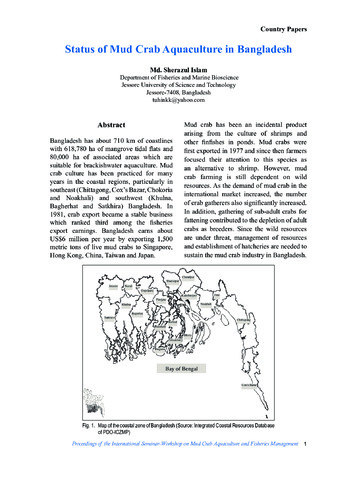
(Rajiv Gandhi Centre for Aquaculture (MPEDA), 2015)Bangladesh has about 710 km of coastlines with 618,780 ha of mangrove tidal flats and 80,000 ha of associated areas which are suitable for brackishwater aquaculture. Mud crab culture has been practiced for many years in the coastal regions, particularly in southeast (Chittagong, Cox’s Bazar, Chokoria and Noakhali) and southwest (Khulna, Bagherhat and Satkhira) Bangladesh. In 1981, crab export became a stable business which ranked third among the fisheries export earnings. Bangladesh earns about US$6 million per year by exporting 1,500 metric tons of live mud crabs to Singapore, Hong Kong, China, Taiwan and Japan. Mud crab has been an incidental product arising from the culture of shrimps and other finfishes in ponds. Mud crabs were first exported in 1977 and since then farmers focused their attention to this species as an alternative to shrimp. However, mud crab farming is still dependent on wild resources. As the demand of mud crab in the international market increased, the number of crab gatherers also significantly increased. In addition, gathering of sub-adult crabs for fattening contributed to the depletion of adult crabs as breeders. Since the wild resources are under threat, management of resources and establishment of hatcheries are needed to sustain the mud crab industry in Bangladesh.