02 SEAFDEC/AQD Collaborative Publications: Recent submissions
Now showing items 101-105 of 453
-
Molecular genetic approaches to resolve taxonomical ambiguity of mud crab species (Genus Scylla) in Indian waters
(Rajiv Gandhi Centre for Aquaculture (MPEDA), 2015)Mud crab or mangrove crab (Genus Scylla de Haan) is one of the most extensively cultured and economically important brachyuran crabs from the family Portunidae in Indo-Pacific countries, including India. Mud crabs exhibit variations in colour, size, spination, polygonal pattern and habitat. These contribute to the confusion in their identification. Accurate identification of the species is essential in the breeding programmes of domesticated stocks and is a crucial factor in the success of stock enhancement programmes. The taxonomic uncertainty of the genus Scylla in India is still an issue and several papers are being published using misleading identification. This is the first attempt to resolve the taxonomical ambiguity of mud crabs commonly found in Indian waters using multiple molecular genetic approaches. ITS-1, RAPD, PCRRFLP and mt-DNA sequencing along with traditional morphometric methods were used. Furthermore, a PCR method was developed by which mud crab species in India could be identified rapidly and accurately. The results of gene sequencing along with other molecular markers clearly indicated that the ‘green’ morph of Indian mud crab is S. serrata, while the ‘brown’ one is S. olivacea which was validated using the revised classification of mud crabs by Keenan et al. (1998). The S. serrata commonly mentioned in published literatures from India is S. olivacea and the S. tranquebarica, as believed by many Indian researchers, should be classified as S. serrata. Therefore, caution should be taken while interpreting or implementing the biological, molecular and aquaculture data published in those literatures. -
Development of practical diet for the grow-out culture of Scylla serrata in ponds
; ; Quinitio, Emilia T. (Rajiv Gandhi Centre for Aquaculture (MPEDA), 2015)
A series of feeding experiments were conducted in the laboratory and in ponds of SEAFDEC/AQD using hatchery-produced Scylla serrata juveniles to develop an effective pelleted grow-out diet. The practical feed ingredients included local and imported fishmeal, shrimp meal, copra meal, soybean meal, corn grits and squid liver powder. The other feed ingredients were rice bran, wheat pollard, bread flour and micronutrient mixes. The results in the laboratory trials were used to improve the feed composition for the culture of crab juveniles in grow-out ponds. Three runs (Run 1 - 108 days, Run 2 - 129 days and Run 3 - 114 days) were conducted in 270m2 ponds. Crab juveniles at stocking densities of 0.08 - 0.10m-2 were fed two dietary treatments containing 44% and 38% crude protein at similar dietary energy level estimated at 17 MJ/kg diet. There were no significant differences in the survival, growth and feed conversion ratio in each of the three runs. In Run 1, the survival rate of crabs fed with 44% protein was higher (56-77%) than crabs fed with 38% protein (35-50%), but these were not significantly different. In Run 2, < 5 g crabs could grow up to a mean body weight of 435 g with survival rates of 31- 45% after 129 days on a ration consisting of 80% pelleted formulated feed and 20% low value fish. Similarly in Run 3, a mean of 443 g was attained in less than 4 months with survival rates of 30-73%. The final average weight and specific growth rate of crabs fed these two diets were not significantly different which showed that in ponds, the 38% crude protein diet was able to sustain growth as with the 44% diet provided the dietary energy is similar. The feed conversion ratio for both test diets and low value fish showed a great variation (low value fish 1 to 4; test diets 1.81 to 5.6). This study showed that low value fish as the traditional feed for mud crab in the grow-out culture can be decreased to only 20% of the ration by incorporating 80% of formulated pelleted feed.
(Rajiv Gandhi Centre for Aquaculture (MPEDA), 2015)
A series of feeding experiments were conducted in the laboratory and in ponds of SEAFDEC/AQD using hatchery-produced Scylla serrata juveniles to develop an effective pelleted grow-out diet. The practical feed ingredients included local and imported fishmeal, shrimp meal, copra meal, soybean meal, corn grits and squid liver powder. The other feed ingredients were rice bran, wheat pollard, bread flour and micronutrient mixes. The results in the laboratory trials were used to improve the feed composition for the culture of crab juveniles in grow-out ponds. Three runs (Run 1 - 108 days, Run 2 - 129 days and Run 3 - 114 days) were conducted in 270m2 ponds. Crab juveniles at stocking densities of 0.08 - 0.10m-2 were fed two dietary treatments containing 44% and 38% crude protein at similar dietary energy level estimated at 17 MJ/kg diet. There were no significant differences in the survival, growth and feed conversion ratio in each of the three runs. In Run 1, the survival rate of crabs fed with 44% protein was higher (56-77%) than crabs fed with 38% protein (35-50%), but these were not significantly different. In Run 2, < 5 g crabs could grow up to a mean body weight of 435 g with survival rates of 31- 45% after 129 days on a ration consisting of 80% pelleted formulated feed and 20% low value fish. Similarly in Run 3, a mean of 443 g was attained in less than 4 months with survival rates of 30-73%. The final average weight and specific growth rate of crabs fed these two diets were not significantly different which showed that in ponds, the 38% crude protein diet was able to sustain growth as with the 44% diet provided the dietary energy is similar. The feed conversion ratio for both test diets and low value fish showed a great variation (low value fish 1 to 4; test diets 1.81 to 5.6). This study showed that low value fish as the traditional feed for mud crab in the grow-out culture can be decreased to only 20% of the ration by incorporating 80% of formulated pelleted feed. -
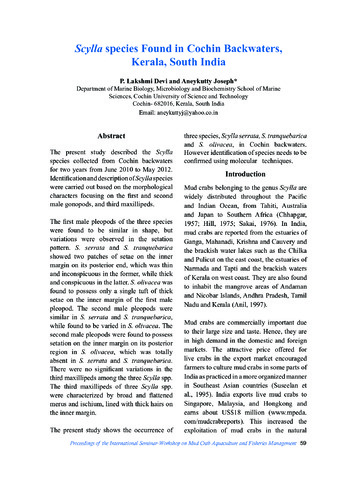
Scylla species found in Cochin backwaters, Kerala, South India
(Rajiv Gandhi Centre for Aquaculture (MPEDA), 2015)The present study described the Scylla species collected from Cochin backwaters for two years from June 2010 to May 2012. Identification and description of Scylla species were carried out based on the morphological characters focusing on the first and second male gonopods, and third maxillipeds. The first male pleopods of the three species were found to be similar in shape, but variations were observed in the setation pattern. S. serrata and S. tranquebarica showed two patches of setae on the inner margin on its posterior end, which was thin and inconspicuous in the former, while thick and conspicuous in the latter. S. olivacea was found to possess only a single tuft of thick setae on the inner margin of the first male pleopod. The second male pleopods were similar in S. serrata and S. tranquebarica, while found to be varied in S. olivacea. The second male pleopods were found to possess setation on the inner margin on its posterior region in S. olivacea, which was totally absent in S. serrata and S. tranquebarica. There were no significant variations in the third maxillipeds among the three Scylla spp. The third maxillipeds of three Scylla spp. were characterized by broad and flattened merus and ischium, lined with thick hairs on the inner margin. The present study shows the occurrence of three species, Scylla serrata, S. tranquebarica and S. olivacea, in Cochin backwaters. However identification of species needs to be confirmed using molecular techniques. -
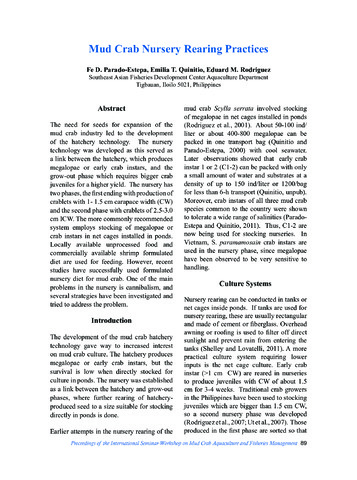
Mud crab nursery rearing practices
; Quinitio, Emilia T.; (Rajiv Gandhi Centre for Aquaculture (MPEDA), 2015)
The need for seeds for expansion of the mud crab industry led to the development of the hatchery technology. The nursery technology was developed as this served as a link between the hatchery, which produces megalopae or early crab instars, and the grow-out phase which requires bigger crab juveniles for a higher yield. The nursery has two phases, the first ending with production of crablets with 1- 1.5 cm carapace width (CW) and the second phase with crablets of 2.5-3.0 cm ICW. The more commonly recommended system employs stocking of megalopae or crab instars in net cages installed in ponds. Locally available unprocessed food and commercially available shrimp formulated diet are used for feeding. However, recent studies have successfully used formulated nursery diet for mud crab. One of the main problems in the nursery is cannibalism, and several strategies have been investigated and tried to address the problem. -
Status of mud crab industry in the Philippines
Quinitio, Emilia T. (Rajiv Gandhi Centre for Aquaculture (MPEDA), 2015)
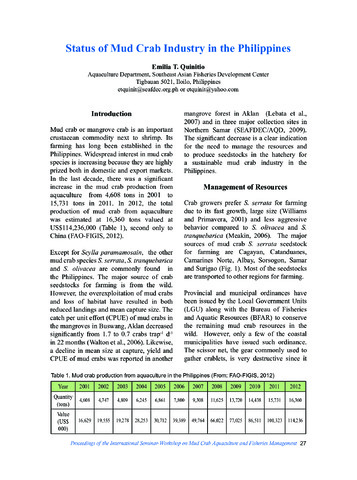
Mud crab farming has long been established in the Philippines. Scylla serrata, S. tranquebarica and S. olivacea are the common species found in the Philippines. S. serrata is the preferred species for farming by crab growers. The total production of mud crab from aquaculture was estimated at 13,720 valued at US$77,025,000 and 14,437 tons valued at US$86,511,000 in 2009 and 2010, respectively. The sources of crab seeds for farming are from the wild and in recent years, from the hatchery although in small percentage. The overexploitation of mud crabs and habitat losses have resulted in both reduced landings and mean capture size. To stem the wild harvest, the provincial and municipal government along with the Bureau of Fisheries and Aquatic Resources have introduced ordinances that prohibit the gathering and selling of crablets (≤ 3 cm) outside the municipality of origin. This resulted to increased acceptability of hatchery-reared crabs by crab growers. Basic technologies in all phases of culture (hatchery, nursery and grow-out) have been developed. However, there are still several issues that need to be addressed. In the hatchery phase, one of the major causes of low survival are the Molt Death Syndrome in which zoea 5 has difficulty molting to megalopa and diseases due to bacterial and fungal infection in eggs and larvae. The use of antibiotics as treatment for Vibrio spp. has proven to improve larval survival. However, the use of antibiotics can lead to the development of resistant strains of bacteria and abnormalities that become apparent at the juvenile stage. In the nursery phase, economic losses have been attributed to cannibalism. Providing sufficient food and shelters, reducing stocking density, size grading and removal or trimming of claws are the common strategies used to mitigate the high level of cannibalism. Recent findings showed that incorporating tryptophan in the diet can reduce the aggressive behavior of crabs. In the grow-out phase, culture of juvenile crabs to market size with one or two more commodities in earthen brackishwater ponds is the most prevalent practice. Due to the cannibalistic nature of mud crab, polyculture (usually with milkfish and shrimp) pond is carried out. Stocking density of each commodity varies with the size and the number of seed stock available and the abundance of natural food growth in the pond. Culture period ranges from 4-5 months. Monoculture of crabs is usually done for short term culture as in fattening in various systems. Mud crab culture is also integrated with the existing mangroves. Formulated diets have been verified in commercial grow-out ponds and showed promising results. Mud crabs are commonly fed with low value fish, molluscs and other unprocessed natural foods. Mortality in mud crabs in grow-out phase is oftentimes due to the white spot syndrome virus. The domestication of S. serrata has been done at SEAFDEC/AQD. The duration from spawning of the base population to F1 broodstock size was 10-14 months and from F1 to F2 was 11-12 months. Selective breeding of S. serrata is currently being done. The results serve as guide to understand and eliminate the obstacles to broodstock management and seed production. Recently, The Department of Science and Technology has funded the National Mud Crab Science and Technology Program being implemented by SEAFDEC/AQD and University of the Philippines Visayas to refine the existing technologies in all phases of culture and to aggressively promote the establishment of several mud crab hatcheries and nurseries in the Philippines. The Bureau of Fisheries and Aquatic Resources is also implementing the Philippine National Aquasilviculture Program, which includes the rehabilitation of mangrove forests and culture of commercially important aquatic animals including mud crab in established mangrove areas. On-site training on all phases of culture of mud crab has also been done by SEAFDEC/AQD not only in the Philippines but also in other countries like Brunei, Myanmar, India and Timor Leste. With the establishment of several hatcheries and nurseries, there will be sufficient seed stock supply for farming, thereby decreasing the dependence on wild stock.