02 SEAFDEC/AQD Collaborative Publications: Recent submissions
Now showing items 126-130 of 453
-
Series: Summary of Proceedings No. 1/2013;
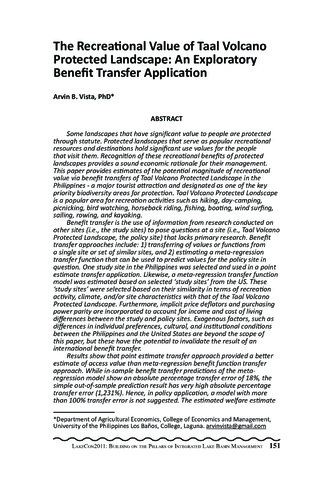
The recreational value of Taal Volcano protected landscape: An exploratory benefit transfer application
(PCAARRD-DOST, 2013)Some landscapes that have significant value to people are protected through statute. Protected landscapes that serve as popular recreational resources and destinations hold significant use values for the people that visit them. Recognition of these recreational benefits of protected landscapes provides a sound economic rationale for their management. This paper provides estimates of the potential magnitude of recreational value via benefit transfers of Taal Volcano Protected Landscape in the Philippines - a major tourist attraction and designated as one of the key priority biodiversity areas for protection. Taal Volcano Protected Landscape is a popular area for recreation activities such as hiking, day-camping, picnicking, bird watching, horseback riding, fishing, boating, wind surfing, sailing, rowing, and kayaking. Benefit transfer is the use of information from research conducted on other sites (i.e., the study sites) to pose questions at a site (i.e., Taal Volcano Protected Landscape, the policy site) that lacks primary research. Benefit transfer approaches include: 1) transferring of values or functions from a single site or set of similar sites, and 2) estimating a meta-regression transfer function that can be used to predict values for the policy site in question. One study site in the Philippines was selected and used in a point estimate transfer application. Likewise, a meta-regression transfer function model was estimated based on selected study sites from the US. These study sites were selected based on their similarity in terms of recreation activity, climate, and/or site characteristics with that of the Taal Volcano Protected Landscape. Furthermore, implicit price deflators and purchasing power parity are incorporated to account for income and cost of living differences between the study and policy sites. Exogenous factors, such as differences in individual preferences, cultural, and institutional conditions between the Philippines and the United States are beyond the scope of this paper, but these have the potential to invalidate the result of an international benefit transfer. Results show that point estimate transfer approach provided a better estimate of access value than meta-regression benefit function transfer approach. While in-sample benefit transfer predictions of the metaregression model show an absolute percentage transfer error of 18%, the simple out-of-sample prediction result has very high absolute percentage transfer error (1,231%). Hence, in policy application, a model with more than 100% transfer error is not suggested. The estimated welfare estimate of recreational access using point estimate transfer was P36/person per trip in 2006. The aggregated recreational benefits at the Taal Volcano Protected Landscape in 2006 was P9.7 million from 155,701 visitors at the Batangas side and P118.9 million from 1,906,242 visitors at the Cavite side, for a sum of about P128 million. This access value is not equivalent to economic resources that can be generated when visitor use fees is imposed to the users. User fees should be based on a willingness-to-pay (WTP) study that captures public perceptions and WTP fees, among others. -
Series: Summary of Proceedings No. 1/2013;
Morphological characterization using sensory canal pores and pit organs in goby fishes (Gobiidae) in Lake Mainit, Agusan del Norte
(PCAARRD-DOST, 2013)The taxonomic status of goby fishes in Lake Mainit, Agusan del Norte has not yet been properly established. Through morphological characterization, it could aid in identifying the fishes up to the species level. In this study, the arrangement of the sensory canal pores and pit organs on the cephalic region of the fish was used to determine its identity. Through this, it was known that all samples belong to Glossogobius giuris. Color patterns present after 95% ethanol immersion were also observed to evaluate which characteristics belong to this species even after decoloration. Procrustes Analysis was also employed to correlate the fish samples gathered in April 2006 and June 2007 in the study of Cherry Sara (2009) with the May 2009 samples obtained in this study by using the fishes morphometrics. This yielded a result that the fishes are correlated to one another with a correlation in a symmetric procrustes rotation value of 0.957 and Pvalue of 0.001. Therefore, fish samples collected from both studies are of the same species with respect to the similar season within a year. -
Series: Summary of Proceedings No. 1/2013;
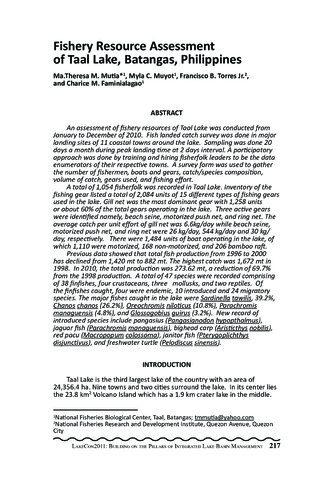
Fishery resource assessment of Taal Lake, Batangas, Philippines
(PCAARRD-DOST, 2013)An assessment of fishery resources of Taal Lake was conducted from January to December of 2010. Fish landed catch survey was done in major landing sites of 11 coastal towns around the lake. Sampling was done 20 days a month during peak landing time at 2 days interval. A participatory approach was done by training and hiring fisherfolk leaders to be the data enumerators of their respective towns. A survey form was used to gather the number of fishermen, boats and gears, catch/species composition, volume of catch, gears used, and fishing effort. A total of 1,054 fisherfolk was recorded in Taal Lake. Inventory of the fishing gear listed a total of 2,084 units of 15 different types of fishing gears used in the lake. Gill net was the most dominant gear with 1,258 units or about 60% of the total gears operating in the lake. Three active gears were identified namely, beach seine, motorized push net, and ring net. The average catch per unit effort of gill net was 6.6kg/day while beach seine, motorized push net, and ring net were 26 kg/day, 544 kg/day and 30 kg/day, respectively. There were 1,484 units of boat operating in the lake, of which 1,110 were motorized, 168 non-motorized, and 206 bamboo raft. Previous data showed that total fish production from 1996 to 2000 has declined from 1,420 mt to 882 mt. The highest catch was 1,672 mt in 1998. In 2010, the total production was 273.62 mt, a reduction of 69.7% from the 1998 production. A total of 47 species were recorded comprising of 38 finfishes, four crustaceans, three mollusks, and two reptiles. Of the finfishes caught, four were endemic, 10 introduced and 24 migratory species. The major fishes caught in the lake were Sardinella tawilis, 39.2%, Chanos chanos (26.2%), Oreochromis niloticus (10.8%), Parachromis managuensis (4.8%), and Glossogobius guirus (3.2%). New record of introduced species include pangasius (Pangasianodon hypopthalmus), jaguar fish (Parachromis managuensis), bighead carp (Aristicthys nobilis), red pacu (Macropopum colossoma), janitor fish (Pterygoplichthys disjunctivus), and freshwater turtle (Pelodiscus sinensis). -
Series: Summary of Proceedings No. 1/2013;
Preliminary observations on the diel vertical migration of crustacean zooplankton in aquaculture and aquaculture-free areas of Lake Taal, Philippines
(PCAARRD-DOST, 2013)Freshwater zooplankton in tropical caldera lakes with intensive aquaculture are exposed to physical, chemical, and biological influences that have differences with other lake types. This study compares the diel vertical migration of crustacean zooplankton between aquaculture and aquaculture-free areas in a tropical caldera lake (Lake Taal, Philippines). Environmental conditions showed little variation in both basins, and crustacean zooplankton showed similar DVM patterns. Wind-induced water movements, volcanic inputs and zooplankton exposure to similar levels of predation influenced zooplankton DVM in the lake. The zooplankton DVM patterns confirm that there is homogeneity in zooplankton composition and distribution in aquaculture and aquaculture-free areas. -
Series: Summary of Proceedings No. 1/2013;
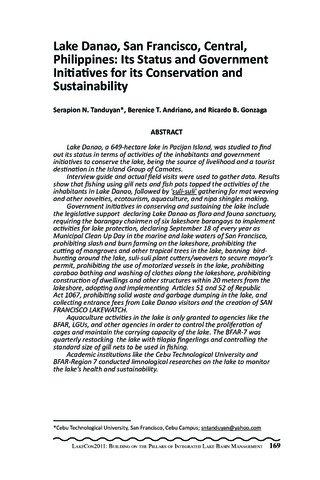
Lake Danao, San Francisco, central, Philippines: Its status and government initiatives for its conservation and sustainability
(PCAARRD-DOST, 2013)Lake Danao, a 649-hectare lake in Pacijan Island, was studied to find out its status in terms of activities of the inhabitants and government initiatives to conserve the lake, being the source of livelihood and a tourist destination in the Island Group of Camotes. Interview guide and actual field visits were used to gather data. Results show that fishing using gill nets and fish pots topped the activities of the inhabitants in Lake Danao, followed by 'suli-suli' gathering for mat weaving and other novelties, ecotourism, aquaculture, and nipa shingles making. Government initiatives in conserving and sustaining the lake include the legislative support declaring Lake Danao as flora and fauna sanctuary, requiring the barangay chairmen of six lakeshore barangays to implement activities for lake protection, declaring September 18 of every year as Municipal Clean Up Day in the marine and lake waters of San Francisco, prohibiting slash and burn farming on the lakeshore, prohibiting the cutting of mangroves and other tropical trees in the lake, banning birdhunting around the lake, suli-suli plant cutters/weavers to secure mayor s permit, prohibiting the use of motorized vessels in the lake, prohibiting carabao bathing and washing of clothes along the lakeshore, prohibiting construction of dwellings and other structures within 20 meters from the lakeshore, adopting and implementing Articles 51 and 52 of Republic Act 1067, prohibiting solid waste and garbage dumping in the lake, and collecting entrance fees from Lake Danao visitors and the creation of SAN FRANCISCO LAKEWATCH. Aquaculture activities in the lake is only granted to agencies like the BFAR, LGUs, and other agencies in order to control the proliferation of cages and maintain the carrying capacity of the lake. The BFAR-7 was quarterly restocking the lake with tilapia fingerlings and controlling the standard size of gill nets to be used in fishing. Academic institutions like the Cebu Technological University and BFAR-Region 7 conducted limnological researches on the lake to monitor the lake s health and sustainability.