02 SEAFDEC/AQD Collaborative Publications: Recent submissions
Now showing items 81-85 of 453
-
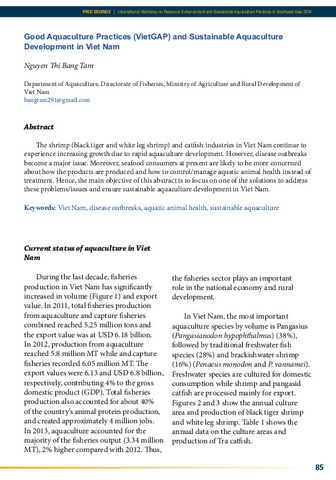
Good aquaculture practices (VietGAP) and sustainable aquaculture development in Viet Nam
(Aquaculture Department, Southeast Asian Fisheries Development Center, 2015)The shrimp (black tiger and white leg shrimp) and catfish industries in Viet Nam continue to experience increasing growth due to rapid aquaculture development. However, disease outbreaks become a major issue. Moreover, seafood consumers at present are likely to be more concerned about how the products are produced and how to control/manage aquatic animal health instead of treatment. Hence, the main objective of this abstract is to focus on one of the solutions to address these problems/issues and ensure sustainable aquaculture development in Viet Nam. -
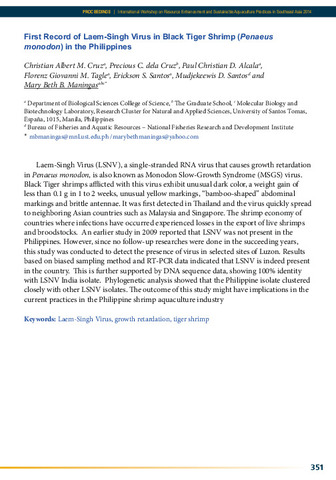
First record of Laem-Singh virus in black tiger shrimp (Penaeus monodon) in the Philippines
(Aquaculture Department, Southeast Asian Fisheries Development Center, 2015)Laem-Singh Virus (LSNV), a single-stranded RNA virus that causes growth retardation in Penaeus monodon, is also known as Monodon Slow-Growth Syndrome (MSGS) virus. Black Tiger shrimps afflicted with this virus exhibit unusual dark color, a weight gain of less than 0.1 g in 1 to 2 weeks, unusual yellow markings, bamboo-shaped abdominal markings and brittle antennae. It was first detected in Thailand and the virus quickly spread to neighboring Asian countries such as Malaysia and Singapore. The shrimp economy of countries where infections have occurred experienced losses in the export of live shrimps and broodstocks. An earlier study in 2009 reported that LSNV was not present in the Philippines. However, since no follow-up researches were done in the succeeding years, this study was conducted to detect the presence of virus in selected sites of Luzon. Results based on biased sampling method and RT-PCR data indicated that LSNV is indeed present in the country. This is further supported by DNA sequence data, showing 100% identity with LSNV India isolate. Phylogenetic analysis showed that the Philippine isolate clustered closely with other LSNV isolates. The outcome of this study might have implications in the current practices in the Philippine shrimp aquaculture industry. -
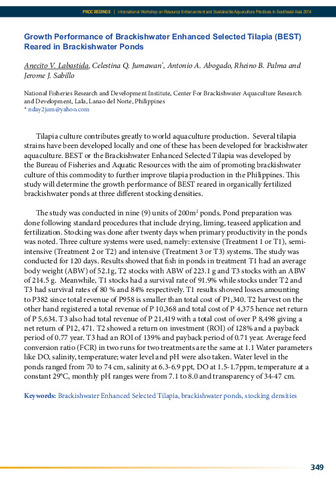
Growth performance of brackishwater enhanced selected tilapia (BEST) reared in brackishwater ponds
(Aquaculture Department, Southeast Asian Fisheries Development Center, 2015)Tilapia culture contributes greatly to world aquaculture production. Several tilapia strains have been developed locally and one of these has been developed for brackishwater aquaculture. BEST or the Brackishwater Enhanced Selected Tilapia was developed by the Bureau of Fisheries and Aquatic Resources with the aim of promoting brackishwater culture of this commodity to further improve tilapia production in the Philippines. This study will determine the growth performance of BEST reared in organically fertilized brackishwater ponds at three different stocking densities. The study was conducted in nine (9) units of 200m2 ponds. Pond preparation was done following standard procedures that include drying, liming, teaseed application and fertilization. Stocking was done after twenty days when primary productivity in the ponds was noted. Three culture systems were used, namely: extensive (Treatment 1 or T1), semiintensive (Treatment 2 or T2) and intensive (Treatment 3 or T3) systems. The study was conducted for 120 days. Results showed that fish in ponds in treatment T1 had an average body weight (ABW) of 52.1g, T2 stocks with ABW of 223.1 g and T3 stocks with an ABW of 214.5 g. Meanwhile, T1 stocks had a survival rate of 91.9% while stocks under T2 and T3 had survival rates of 80 % and 84% respectively. T1 results showed losses amounting to P382 since total revenue of P958 is smaller than total cost of P1,340. T2 harvest on the other hand registered a total revenue of P 10,368 and total cost of P 4,375 hence net return of P 5,634. T3 also had total revenue of P 21,419 with a total cost of over P 8,498 giving a net return of P12, 471. T2 showed a return on investment (ROI) of 128% and a payback period of 0.77 year. T3 had an ROI of 139% and payback period of 0.71 year. Average feed conversion ratio (FCR) in two runs for two treatments are the same at 1.1 Water parameters like DO, salinity, temperature; water level and pH were also taken. Water level in the ponds ranged from 70 to 74 cm, salinity at 6.3-6.9 ppt, DO at 1.5-1.7ppm, temperature at a constant 29°C, monthly pH ranges were from 7.1 to 8.0 and transparency of 34-47 cm. -
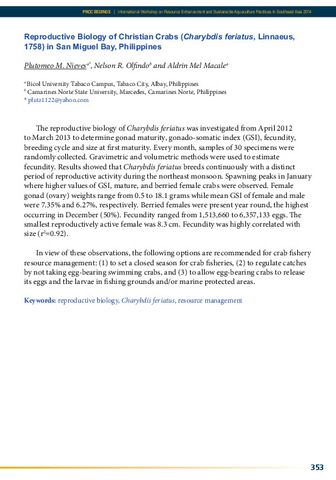
Reproductive biology of christian crabs (Charybdis feriatus, Linnaeus, 1758) in San Miguel Bay, Philippines
(Aquaculture Department, Southeast Asian Fisheries Development Center, 2015)The reproductive biology of Charybdis feriatus was investigated from April 2012 to March 2013 to determine gonad maturity, gonado-somatic index (GSI), fecundity, breeding cycle and size at first maturity. Every month, samples of 30 specimens were randomly collected. Gravimetric and volumetric methods were used to estimate fecundity. Results showed that Charybdis feriatus breeds continuously with a distinct period of reproductive activity during the northeast monsoon. Spawning peaks in January where higher values of GSI, mature, and berried female crabs were observed. Female gonad (ovary) weights range from 0.5 to 18.1 grams while mean GSI of female and male were 7.35% and 6.27%, respectively. Berried females were present year round, the highest occurring in December (50%). Fecundity ranged from 1,513,660 to 6,357,133 eggs. The smallest reproductively active female was 8.3 cm. Fecundity was highly correlated with size (r2=0.92). In view of these observations, the following options are recommended for crab fishery resource management: (1) to set a closed season for crab fisheries, (2) to regulate catches by not taking egg-bearing swimming crabs, and (3) to allow egg-bearing crabs to release its eggs and the larvae in fishing grounds and/or marine protected areas. -
Inland fisheries resource enhancement and conservation practices in Myanmar
(Aquaculture Department, Southeast Asian Fisheries Development Center, 2015)Myanmar has impressive freshwater capture fisheries. Inland freshwater bodies cover 8.1 million ha of which 1.3 million ha are permanent while the rest are seasonally inundated floodplains. There are repeated references to the crucial importance of fish and fish products in the nutrition of the Myanmar people. Over the past few decades, inland fisheries resources have increased pressure from overfishing, use of destructive fishing gear/methods, pollution and environment changes. In order to make a sustainable inland capture fisheries and conservation of aquatic biodiversity as well as nutritional security and improved rural livelihoods, fisheries resource enhancement and conservation measures have long been adopted in Myanmar since 1967, initiated through a seed replenishment program in natural waters, such rivers, lake, dams, even rice fields, etc. However, the institutional, policy, legislative and financial environments under which enhancement and capture fisheries regimes exist are not conducive to the interests of the fishers. Strong tools for valuation of ecosystem goods and services, enabling governance arrangements and estimation of environmental flows are needed. Fishing communities need to be organized into strong co-management/participatory/community regimes in order to ensure that all stakeholders take part in decision-making process and the benefits accrued are shared equitably by all.