The role of the Office International des Epizooties (OIE) in health improvement of aquatic animals


Share
Abstract
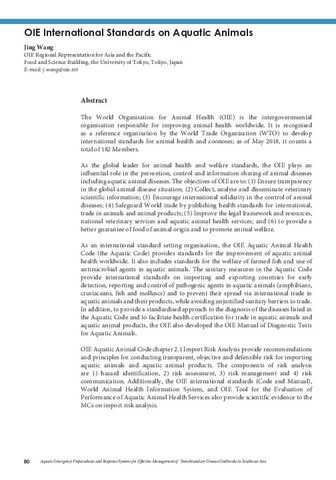
The paper discusses the roles of the Office International des Epizooties (OIE) in aquatic animal health. The main objectives of OIE are to: ensure transparency in the global animal disease situation; collect, analysis and disseminate scientific veterinary information; contribute expertise and encourage international solidarity in the control of animal diseases; to safeguard world trade in animals and animal products; improve the legal framework and resources of Veterinary Services; and to provide a better guarantee of the safety of food animal origin and to promote animal welfare through a science-based approach.
Suggested Citation
Oketani, Y. (2004). The role of the Office International des Epizooties (OIE) in health improvement of aquatic animals. In C. R. Lavilla-Pitogo & K. Nagasawa (Eds.), Transboundary Fish Diseases in Southeast Asia: Occurence, Surveillance, Research and Training. Proceedings of the Meeting on Current Status of Transboundary Fish Diseases in Southeast Asia: Occurence, Surveillance, Research and Training, Manila, Philippines, 23-24 June 2004 (pp. 35-40). Tigbauan, Iloilo, Philippines: SEAFDEC Aquaculture Department.
Type
Conference paperISBN
9718511695Related items
Showing items related by title, author, creator and subject.
-
OIE international standards on aquatic animals
(Aquaculture Department, Southeast Asian Fisheries Development Center, 2019)The World Organisation for Animal Health (OIE) is the intergovernmental organisation responsible for improving animal health worldwide. It is recognised as a reference organisation by the World Trade Organization (WTO) to develop international standards for animal health and zoonoses; as of May 2018, it counts a total of 182 Members. As the global leader for animal health and welfare standards, the OIE plays an influential role in the prevention, control and information sharing of animal diseases including aquatic animal diseases. The objectives of OIE are to: (1) Ensure transparency in the global animal disease situation; (2) Collect, analyse and disseminate veterinary scientific information; (3) Encourage international solidarity in the control of animal diseases; (4) Safeguard World trade by publishing health standards for international, trade in animals and animal products; (5) Improve the legal framework and resources, national veterinary services and aquatic animal health services; and (6) to provide a better guarantee of food of animal origin and to promote animal welfare. As an international standard setting organisation, the OIE Aquatic Animal Health Code (the Aquatic Code) provides standards for the improvement of aquatic animal health worldwide. It also includes standards for the welfare of farmed fish and use of antimicrobial agents in aquatic animals. The sanitary measures in the Aquatic Code provide international standards on importing and exporting countries for early detection, reporting and control of pathogenic agents in aquatic animals (amphibians, crustaceans, fish and molluscs) and to prevent their spread via international trade in aquatic animals and their products, while avoiding unjustified sanitary barriers to trade. In addition, to provide a standardised approach to the diagnosis of the diseases listed in the Aquatic Code and to facilitate health certification for trade in aquatic animals and aquatic animal products, the OIE also developed the OIE Manual of Diagnostic Tests for Aquatic Animals. OIE Aquatic Animal Code chapter 2.1 Import Risk Analysis provide recommendations and principles for conducting transparent, objective and defensible risk for importing aquatic animals and aquatic animal products. The components of risk analysis are 1) hazard identification, 2) risk assessment, 3) risk management and 4) risk communication. Additionally, the OIE international standards (Code and Manual), World Animal Health Information System, and OIE Tool for the Evaluation of Performance of Aquatic Animal Health Services also provide scientific evidence to the MCs on import risk analysis. -
Fish disease control in Japan
(Aquaculture Department, Southeast Asian Fisheries Development Center, 2019)The regulatory authority responsible for the control of aquatic animal diseases in Japan is the Animal Products Safety Division, Food Safety and Consumer Affairs Bureau, Ministry of Agriculture, Forestry, and Fisheries (MAFF). The ministry (Animal Products Safety Division) specifies certain diseases and their host species that are subjects for import quarantine on the basis of the law called Fisheries Resources Protection Act. The MAFF also implements risk control measures for the same diseases within Japan on the basis of another law, Fish Farming Production Maintaining Act. Currently, 24 such diseases are listed. For disease control within Japan, the MAFF issues Guideline for the Control of Aquatic Animal Diseases, which states the roles of different stakeholders, appropriate actions that are to be taken on the occurrences of specified or other diseases, fish health guidelines for fish farmers, or diagnostic methods for specified diseases, etc. Local prefectural governments in Japan are required to place personnel who work on fish health issues at the prefectural fisheries research laboratories. These people usually inspect fish farms, observe cultured aquatic animals, supervise the use of antibiotics or vaccines, and guide fish farmers for disease control. Disease diagnosis for aquatic animals is usually conducted by these local fisheries research labs for free. The Japan Fisheries Resource Conservation Association provides a comprehensive training course on fish diseases including laws or hands-on trainings for the staff of prefectural fisheries research laboratories. The JFRCA also give local fish health personnel the qualification as the fish health expert, if the person passes the examination conducted after the training course. Primary diagnosis for specified diseases is conducted by local fisheries laboratories. On the occurrence of the diseases that are suspected to be one of the specified diseases or OIE listed diseases that have not been reported in Japan, the samples are sent to the National Research Institute of Aquaculture (NRIA) where confirmatory diagnosis is made. When such diseases are confirmed, it is reported to the MAFF (or to the OIE through MAFF). For specified diseases, Fish Farming Production Maintaining Act enables local governments to implement necessary measures to prevent the disease from spreading, including issuing orders such as to stop the transfer of the animals to other watersheds, to destroy animals, or to disinfect the facilities. When an unknown disease is encountered by a prefectural fisheries research laboratory, the NRIA is requested to conduct diagnosis. The NRIA develops diagnostic methods for new diseases and disseminate the techniques to local fisheries research laboratories. The NRIA provide positive control materials for disease diagnosis, hands-on trainings of specific subjects concerning diagnostic techniques, or proficiency tests for the fish health personnel of the local fisheries research laboratories. -
Country status of aquatic emergency preparedness and response systems for effective management of aquatic animal disease outbreaks in Myanmar
(Aquaculture Department, Southeast Asian Fisheries Development Center, 2019)Myanmar is one of the OIE members and the Department of Fisheries (DoF) is highly concerned with transboundary aquatic animal pathogens. Therefore, the Aquatic Animal Health & Disease Control Section has already been formed not only for field diagnostic surveys but also for border control especially at international airport and border trade areas by checking and counter checking export and import of aquatic animals and products. At the moment, the DoF is stressing an issue of some transboundary diseases for finfish such as Gyrodactylus sp., Dactylogyrus sp., Argulus sp., Trichodena sp., Streptococcus sp., Aeromonas sp., and for crustacean are MrNV/XSV and WSSV. In addition, the DoF is facing challenges with parasitic disease and bacterial disease problems due to poor water quality management at culturing fish ponds. For the prevention and control of fish diseases within the country, the DoF is issuing Health Certificates by physical and microbiological examination of fishes and fisheries products. At the same time, Quarterly report on fish disease has being regularly submitted to NACA, OIE since 1998 until now. Although the DoF has no specific law and legislation on the control of quarantine pest and disease of aquatic animal, a good aquaculture practice has been implemented and code of conduct responsible for aquaculture is being followed in the country. The aquatic health management is a challenging issue in aquaculture development. Myanmar is still needing technical assistance to improve quarantine system especially for importation and exportation of live aquatic animals. Moreover, monitoring and surveillance programs with harmonized aquatic emergency preparedness and response system are required to boost up not only for Myanmar but also for effective management of transboundary disease outbreaks in Southeast Asia.