An idealized rural coastal zone management integrating land and water use


Share
Abstract
Various countries have formulated special integrated coastal zone management (ICZM) strategies which seek to both manage development and conserve natural resources and integrate and coordinate the relevant people sectors and their functions and roles within the bounds of this rich realm. Concerns that may be addressed by ICZM include: 1) Natural resources degradation; 2) Pollution; 3) Land use conflicts; and, 4) Destruction of life and property by natural hazards. Some prevalent sources of environmental impacts (livelihoods) are listed, together with some recommendations to the concerns which they may raise in relation to coastal zone management: agriculture; aquaculture; fisheries; forestry; human settlements; tourism; and, transport industry.
Suggested Citation
Dagoon, N. J. (1998). An idealized rural coastal zone management integrating land and water use. SEAFDEC Asian Aquaculture , 20(3), 18-21. http://hdl.handle.net/10862/1794
Type
magazineArticleISSN
0115-4974Collections
Related items
Showing items related by title, author, creator and subject.
-
Using local user perceptions to evaluate outcomes of protected area management in the Sagay Marine Reserve, Philippines
(Cambridge University Press, 2004)Local user perceptions of resource trajectory and indicators of protected area outcomes can be useful in the assessment of integrated conservation projects, both marine and terrestrial. In-depth stakeholder surveys using 12 performance indicators were used to evaluate the perceived outcomes of the Sagay Marine Reserve (SMR), the Philippines. These indicators were a measure of whether the SMR had achieved its management objectives in the recent past and what local stakeholders expected in the future. The respondents contextual situation could be correlated with their perceptions of SMR indicators. There was a generally high level of perceived equity and efficiency of SMR management outcomes, but the sustainability of the SMR, particularly the condition of the fisheries, had been poor over the previous 10 years. Few anticipated an improvement in sustainability indicators over the next 10 years. Respondents from an island village within the SMR had more negative (or less positive) perceptions of SMR outcomes because of their high dependence on the degraded resource, combined with physical and economic isolation. Specific remedies to enhance island villagers satisfaction, such as greater participation, empowerment, alternative economic opportunities and fisheries protection, and replenishment, are necessary. This research serves as an example of how indicators perceived by local resource-accessing stakeholders can and should be main components of both marine and terrestrial protected area assessment. -
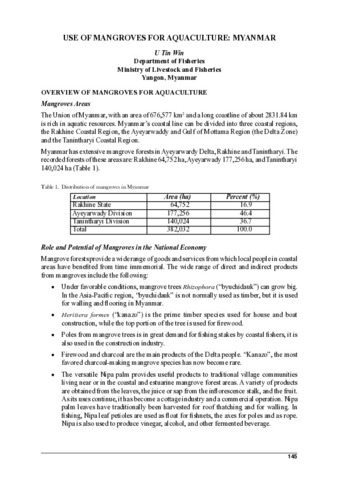
Use of mangroves for aquaculture: Myanmar.
(Aquaculture Department, Southeast Asian Fisheries Development Center, 2004)Aquaculture has only started to develop rapidly in the past few decades, due to better knowledge of culture species, improved methodologies and techniques in breeding, nutrition and increasing demand for food fish of high-value species such as shrimps, sea bass and groupers. Mangrove deforestation has an impact on shrimp culture itself, the success of the latter (when traditional culture method is used) depends on stocking of wild fry. For semi-intensive and intensive shrimp culture, the number of wild caught spawners may decrease because wild shrimp populations also use mangrove swamps as its feeding ground. Other negative effects of mangrove destruction to make way to shrimp ponds, include water pollution from pond effluents, sedimentation from the release of solid materials from pond, interruption of the tidal water flow, dwindling natural shrimp and fish stock due to increased pollution or product contamination due to indiscriminate use of chemicals. Chemicals and drugs (antibiotic) should not be used in fish and shrimp culture for prevention and control of bacteria and viral diseases. In order to ensure the sustainable development of aquaculture, it is important to bear in mind the interdependence of technology and natural resource under various socioeconomic setting. -
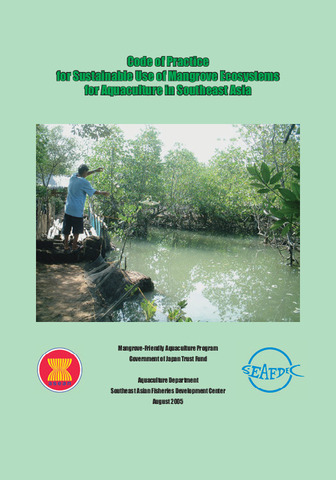
Code of practice for sustainable use of mangrove ecosystems for aquaculture in Southeast Asia
Bagarinao, TeodoraThis 47-page guidebook presents the 22 concepts, principles or policy statements that prescribe the preferred ways of doing and acting to ensure the sustainable use of mangroves for fish farming. It is annotated with ... ; Primavera, Jurgenne (Aquaculture Department, Southeast Asian Fisheries Development Center, 2005)