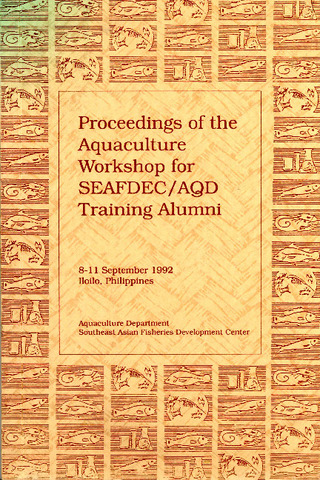
Proceedings of the Aquaculture Workshop for SEAFDEC/AQD Training Alumni, 8-11 September 1992, Iloilo, Philippines


Share
Abstract
The workshop was conducted to maintain linkage between Southeast Asian Fisheries Development Center, Aquaculture Department and its alumni. It also aimed to: assess the effectiveness of the training alumni and among trainees; inform alumni of the recent technologies developed by the Department; recommend ways to make the training courses more responsive to the needs of the fish farmers and the aquaculture industry. The training alumni identified several problems regarding the capability of the technical staff in aquaculture, i.e. shrimp seed production, marine fish seed production, grow-out culture, and fish diseases. The contributions of the selected participants during the meeting which are contained in this volume are cited individually.
Suggested Citation
Villegas, C. T., Castaños, M. T., & Lacierda, R. B. (Eds.). (1993). Proceedings of the Aquaculture Workshop for SEAFDEC/AQD Training Alumni, 8-11 September 1992, Iloilo, Philippines. Tigbauan, Iloilo, Philippines: Aquaculture Department, Southeast Asian Fisheries Development Center.
Type
Book; Conference publicationISBN
9718511253Related items
Showing items related by title, author, creator and subject.
-
Socioeconomics of tilapia culture in Asia
(Aquaculture Department, Southeast Asian Fisheries Development Center, 1998) -
Recent developments in aquaculture in Japan
(Aquaculture Department, Southeast Asian Fisheries Development Center, 1995)Aquaculture production in Japan in 1993 was 1,351,000 tons, 15.6% of the total fisheries production. About 93.6% came from mariculture and 6.4% from freshwater aquaculture. The per cent contribution of aquaculture to total production has increased in recent years but partly because marine fisheries,especially of sardine and pollack, have decreased. Aquaculture has reached a plateau, and decreased slightly between 1992 and 1993. Diverse marine and freshwater species are cultured in Japan — various fishes, crustaceans, mollusks, seaweeds, sea squirt, sea urchin, and others. Research and development in mariculture focus on finding substitutes for animal protein in feeds, improvement of fish quality, protection of the culture environment, use of offshore floating culture systems, and protection from diseases. Research in freshwater aquaculture has expanded to include recreational fishing, the propagation and preservation of endangered species, and the construction of fish ladders for salmonids and other migratory species. -
Transboundary aquatic animal diseases: History and impacts in ASEAN aquaculture
(Aquaculture Department, Southeast Asian Fisheries Development Center, 2019)Aquaculture is one of the important sectors in the economy of most Asia-Pacific countries. However, majority of aquaculture farms are small-scale and most often lack the necessary facilities to comply with or are not well informed of the product standards imposed by concerned authorities, especially for international trade. Most countries in the region have a high reliance on aquatic animals as the major source of protein for their populations. In the past 20 years, farming of shrimp and fish for export has become a major employer and revenue earner for many countries in the region. Aquaculture is a major employer, contributes significantly to national economies, assists in poverty reduction, and is an important element in food security and other national development priorities. Aquaculture has developed rapidly in the region and is now a significant component in the national economies of many countries. However, recent disease events in fish and shrimp farming have indicated that preparedness and response measures are lacking, contributing to spread of disease across large areas of the countries involved. The growth of aquaculture in recent decades has been dependent on the international movement of aquatic animals and, in particular, the introduction of non-native species. The movement of live aquatic animals and their products has the potential to spread pathogens from one country or region to another, which may result to disease outbreaks. In shrimps as example, most major disease outbreaks were associated with the movement of live animals (broodstock, nauplii and postlarvae) when the patterns of disease spread were analyzed. Many aquatic animal diseases, once established, are often difficult to treat or to eliminate. Over the past 30 years, the Asia-Pacific region has been swept by a number of devastating diseases of aquatic animals which have caused massive economic and social losses. These include spread and outbreaks of infection with Aphanomyces invadans (EUS) in freshwater fish, viral nervous necrosis (VNN) in marine fish, viral hemorrhagic septicaemia (VHS) in marine and freshwater fish, and several viral diseases in shrimps such as white spot disease (WSD), white tail disease (WTD), yellow head disease (YHD) and infectious myonecrosis (IMN) among others. This demonstrates the vulnerability of the aquaculture industry as well as the wild populations to disease emergence in the region. The impacts of these diseases have been aggravated by the lack of effective preparedness and response whenever diseases emerge. Although some national, regional and international actions towards disease emergencies have paved way to disease spread prevention in recent years (e.g. Acute hepatopancreatic necrosis diseases; AHPND), there are still several emerging diseases that need to be considered by aquaculture-producing countries, especially in the ASEAN, through a harmonized and effective emergency preparedness and disease response.