Integration of finfish in shrimp (Penaeus monodon) culture: an effective disease prevention strategy


Share
抄録
A farm trial on integration of finfish (i.e., tilapia) in shrimp (Penaeus monodon) culture was conducted in Negros Occidental, Philippines to prevent luminous vibriosis in shrimp. The farm engaged in shrimp monoculture from 1987 to 1995. However, the prevailing luminous vibriosis outbreaks that started in 1994 prompted the farm operator to shift to tilapia culture in 1995-1996. The farm resumed shrimp operations in 1996 but by this time tilapia had already been integrated in the culture system. This paper reports on the results of the trial for 1999 using three ponds (ponds 7, 9, 29). These ponds had previously been used for tilapia culture for two years. During shrimp culture, they drew water from reservoirs stocked with tilapia and within the shrimp ponds tilapia are also stocked inside cages. This technology integrates crop rotation, biological pretreatment and polyculture into one system. During the culture period the chemical and bacteriological quality of soil, water and shrimp were monitored. Water quality parameters were within normal ranges for shrimp culture. Luminous bacterial counts in water and shrimp were consistently below 10 colony forming units (cfu)/ml and 103 cfu/hepatopancreas (hp), respectively. These levels are below threshold levels associated with luminous vibriosis outbreaks. With a stocking density of 19.43 shrimp postlarvae (PL)/m2, pond 7 yielded 2,605 kg shrimp/ha with an estimated survival of 35.65% after 109 days of culture (DOC). With a stocking density of 18.69 PL/ m2, pond 9 yielded 5,472 kg shrimp/ha with survival of 100% after 148 DOC. With a stocking density of 19.33 PL/m2, Pond 29 yielded 5,702 kg shrimp/ha with survival of 82.66% after 151 DOC. The relatively low production in pond 7 can be attributed to the inferior quality of the batch of stocked shrimp PL that already had a low survival of 50% at DOC 30. Comparing the production performance from this present trial with that of this and other farms before the 1994 outbreaks, these good results cannot simply be attributed to chance despite of the lack of control in this farm trial. These results are consistent with the results of a previous trial of the same farm, the ongoing verification trials in Negros Occidental, and the observations of many farmers in other parts of the country on the potential of shrimp-finfish integration in preventing luminous vibriosis in shrimp.
Suggested Citation
Paclibare, J. O., Usero, R. C., Somga, J. R., & Visitacion, R. N. (2002). Integration of finfish in shrimp (Penaeus monodon) culture: an effective disease prevention strategy. In Y. Inui & E. R. Cruz-Lacierda (Eds.), Disease Control in Fish and Shrimp Aquaculture in Southeast Asia - Diagnosis and Husbandry Techniques: Proceedings of the SEAFDEC-OIE Seminar-Workshop on Disease Control in Fish and Shrimp Aquaculture in Southeast Asia - Diagnosis and Husbandry Techniques, 4-6 December 2001, Iloilo City, Philippines (pp. 151-171). Tigbauan, Iloilo, Philippines: SEAFDEC Aquaculture Department.
Type
Conference paperISBN
9718511601Related items
Showing items related by title, author, creator and subject.
-
Series: Aquaculture extension manual; No. 16
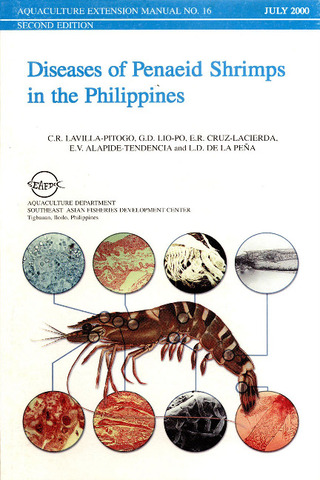
Diseases of penaeid shrimps in the Philippines
; ; ; Tendencia, Eleonor ; (Aquaculture Department, Southeast Asian Fisheries Development Center, 2000)
The manual provides information on the diseases that affect the 3 major species of shrimps cultured in the Philippines: Penaeus monodon, P. merguiensis and P. indicus. It includes the common name of the disease, causative agent, species affected, stages affected, gross signs, effects on the host and methods of prevention and treatment. This revised edition includes newly discovered diseases. It is hoped that the manual will be of considerable help to shrimp farmers in identifying the disease and lead to prevention or early disease diagnosis and control.
; (Aquaculture Department, Southeast Asian Fisheries Development Center, 2000)
The manual provides information on the diseases that affect the 3 major species of shrimps cultured in the Philippines: Penaeus monodon, P. merguiensis and P. indicus. It includes the common name of the disease, causative agent, species affected, stages affected, gross signs, effects on the host and methods of prevention and treatment. This revised edition includes newly discovered diseases. It is hoped that the manual will be of considerable help to shrimp farmers in identifying the disease and lead to prevention or early disease diagnosis and control. -
Current status of shrimp farming and diseases in Cambodia
(Aquaculture Department, Southeast Asian Fisheries Development Center, 2016)The farming of penaeid shrimps in Cambodia began in 1989 and has significantly expanded since 1991. Shrimp cultivation has been carried out in the four coastal provinces, i.e. Kampot, Kep, Preah Sihanouk Ville, and Koh Kong. Black tiger shrimp (Penaeus monodon) and whiteleg shrimp (P. vannamei) are the main species being cultured extensively and intensively in brackishwater ponds in Kampot, Kep, and Preah Sihanouk Ville, and Koh Kong, respectively. Extensive shrimp ponds were constructed close to the mangrove areas with some containing mangroves within the pond and stocking density ranging from 5,000 to 20,000 postlarvae/ha. However, the productivity remains low at >100 kg/ ha/ year. On the contrary, intensive culture has a stocking density ranging from 300,000 to 500,000 postlarvae/ha. While high cost of investment for farm establishment, pond construction and farm operation are required, productions of newly established farms have reached 7 to 8 metric tons (MT) /ha per crop. The occurrence of white spot disease, monodon baculovirus disease, and yellow head disease was first reported in 1999 among cultured P. monodon in Koh Kong province causing a number of farmers to stop the intensive cultivation of black tiger shrimp. To date, only a small proportion of shrimp farmers have ventured into extensive shrimp farming with approximately 10 ha of shrimp areas currently in operation. To mitigate the negative impacts of shrimp diseases and promote the expansion of the shrimp industry in Cambodia, development of a national reporting system for aquatic animal diseases; capacity building for detection, monitoring and disease surveillance; creation of National Guidelines On Good Shrimp Aquaculture Practices; establishment of subresearch centers and concomitant funding support for marine aquaculture development and extension services; establishment of local shrimp hatcheries and provision of hands-on trainings for farmers; and strengthening collaborations among provincial officers, researchers and farmers network should be accordingly instituted. -
Status of acute hepatopancreatic necrosis disease (AHPND) of cultured shrimps in the Philippines
(Aquaculture Department, Southeast Asian Fisheries Development Center, 2016)Shrimp is the fourth most important aquaculture commodity in the Philippines in terms of production quantity and second in terms of export value. The two species of shrimp being cultivated in the Philippines are the black tiger shrimp (Penaeus monodon) and Pacific white shrimp (P. vannamei). Although shrimp production markedly declined in the 1990 s due to luminescent vibriosis and white spot disease caused by Vibrio harveyi and white spot syndrome virus (WSSV), respectively, the industry was able to recover due to collaborative and participatory efforts of both the public and private sectors. Recovery programs focused on improving culture technologies, prevention and control of disease introduction and outbreaks and environmental enhancement. However, serious outbreaks of an emerging transboundary disease named acute hepatopancreatic necrosis disease (AHPND) caused by unique strains of V. parahaemolyticus have recently caused heavy economic losses among shrimps growers in some major shrimp producing provinces in the country, thereby threatening production growth and export expansion of the Philippine shrimp industry. This paper presents the status of AHPND in cultured penaeids and activities of the National Shrimp Health Management Program (NSHMP) of the Bureau of Fisheries and Aquatic Resources (BFAR) on importation policies, disease surveillance, monitoring and reporting, disease diagnosis, and preventive and control measures against AHPND and other transboundary diseases of cultured penaeids in the Philippines.