Apparent digestibility of selected ingredients in diets for juvenile grouper, Epinephelus coioides (Hamilton)

Share
นามธรรม
Apparent digestibility coefficients (ADCs) for dry matter (ADCdm) and crude protein (ADCcp) of selected feed ingredients were determined in vivo for grouper using passive faeces collection (Guelph System). A reference diet (RF) and test diets (consisted of 70% RF and 30% test ingredient) with 1% Cr2O3 as an inert indicator were used. An RF contained 45% protein, 10% fat and 15.7 kJ g−1 metabolizable energy. Three isonitrogenous and isocaloric diets, each contained a test ingredient (white fish meal, white cowpea meal and ipil-ipil leaf meal), were used in a growth study based on ADCcp of feed ingredients. An RF without Cr2O3 was a control. The ADC values of experimental diets were also determined. In grouper, the ADCdm of white cowpea meal, defatted soybean meal, wheat flour and shrimp meal (74–76%) were significantly lower than that of squid meal (99%), but comparable with those of the fish meals (84–89%). No significant difference was observed between the ADCdm of ipil-ipil leaf meal, rice bran and wheat flour (56–73%). The ADCcp of white cowpea meal and defatted soybean meal were similar to those of the fish meals, squid meal and shrimp meal (94–99%). The ADCcp of wheat flour was comparable with that of ipil-ipil leaf meal (79–83%). Rice bran had the lowest ADCcp value of 43%. Based on specific growth rate (SGR), the growth of fish fed white cowpea meal-based diets was similar to that of the control fish (3.2–3.3% day−1). Also, no significant difference was observed between the ADCdm (68–72%) and ADCcp (88–91%) of white cowpea meal-based diet and the control diet. The results suggest that ADC values can be used as indicators to determine the nutritional value of feed ingredients. White cowpea meal can be incorporated as a protein source in practical diet for grouper at 20.5% of the diet with no adverse effect on growth.
การอ้างอิง
Eusebio, P. S., Coloso, R. M., & Mamauag, R. E. P. (2004). Apparent digestibility of selected ingredients in diets for juvenile grouper, Epinephelus coioides (Hamilton). Aquaculture Research , 35(13), 1261-1269. https://doi.org/10.1111/j.1365-2109.2004.01148.x
Type
ArticleISSN
1355-557X; 1365-2109คอลเลกชัน
- Journal Articles [1267]
Related items
Showing items related by title, author, creator and subject.
-
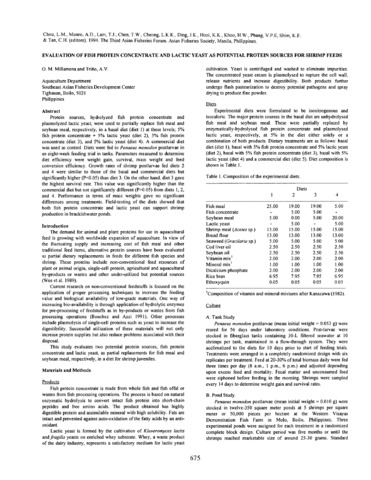
Evaluation of fish protein concentrate and lactic yeast as protein sources for shrimp feeds
(Asian Fisheries Society, 1994)Protein sources, hydrolyzed fish protein concentrate and plasmolyzed lactic yeast, were used to partially replace fish meal and soybean meal, respectively, in a basal diet (diet 1) at these levels; 5% fish protein concentrate + 5% lactic yeast (diet 2), 5% fish protein concentrate (diet 3), and 5% lactic yeast (diet 4). A commercial diet was used as control. Diets were fed to Penaeus monodon postlarvae in an eight-week feeding trial in tanks. Parameters measured to determine diet efficiency were weight gain, survival, mass weight and feed conversion efficiency. Growth rates of shrimp postlarvae fed diets 2 and 4 were similar to those of the basal and commercial diets but significantly higher (P<0.05) than diet 3. On the other hand, diet 3 gave the highest survival rate. This value was significantly higher than the commercial diet but not significantly different (P>0.05) from diets 1, 2, and 4. Performance in terms of mass weights gave no significant differences among treatments. Field-testing of the diets showed that both fish protein concentrate and lactic yeast can support shrimp production in brackishwater ponds. -
Earthworm, marine annelids and squid as feed ingredients in formulated diets for juvenile Penaeus monodon
(Aquaculture Department, Southeast Asian Fisheries Development Center, 1985)Earthworm and annelids were incorporated in diets for Penaeus monodon juveniles (mean weight 0.54 g) either in wet or dry form. These protein sources were added in amounts needed to replace 10% of the animal source of protein. Other sources of protein in the diet were shrimp head meal, fish meal, and defatted soybean meal. Diets were computed such that two-thirds of total protein came from animal sources and one-third from vegetable sources. Other components of the diet were rice bran, sago palm starch, cod liver oil and a vitamin-mineral mixture. Another diet, used as maintenance diet, served as control. Postlarvae were randomly stocked at 6 individuals/tank in a flowthrough system with 5 replicates/treatment. Each of the oval fiberglass tanks had three 10-cm diameter PVC pipes for shelter. The prawns were fed 10% of biomass twice daily. Although treatment means for percent weight gain were not significantly different, the diet that contained dried earthworm or annelid meal gave higher weight gain than diets containing the wet form. The earthworm diet gave higher weight gain than diets containing annelids. Survival rate also followed a similar pattern as that of weight gain. Shrimp fed earthworm (wet or dried) gave survival rates numerically higher than those fed marine annelids. Shrimp fed the control diet had survival rates lower than those fed earthworm-containing diets but higher than those fed the wet annelid diet. In another experiment, earthworm or squid was incorporated in the diet. Survival rates of shrimp with earthworm or squid in the diet were significantly higher than those fed the control. Weight gains were not significantly different from each other. Food conversion was generally low. The drawback in the use of earthworm, annelids and squid is that they are relatively expensive compared to fish meal and shrimp head meal. -
Subtracted transcriptome profile of tiger shrimp (Penaeus monodon) that survived WSSV challenge
; ; ; Amar, Edgar C. ; (Hindawi Publishing Corporation, 2014)
There is increased interest in the development of virus-resistant or improved shrimp stock because production is currently hindered by outbreaks and limited understanding of shrimp defense. Recent advancement now allows for high-throughput molecular studies on shrimp immunity. We used next-generation sequencing (NGS) coupled with suppression subtractive hybridization (SSH) to generate a transcriptome database of genes from tiger shrimp that survived White spot syndrome virus (WSSV) challenge. A total of 9,597 unique sequences were uploaded to NCBI Sequence Read Archive with accession number SRR577080. Sixty-five unique sequences, 6% of the total, were homologous to genes of Penaeus monodon. Genes that were initially related to bacterial infection and environmental stress such as 14-3-3 gene, heat shock protein 90, and calreticulin were also found including a few full-length gene sequences. Initial analysis of the expression of some genes was done. Hemocyanin, ferritin, and fortilin-binding protein exhibited differential expression between survivor and control tiger shrimps. Furthermore, candidate microsatellite markers for brood stock selection were mined and tested. Four trinucleotide and one dinucleotide microsatellites were successfully amplified. The study highlights the advantage of the NGS platform coupled with SSH in terms of gene discovery and marker generation.
; (Hindawi Publishing Corporation, 2014)
There is increased interest in the development of virus-resistant or improved shrimp stock because production is currently hindered by outbreaks and limited understanding of shrimp defense. Recent advancement now allows for high-throughput molecular studies on shrimp immunity. We used next-generation sequencing (NGS) coupled with suppression subtractive hybridization (SSH) to generate a transcriptome database of genes from tiger shrimp that survived White spot syndrome virus (WSSV) challenge. A total of 9,597 unique sequences were uploaded to NCBI Sequence Read Archive with accession number SRR577080. Sixty-five unique sequences, 6% of the total, were homologous to genes of Penaeus monodon. Genes that were initially related to bacterial infection and environmental stress such as 14-3-3 gene, heat shock protein 90, and calreticulin were also found including a few full-length gene sequences. Initial analysis of the expression of some genes was done. Hemocyanin, ferritin, and fortilin-binding protein exhibited differential expression between survivor and control tiger shrimps. Furthermore, candidate microsatellite markers for brood stock selection were mined and tested. Four trinucleotide and one dinucleotide microsatellites were successfully amplified. The study highlights the advantage of the NGS platform coupled with SSH in terms of gene discovery and marker generation.