Tolerance of Penaeus monodon larvae to cupric sulfate added in bath


Share
抄録
Copper is used to deter the growth of bacterial, fungal and protozoan disease organism in fishes. Zoeae (Z1), myses (M1) and postlarvae (P1) were exposed to copper sulfate at concentrations of 0 . 025, 0 . 05, 0 . 75, 0 . 1 and 0 . 2 ppm from 24 to 96 hours. The number of surviving larvae were counted at the end of each 24-hour period and the percentage of survival is determined for each dose level. The LC SUB-50 for each of the larval stages was interpolated from the data whenever possible. Three trials with 2 replicates per trial were conducted. The physico-chemical characteristics of the bath taken before and at the end of the experimental period show insignificant differences between initial and final values in each trial. Results indicate that mortality rates of all larval stages increased with exposure time and that mortality rates of the experimental group is higher than the control. Interpolation of the LC SUB-50 is possible only for the 48-h and 72-h exposure times for both zoeae and myses and for the 48-h exposure time for the postlarvae. This is due to the high survival percentage of the 24-h group and the low survival percentage (below 50%) of the larvae exposed for 96 hours. The 48-hour LC50 for Z1, M1 and P1 are 0 . 225, 0 . 350 and 0 . 125 ppm respectively. Postlarvae seem to be more sensitive than either of the 2 larval stages having a lower 48-h LC50 and a low survival rate after 72 hours. The larvae were observed to lose their balance and were lethargic, producing few swimming movements so that they were mostly confined to the bottom of the aquaria. Moribund larvae observed under the microscope had a faster but weak heartbeat compared to healthy larvae. Slight or complete loss of feeding ability indicated by empty guts and delayed molting of Z1 to Z 2 were also noted.
記述
Extended abstract only.
Suggested Citation
Canto Jr., J. T. (1977). Tolerance of Penaeus monodon larvae to cupric sulfate added in bath. SEAFDEC Aquaculture Department Quarterly Research Report , 1(1), 18-23. http://hdl.handle.net/10862/2278
Type
ArticleCollections
Related items
Showing items related by title, author, creator and subject.
-
An overview of the nutrition, feed and feeding techniques of prawn penaeid/shrimps
(Philippine Council for Aquatic and Marine Research and Development, 1989)This paper echoes what transpired during the first International Conference of Penaeid Prawns/Shrimps held in Iloilo City in December 4-7, 1984, particularly on the Nutrition nd Feed Development. Around 25 papers were ... -
Series: Aquaculture extension manual; No. 19
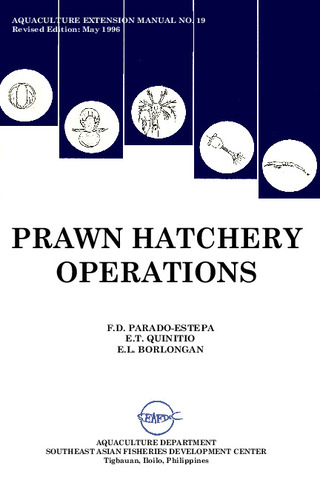
Prawn hatchery operations
; Quinitio, Emilia T. ; (Aquaculture Department, Southeast Asian Fisheries Development Center, 1996-05)
The manual, an updated version of the 1984 SEAFDEC/AQD manual, presents the underlying principles and step-by-step instructions of prawn larval and post-larval rearing. The techniques described are not only applicable to ...
; (Aquaculture Department, Southeast Asian Fisheries Development Center, 1996-05)
The manual, an updated version of the 1984 SEAFDEC/AQD manual, presents the underlying principles and step-by-step instructions of prawn larval and post-larval rearing. The techniques described are not only applicable to ... -
The lowdown on world shrimp culture - II
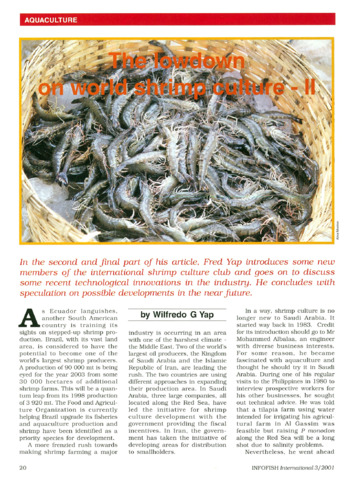
(INFOFISH, 2001)This paper introduces some new members of the international shrimp culture club and goes on to discuss some recent technological innovations in the industry, particularly the polyculture of tilapia (mainly Oreochromis ...