Preliminary chemical and physical evaluation of some formulated feeds for P. monodon


Share
Abstract
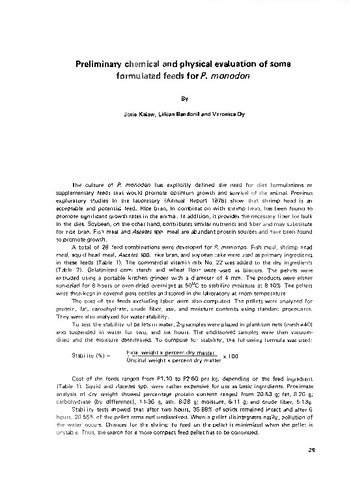
The culture of Penaeus monodon has explicitly defined the need for diet formulations or supplementary feeds that would promote optimum growth and survival of the animal. A total of 28 feed combinations were developed for P. monodon. Fish meal, shrimp head meal, squid head meal, Ascetes spp. rice bran, and soybean cake were used as primary ingredients in these feeds. The commercial vitamin mix No. 22 was added to the dry ingredients. Gelatinized corn starch and wheat flour were used as binders. The pellets were extruded using a portable kitchen grinder with a diameter of 4 mm. The products were either sun-dried for 8 hours or oven-dried overnight at 50 degree C to stabilize moisture at 8-10%. The pellets were then kept in covered glass bottles and stored in the laboratory at room temperature. The cost of the feeds excluding labour were also computed. The pellets were analyzed for protein, fat, carbohydrate, crude fiber, ash, and moisture contents using standard procedures. They were also analyzed for water stability. To test the stability of pellets in water, 2-g samples were placed in plankton nets (mesh #40) and suspended in water for two, and six hours. The undissolved samples were then vacuum-dried and the moisture determined. Cost of the feeds ranged from P1.10 to P2.60 per kg depending on the feed ingredient. Squid and Ascetes spp. were rather expensive for use as basic ingredients. Proximate analysis of dry weight showed percentage protein content ranged from 20-63 g; fat, 8-20 g; carbohydrate (by difference), 11-36 g; ash, 8-28 g; moisture, 6-11 g; and crude fiber, 5 . 13 g. Stability tests showed that after two hours, 35-88% of solids remained intact and after 6 hours, 20-55% of the pellets remained undissolved. When a pellet disintegrates easily, pollution of the water occurs. Chances for the shrimp to feed on the pellet is minimized when the pellet is unstable. Thus, the search for a more compact feed pellet has to be continued.
Description
Extended abstract only.
Suggested Citation
Kalaw, J., Bandonil, L., & Dy, V. (1977). Preliminary chemical and physical evaluation of some formulated feeds for P. monodon. SEAFDEC Aquaculture Department Quarterly Research Report , 1(1), 29-31. http://hdl.handle.net/10862/2280
Type
ArticleCollections
Related items
Showing items related by title, author, creator and subject.
-
Staggered harvesting as a method of increasing prawn production with supplemental feeding
(Aquaculture Department, Southeast Asian Fisheries Development Center, 1985)Prawns, like any other animals, exhibit dissimilarities in growth rates. As they grow, a wide range of body weight distribution from the same population is observed. Staggered harvesting method is commonly practised in cultured animals having this characteristic. Selective or partial harvesting is especially useful in this type of management system. In this case, the larger shrimps are caught earlier than the small ones thus giving chance for the smaller ones to grow bigger. The study was conducted in four one-ha ponds. Recommended pond preparation was followed. Partial harvesting was employed in experimental ponds by using 2-4 units of 8 knots selective pound nets once a week commencing after three months culture until final harvest. Control ponds were harvested only once at the end of the culture period. The results show a mean production value of 506 kg from control ponds and 639 kg from experimental ponds. Average survival rate for experimental ponds was higher (92.90%) than for control (77.65%). Final average body weight was higher for experimental ponds (21.8 g) than for control (20.5 g). Size-wise, production of big size group (30-35 g) is 578.0 kg compared to 434.6 kg for small size group (13.1-13.4 g) from both control ponds with over-all production of 1,012.6 kg. On the other hand, production from the two experimental ponds for big and small size groups is 872.2 and 405.8 kg, respectively. The means of the total weights of marketable size Penaeus monodon from control and experimental ponds are 289.0 and 436.1 kg, respectively. That is, 43.5% of the stock reached marketable size in ponds with staggered/partial harvest method compared to only 27.5% from control ponds. -
Lipids and essential fatty acids in the nutrition of Penaeus monodon larvae
(Aquaculture Department, Southeast Asian Fisheries Development Center, 1985)Total lipid levels and fatty acid distribution during larval development of Penaeus monodon were determined. Larvae were cultured utilizing standard rearing procedures and feeding schemes adopted by the Crustacean Hatchery of SEAFDEC Aquaculture Department in Tigbauan, Iloilo, Philippines. At each developmental stage (spawned egg, nauplius, protozoea, mysis, postlarva), samples were collected for biochemical analysis. Lipid content decreased with developmental stage (from egg to postlarva), indicating utilization of lipids as energy source during larval development and metamorphosis. The major fatty acids in the egg lipid were 16:0 (palmitic), 16:1 (palmitoleic), 18:0 (stearic), 18:1 (oleic), 18:3 (linolenic), 20:4 (arachidonic), 20:5 (eicosapentaenoic), and 22:6 (docosahexa-enoic acids. As the larvae developed, levels of 16:1 and 18:1 fatty acids decreased with a corresponding increase in polyunsaturated fatty acids (PUFA), particularly 20:5ω3 and 22:6ω3. These indicate the importance of PUFA as dietary components. Comparison was made between fatty acid changes during larval development and the fatty acid constituents of commonly used larval feeds (algae, rotifer, brine shrimp, egg yolk) for P. monodon. The algae and zooplankton were found to contain 20:5ω3, while egg yolk was high in total lipids but low in polyunsaturates. Most larval diets were deficient in 22:6ω3 fatty acid. Crustaceans have been shown to have a limited capacity to biosynthesize long-chain PUFA; these have to be provided in their diet. These essential fatty acids must be available in appropriate amounts to ensure successful larval development and survival. -
The tolerance of Penaeus monodon eggs and larvae to fungicides against Lagenidium sp. and Haliphthoros philippinensis
(Aquaculture Department, Southeast Asian Fisheries Development Center, 1985)The in vivo effect of mycostatic levels of fungicides against the fungi Lagenidium sp. and Haliphthoros sp. were tested on Penaeus monodon eggs and larvae. Hatching rate and survival of nauplii, zoeae, myses and postlarvae exposed to 10 mg/ℓ Benzalkonium chloride, 1 mg/ℓ Clotrimazole, 1 mg/ℓ Crystal Violet, 10 mg/ℓ 2,4-D, 10 mg/ℓ Daconil, 20 mg/ℓ laundry detergent, 1 mg/ℓ Econazole nitrate, 10 mg/ℓ Resiguard, 0.2 mg/ℓ and 10 mg/ℓ Treflan-R, 0.01 mg/ℓ and 0.2 mg/ℓ Trifluralin were monitored daily for 96 hr in a static bioassay in glass aquaria. Results showed that all test chemicals had no inhibitory effect on hatching rate but survival rate of hatched nauplii was significantly reduced in most treatments except that of 0.2 mg/ℓ Treflan-R. Tests with zoeae, myses and postlarvae indicated that 0.2 mg/ℓ Treflan-R and 0.01 mg/ℓ and 0.2 mg/ℓ Trifluralin did not adversely affect survival. In addition, Benzalkonium chloride caused no significant mortalities among exposed myses.