Effect of some physico-chemical factors on the survival and growth of Penaeus monodon postlarvae


Share
Abstract
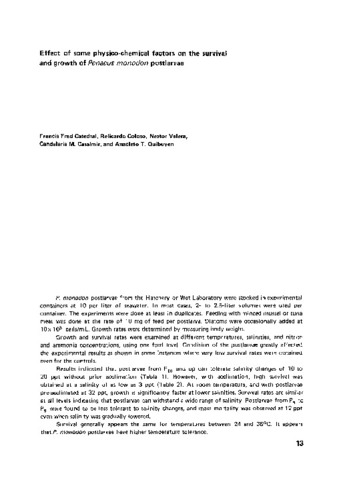
Growth and survival rates of P. monodon postlarvae were examined at different temperatures, salinities, and nitrite and ammonia concentrations, using one feed level. Condition of postlarvae greatly affected the experimental results shown in some instances where very low survival rates were obtained, even for the controls. Results indicated that postlarvae from P10 and up can tolerate salinity changes of 10 to 20 ppt without prior acclimation. Survival generally appears the same for temperatures between 24 and 36°C. It appears that P. monodon postlarvae have higher temperature tolerance. Tolerance of postlarvae at the early postlarval stage is between 30 and 50 ppm of nitrate. They were more tolerant from P10 upwards. Although survival was high in runs containing nitrite, growing appears to have been affected. Postlarvae could tolerate ammonia concentrations up to about 50 ppm. At 100 ppm higher mortality rates were observed. Whether or not there was any permanent effect by nitrate and ammonia at high but apparently tolerable levels is not known.
Description
Extended abstract only.
Suggested Citation
Catedral, F. F., Coloso, R., Valera, N., Casalmir, C. M., & Quibuyen, A. T. (1977). Effect of some physico-chemical factors on the survival and growth of Penaeus monodon postlarvae. SEAFDEC Aquaculture Department Quarterly Research Report , 1(3), 13-16. http://hdl.handle.net/10862/2295
Type
ArticleCollections
Related items
Showing items related by title, author, creator and subject.
-
An overview of the nutrition, feed and feeding techniques of prawn penaeid/shrimps
(Philippine Council for Aquatic and Marine Research and Development, 1989)This paper echoes what transpired during the first International Conference of Penaeid Prawns/Shrimps held in Iloilo City in December 4-7, 1984, particularly on the Nutrition nd Feed Development. Around 25 papers were ... -
Series: Aquaculture extension manual; No. 19
Prawn hatchery operations
; Quinitio, Emilia T. ; (Aquaculture Department, Southeast Asian Fisheries Development Center, 1996-05)
The manual, an updated version of the 1984 SEAFDEC/AQD manual, presents the underlying principles and step-by-step instructions of prawn larval and post-larval rearing. The techniques described are not only applicable to ...
; (Aquaculture Department, Southeast Asian Fisheries Development Center, 1996-05)
The manual, an updated version of the 1984 SEAFDEC/AQD manual, presents the underlying principles and step-by-step instructions of prawn larval and post-larval rearing. The techniques described are not only applicable to ... -
The lowdown on world shrimp culture - II
(INFOFISH, 2001)This paper introduces some new members of the international shrimp culture club and goes on to discuss some recent technological innovations in the industry, particularly the polyculture of tilapia (mainly Oreochromis ...