Notes on ovarian rematuration of ablated sugpo (prawn) Penaeus monodon Fabricius

View/

Downloads: 266
Date
1977Author
Page views
10,096ASFA keyword

AGROVOC keyword
Taxonomic term

Metadata
Perlihat publikasi penuhShare
Abstract
To what extent spent P. monodon females can remature and spawn successive broods is an important question in terms of recycling spawners in a commercially viable operation. Corollary to this is the quantity and quality of fry from rematured females in comparison to those from first spawning. Of 347 experimental females, only 10.1% had a second spawning, and 1.4% a third spawning. To a large degree the low rate of rematuration is due to high spawner mortality - average survival period after spawning was only 6 days in a sample of 176 spawners. It took an average of 23 days after ablation for a prawn with undeveloped ovaries to mature and spawn. An ablated female may have another spawning in as little as 5 days after the previous one. Average fecundity was 180,000 eggs per second spawning, and 140,000 eggs per third spawning. The average number of eggs from first spawning ablated females was 110-120,000. Hatching rate was lower for rematuration: 44% for second spawnings, and 35% for third spawnings, as compared to 64% for first maturation.
Description
Extended abstract of the paper delivered by Mrs. Jurgenne H. Primavera at the Symposium on Reproductive Physiology of Fish, Paimpont, France, Sept. 19-21, 1977.
Suggested Citation
Primavera, J., & Borlongan, E. L. (1977). Notes on ovarian rematuration of ablated sugpo (prawn) Penaeus monodon Fabricius. SEAFDEC Aquaculture Department Quarterly Research Report , 1(3), 5-8. http://hdl.handle.net/10862/2297
Type
ArticleKoleksi
Related items
Showing items related by title, author, creator and subject.
-
An overview of the nutrition, feed and feeding techniques of prawn penaeid/shrimps
(Philippine Council for Aquatic and Marine Research and Development, 1989)This paper echoes what transpired during the first International Conference of Penaeid Prawns/Shrimps held in Iloilo City in December 4-7, 1984, particularly on the Nutrition nd Feed Development. Around 25 papers were presented during the conference. The nutrient requirements of P. japonicus and to some extent, P. monodon have been studied quite extensively compared to other penaeid species. Requirements for protein, carbohydrates fats, amino acids and essential fatty acids for juveniles and larvae have been defined compared to those of the broodstock. Optimum protein levels for prawn juveniles vary from 28-38% for P. kerathurus, 40-46% for P. monodon, 43% for P. indicus and 50-54% for P. japonicus. Dissacharides like sucrose and trehalose have been found to be good source of carbohydrates at 20-25% in the diet. Crustacean diets require around 0.5% cholesterol. There are few studies on vitamine and mineral requirements. There are artificial diets for juveniles and microencapsulated diets that can completely replace live organisms as larval feed. Microencapsulated diets have been field-tested for P. vannamei, P. stylirostris, P. monodon, P. indicus and P. merguiensis in Ecuador, Taiwan, Malaysia, Thailand and the Philippines. When a commercial diet for the broodstock becomes available ther will be an artificial diet for athe life cycle of tha prawn. -
Series: Aquaculture extension manual; No. 19
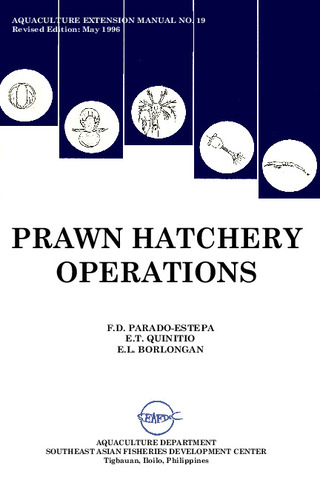
Prawn hatchery operations
; Quinitio, Emilia T. ; (Aquaculture Department, Southeast Asian Fisheries Development Center, 1996-05)
The manual, an updated version of the 1984 SEAFDEC/AQD manual, presents the underlying principles and step-by-step instructions of prawn larval and post-larval rearing. The techniques described are not only applicable to Penaeus monodon, but may also be modified and applied to other penaeid and metapenaeid species. The following aspects are covered: Site selection; Life cycle; Hatchery design and planning; Hatchery operations; Diseases; and Economics.
; (Aquaculture Department, Southeast Asian Fisheries Development Center, 1996-05)
The manual, an updated version of the 1984 SEAFDEC/AQD manual, presents the underlying principles and step-by-step instructions of prawn larval and post-larval rearing. The techniques described are not only applicable to Penaeus monodon, but may also be modified and applied to other penaeid and metapenaeid species. The following aspects are covered: Site selection; Life cycle; Hatchery design and planning; Hatchery operations; Diseases; and Economics. -
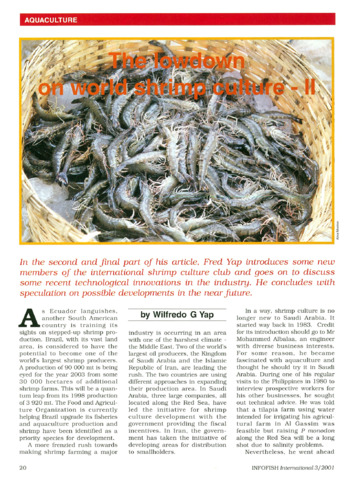
The lowdown on world shrimp culture - II
(INFOFISH, 2001)This paper introduces some new members of the international shrimp culture club and goes on to discuss some recent technological innovations in the industry, particularly the polyculture of tilapia (mainly Oreochromis mossambicus) and shrimp.