In observance of the Lenten season, please be advised of the following adjustments to our repository services:
- Effective Date: Afternoon of April 1, 2026
- Service Resumption: Monday, April 6, 2026
Our repository remains online for browsing; however, "Request a Copy" responses will be paused starting April 1, 2026 afternoon. Standard processing and responses will resume on April 6, 2026. Thank you for your patience!
Fish behaviour and aquaculture


Share
Abstract
Research in the application of fundamental concepts of fish behaviour to aquaculture has intensified recently and this chapter further elucidates fish sensory systems and functions and their involvement in the success or failure of hatchery and farm operations. Most marine fishes hatch with rudimentary sense organs that are elaborated by the time of first feeding and further improved with growth; thus, hatcheries must have the appropriate food, light and water currents for proper larval development. In grow-out farms, the ambient conditions must be at optimum or tolerable levels for the fish stock and the diets must have the right sensory characteristics to stimulate efficient feeding. Stressors for fish sensory systems include crowding, turbidity, underwater noise, chemotherapeutants, extreme pH, gas supersaturation and infection. High-density farms are stressful because the fish can sense, but cannot escape from, unfavourable conditions. Monitoring fish behaviour provides early warning of stress and disease and helps avert mortality and financial losses in aquaculture.
Suggested Citation
Kawamura, G., Bagarinao, T. U., & Seng, L. L. (2015). Fish behaviour and aquaculture. In S. Mustafa & R. Shapawi (Eds.), Aquaculture Ecosystems: Adaptability and Sustainability (pp. 68–106). Chichester, UK: John Wiley & Sons, Ltd.
Type
Book chapterISBN
9781118778548Collections
- Books and Book Chapters [123]
Related items
Showing items related by title, author, creator and subject.
-
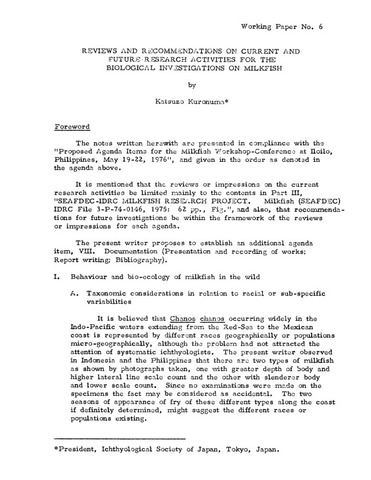
Reviews and recommendations on current and future research activities for the biological investigations on milkfish
(Aquaculture Department, Southeast Asian Fisheries Development Center, 1976)Presented in this paper are the recommendations on current and future research activities for the biological investigations on milkfish (Chanos chanos). Included were the bahavior and bio-ecology of milkfish in the wild. It also tackled the protocols in transporting broodstocks. -
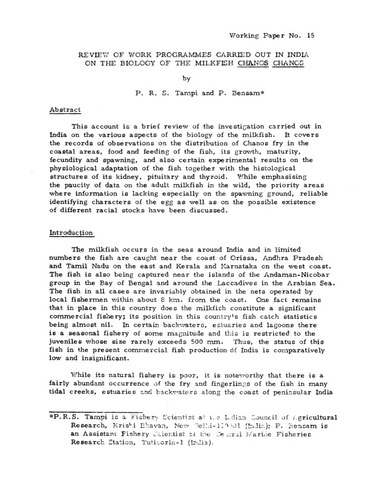
Review of work programmes carried out in India on the biology of the milkfish Chanos chanos
(Aquaculture Department, Southeast Asian Fisheries Development Center, 1976)This account is a brief review of the investigation carried out in India on the various aspects of the biology of the milkfish. It covers the records of observations on the distribution of Chanos fry in the coastal areas, food and feeding of the fish, its growth, maturity, fecundity and spawning, and also certain experimental results on the physiological adaptation of the fish together with the histological structures of its kidney, pituitary and thyroid. While emphasising the paucity of data on the adult milkfish in the wild, the priority areas where information is lacking especially on the spawning ground, reliable identifying characters of the egg as well as on the possible existence of different racial stocks have been discussed. -
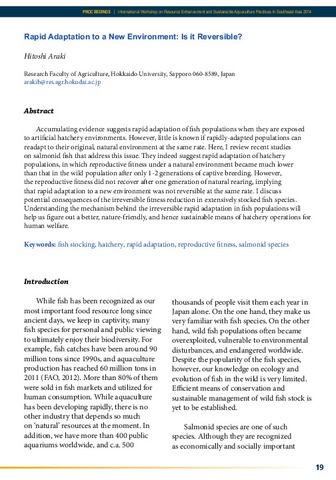
Rapid adaptation to a new environment: is it reversible?
(Aquaculture Department, Southeast Asian Fisheries Development Center, 2015)Accumulating evidence suggests rapid adaptation of fish populations when they are exposed to artificial hatchery environments. However, little is known if rapidly-adapted populations can readapt to their original, natural environment at the same rate. Here, I review recent studies on salmonid fish that address this issue. They indeed suggest rapid adaptation of hatchery populations, in which reproductive fitness under a natural environment became much lower than that in the wild population after only 1-2 generations of captive breeding. However, the reproductive fitness did not recover after one generation of natural rearing, implying that rapid adaptation to a new environment was not reversible at the same rate. I discuss potential consequences of the irreversible fitness reduction in extensively stocked fish species. Understanding the mechanism behind the irreversible rapid adaptation in fish populations will help us figure out a better, nature-friendly, and hence sustainable means of hatchery operations for human welfare.