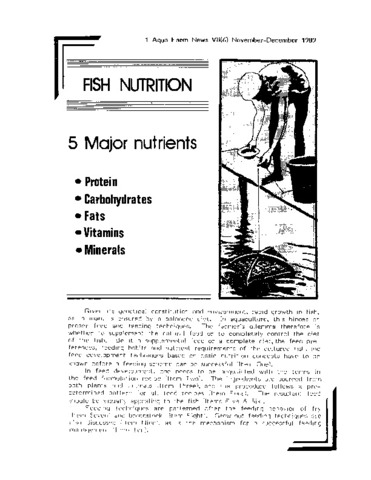
Fish nutrition


Share
Suggested Citation
SEAFDEC/AQD (1989). Fish nutrition. Aqua Farm News , 7(6), 1-14. http://hdl.handle.net/10862/2673
Type
magazineArticleISSN
0116-6573Collections
- Aqua Farm News [286]
Related items
Showing items related by title, author, creator and subject.
-
Research on crustaceans
(Aquaculture Department, Southeast Asian Fisheries Development Center, 1995)Crustacean research at the SEAFDEC Aquaculture Department during the last three years focused mostly on the tiger shrimp Penaeus monodon. Studies were done along six problem areas: (1) developing spawning techniques for captive broodstock, (2) defining physico-chemical levels tolerable by larvae or postlarvae, (3) finding alternative feeds or fertilizers for extensive culture, (4) reducing the cost and evaluating the quality of formulated feeds for semiintensive culture, (5) preventing and controlling disease, and (6) documenting the chemicals used in shrimp culture and their effects on the environment. To reduce feed costs, substitutes for expensive feed components were screened and the specific nutrient requirements of tiger shrimp during culture were determined. A few studies were made on other crustaceans. The vitellogenin levels during maturation of the white shrimp P. indicus were measured. The digestibility of feedstuffs was also tested in the white shrimp. Culture techniques are being developed for the mudcrab Scylla serrata in ponds, pens, and cages. -
Effects of different fat sources on the egg quality of grouper, Epinephelus suillus
(Aquaculture Department, Southeast Asian Fisheries Development Center, 1996)The effect of different fat sources on the egg quality of grouper, Epinephelus suillus eggs was evaluated. Fish in three tanks, each containing 3 females and 1 male, were fed various types of feeds namely: trash fish (control), trash fish + cod liver oil (treatment 1) and trash fish + SELCO, a lipid emulsion containing high levels of highly unsaturated fatty acid (HUFA) (treatment 2). Approximately 77.9 million eggs spawned from January to October 1992 by the control group, 40.0 million by fish in treatment 1, and 36.4 million by the treatment 2 group. Egg production (0.45 million eggs/kg BW) among the control group was significantly higher than treatment 2. Egg production of treatment 1 (0.06-0.36 million eggs/kg BW) was not significantly different (P<0.01) from the control group nor treatment 2 (0.02-0.30 million eggs/kg BW). Fertilization and hatching rates showed significant differences among the three groups with control > treatment 1 > treatment 2. There were no differences detected in the egg and oil globule diameters among the treatments. Crude protein and lipid levels of floating (good) and sinking (bad) eggs collected in February to March 1992, and August to September 1992 were similar in all treatments. Unfed larvae from treatment 1 survived until the fifth day after hatching while those in the control and treatment 2 groups lasted only until the third day. These results suggest that supplementation of cod liver oil and SELCO in the trash fish diet of E. suillus broodstock does not influence egg production, fertilization and hatching rates, and egg quality. -
Nursery and grow-out operation for tilapia and carp
(Aquaculture Department, Southeast Asian Fisheries Development Center, 1988)Most researches conducted at the Binangonan Freshwater Station of the SEAFDEC Aquaculture Department were directed toward enhancing growth and survival of the young tilapia and carp in the nursery as well as increasing yields in grow-out cages, pens, and ponds. Studies included the culture and evaluation of phytoplankton and zooplankton as feeds of the tilapia and carp fry to fingerlings; determination of protein and amino acid requirements of young Nile tilapia; development of practical dry diets; evaluation of feeding regimes, feeding rates, and feeding frequencies ; and the use of fertilizers in nursery ponds. For the grow-out aspect, one of the earliest studies demonstrated the profitability of the monoculture of tilapia in cages which triggered the initial proliferation of tilapia cage culture by the private sector in areas near the Station. Subsequently, supplemental feeds were developed and evaluated; non-conventional feedstuffs were tested as feeds or feed components; and the growth rates of Nile tilapia fingerlings in cages at varying stocking densities were evaluated at three distinct rearing periods covering one year. Prior to the successful mass production of bighead carp fingerlings at the Station, studies on polyculture of tilapia, milk fish, and different species of carp were conducted in cages and pens with remarkable results. This led to the technology-verification projects on polyculture at various areas in Laguna Lake. With the availability of freshwater fishponds for research purposes, studies on polyculture in ponds were also conducted.