Status of resource management and aquaculture in Malaysia


Share
抄録
Malaysia is a maritime nation and its fishing industry is a source of income for 134,000 fishermen. In 2012, the fisheries sector produced 1.7 million tons of fish valued at RM10.8 billion and generated trade worth RM6 billion. The landings from capture fisheries are expected to increase from 1.32 million tons in 2010 to 1.76 million tons in 2020 at an annual growth rate of 2.9%. In 2012, 65% of total catch was contributed by the coastal fisheries as compared to 35% from deep sea fishing. Landing from deep sea fishing is expected to rise from 381,000 tons in 2012 to 620,000 tons in 2020. Deep sea fishing has been identified for its potential to contribute to the increase in the country s fish production. With a growing population and an increasing preference for fish as a healthy source of animal protein, the National Agro-food Policy (2011-2020) estimated that the annual demand for fish will increase to 1.93 million tons by the year 2020. The Department of Fisheries (DOF) has developed the Capture Fisheries Strategic Management Plan (2011-2020) based on three main documents i.e.; National Agro-food Policy (NAP, 2011-2020), Department of Fisheries Strategic Management Plan (2011-2020), and Malaysia National Plan of Action on Sustainable Fisheries for Food Security towards 2020.
Aquaculture is now being promoted in Malaysia as an important engine of growth and eventually to become the mainstay of the nation s economy. Situated in a region with abundant supply of land and water, two determinant factors for aquaculture activities, Malaysia has always strived to ensure that this sector is not sidelined in their development efforts. With a growing population and an increasing preference for fish as a healthy source of animal protein, it has been estimated that the annual demand for fish will increase to 1.7 million tons in 2011 and further to 1.93 million tons by 2020. From the present annual aquaculture production of about 525,000 tons, this output would need to be raised to 790,000 tons to meet the projected demand by 2020. In a move to develop the aquaculture industry, the DOF, has initiated the Aquaculture Industrial Zone (AIZ) Program involving the development of 49 zones, located across Malaysia, which will be used for culture of various types of high value aquatic species. The DOF has identified several strategic areas that would be developed for downstream activities such as fish seed production, feed mills, fish processing plants, and other supporting industries. Aquaculture is also currently listed amongst the 16 Agro-food s Entry Point Projects (EPP) of the National Key Economic Area (NKEA). The government aims to double the Agro-food sector s contribution to Gross National Income (GNI) from Malaysian Ringgit (RM) 20.2 billion in the year 2010 to RM49.1 billion by 2020, or an increase of RM28.9 billion.
Suggested Citation
Yusoff, A. (2015). Status of resource management and aquaculture in Malaysia. In M. R. R. Romana-Eguia, F. D. Parado-Estepa, N. D. Salayo, & M. J. H. Lebata-Ramos (Eds.), Resource Enhancement and Sustainable Aquaculture Practices in Southeast Asia: Challenges in Responsible Production of Aquatic Species: Proceedings of the International Workshop on Resource Enhancement and Sustainable Aquaculture Practices in Southeast Asia 2014 (RESA) (pp. 53-65). Tigbauan, Iloilo, Philippines: Aquaculture Dept., Southeast Asian Fisheries Development Center.
Type
Conference paperISBN
9789719931041Related items
Showing items related by title, author, creator and subject.
-
Community fishery resources management on Malalison Island, Philippines: R & D framework, interventions, and policy implications
(Taylor & Francis, 2000)In 1991, the Aquaculture Department of the Southeast Asian Fisheries Development Center launched a community-based fishery resources management project on Malalison Island, in central Philippines, to help conserve the country's marine resources and to help the fisherfolk rise above their poverty. The eight-year project integrated various disciplines in biology, economics, sociology, public administration, and engineering in its study of fishery resources and fishing communities and in evolving intervention strategies for resource conservation and management, and for community development. The project's most important accomplishment was the inculcation among the fisherfolk of the importance of resource conservation and management. The most important lesson learned was that an enlightened and empowered fisherfolk could be effective managers and responsible users of fishery resources. -
Socio-cultural context of fishers’ participation in coastal resources management in Anini-y, Antique in west central Philippines
(Elsevier, 2011)The vicious cycle of poverty, overfishing and resource degradation in coastal communities in the Philippines calls for action that will address the problem of declining fish catch and degraded fish habitats. The literature has shown that an efficient and effective coastal management program can be instrumental in approaching this problem. In order to secure food and livelihood of fishers, the Southeast Asian Fisheries Development Center/Aquaculture Department collaborated with the local government of Anini-y, Antique to develop a sustainable utilization of natural marine resources through sea ranching of abalone within the Nogas Island marine protected area. Establishing a marine protected area is a means of conserving natural stocks while sea ranching is considered an effective strategy that can increase fishery resources. The two management schemes are considered as effective coastal resources management strategies. The success of a sea-ranching project is dependent not only on biophysical but also on socioeconomic factors as determinants of community participation and cooperation. A social assessment was conducted to determine the fishers’ socio-cultural characteristics, their perceptions of their coastal resources and knowledge on how to effectively manage these coastal resources. The fishers’ awareness on fishing regulations and the extent of their participation in community's coastal resources management activities were also determined. Data were collected from a household survey using a semi-structured questionnaire, focus group discussions and in-depth interviews with key informants. The fishers generally scored low in almost all aspects of their socioeconomic wellbeing. Most fishers perceived that their coastal resources were in a bad condition which they attributed to illegal and commercial fishing, increasing number of fishers and the poor enforcement of fishery regulations. However, the weighted mean scores of their knowledge on coastal resources management, awareness to fishery regulations and participation in community coastal resource management activities were average. This implied that fishers when trained and developed can become potential partners for effective coastal resources management programs. -
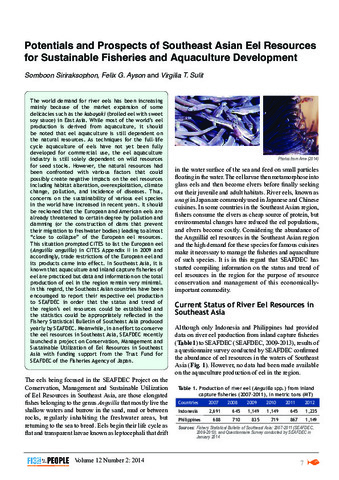
Potentials and prospects of Southeast Asian eel resources for sustainable fisheries and aquaculture development
(Secretariat, Southeast Asian Fisheries Development Center, 2014)The world demand for river eels has been increasing mainly because of the market expansion of some delicacies such as the kabayaki (broiled eel with sweet soy sauce) in East Asia. While most of the world’s eel production is derived from aquaculture, it should be noted that eel aquaculture is still dependent on the natural resources. As techniques for the full-life cycle aquaculture of eels have not yet been fully developed for commercial use, the eel aquaculture industry is still solely dependent on wild resources for seed stocks. However, the natural resources had been confronted with various factors that could possibly create negative impacts on the eel resources including habitat alteration, overexploitation, climate change, pollution, and incidence of diseases. Thus, concerns on the sustainability of various eel species in the world have increased in recent years. It should be reckoned that the European and American eels are already threatened to certain degree by pollution and damming (or the construction of dams that prevent their migration to freshwater bodies) leading to almost “close to collapse” of the European eel resources. This situation prompted CITES to list the European eel (Anguilla anguilla) in CITES Appendix II in 2009 and accordingly, trade restrictions of the European eel and its products came into effect. In Southeast Asia, it is known that aquaculture and inland capture fisheries of eel are practiced but data and information on the total production of eel in the region remain very minimal. In this regard, the Southeast Asian countries have been encouraged to report their respective eel production to SEAFDEC in order that the status and trend of the region’s eel resources could be established and the statistics could be appropriately reflected in the Fishery Statistical Bulletin of Southeast Asia produced yearly by SEAFDEC. Meanwhile, in an effort to conserve the eel resources in Southeast Asia, SEAFDEC recently launched a project on Conservation, Management and Sustainable Utilization of Eel Resources in Southeast Asia with funding support from the Trust Fund for SEAFDEC of the Fisheries Agency of Japan.