Status on development and use of alternative dietary ingredients in aquaculture feed formulations in Thailand


Share
นามธรรม
Thailand is one of the major producers of aquaculture commodities and aquafeeds in Asia. As the aquafeed industry has been growing continuously, the government through the Department of Fisheries (DOF) had undertaken the enactment of the Animal Feed Quality Control Act (1982) since 1992.The DOF oversees production of commercial aquafeeds of eight species. At present, there are many negative impacts by both aquaculture activities and the aquafeed industry. These include the use of feed ingredients from non-sustainable sources. Researches on the use of alternative dietary ingredients in aquafeeds are on-going. However, these solutions need to be cost-effective to be commercially feasible and alternative culture-systems have to be considered to improve feed efficiency. Thus, the important sectors that are involved to ensure the sustainable development and use of alternative dietary ingredients in aquafeeds are the: 1) government, 2) feed millers, and 3) fish farmers.
การอ้างอิง
Kosutarak, P. (2015). Status on development and use of alternative dietary ingredients in aquaculture feed formulations in Thailand. In M. R. Catacutan, R. M. Coloso, & B. O. Acosta (Eds.), Development and Use of Alternative Dietary Ingredients or Fish Meal Substitutes in Aquaculture Feed Formulation : Proceedings of the ASEAN Regional Technical Consultation on Development and Use of Alternative Dietary Ingredients or Fish Meal Substitutes in Aquaculture Feed Formulation, 9-11 December 2014, Nay Pyi Taw, Myanmar (pp. 31-39). Tigbauan, Iloilo, Philippines: Aquaculture Department, Southeast Asian Fisheries Development Center.
Type
Conference paperISBN
9789719931058Related items
Showing items related by title, author, creator and subject.
-
Processing of feedstuffs and aquafeeds
(Aquaculture Department, Southeast Asian Fisheries Development Center, 2002)This chapter will help the reader understand and appreciate the basic principles of processing, preparation, storage, and quality control in the preparation of aquafeeds. The material in this section is presented in sequence beginning with the processing of basic ingredients to remove antinutritional factors, followed by steps in feed preparation, from the easiest to the more complex processes, and storage. This chapter presents methods and equipment that are useful not only for feed millers, but also for extension workers and fish farmers. -
Management of feeding aquaculture species
(Aquaculture Department, Southeast Asian Fisheries Development Center, 2002)This chapter teaches the reader to: differentiate the different feeding strategies in pond culture; learn feeding management methods such as stock sampling and record keeping, calculating daily feed ration, choosing appropriate feed size, and methods of applying feeds; understand the impact of feeding management on water quality and environment and on the cultured animal’s growth, survival, and feed conversion ratio; and describe the different feeding schemes used to culture fishes (milkfish, tilapia, rabbitfish, bighead carp, native catfish, sea bass, orange-spotted grouper, and mangrove red snapper; and crustaceans (tiger shrimp and mud crab). Other species for aquaculture stock enhancement (donkey’s ear abalone, seahorses, window-pane oyster) are also discussed. -
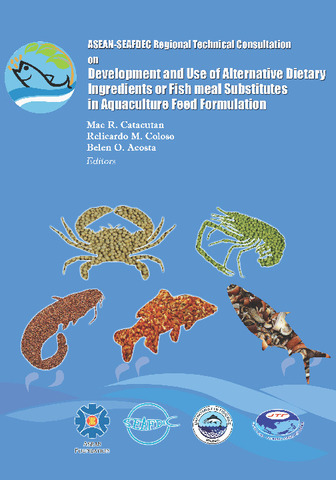
Development and use of alternative ingredients or fish meal substitutes in aquaculture feed formulation: Proceedings of the ASEAN Regional Technical Consultation on Development and Use of Alternative Dietary Ingredients or Fish Meal Substitutes in Aquaculture Feed Formulation
(Aquaculture Department, Southeast Asian Fisheries Development Center, 2015)Recognizing the need for a concerted effort to follow-up on this priority issue of the ASEAN on aquaculture feed development and utilization. SEAFDEC (Aquaculture Department and Secretariat) and the Government of Myanmar organized the 'Regional Technical Consultation (RTC) on development and Use of Alternative Dietary Ingredients or Fish Meal Substitutes in Aquaculture Feed Formulation'. The meeting was convened with the main purpose of providing a forum for charting the regional priorities and future directions on feed development, particularly on the use of alternative feed ingredients or protein substitutes. The specific objectives were to: (i) review the ASEAN-SEAFDEC member country status, constraints associated with developing alternative dietary ingredients for aquaculture feed; (ii) identify specific advances being made in the region with respect to the development of alternative aquaculture feed ingredients; and (iii) define approaches or initiatives supporting catch reduction of low-value/trash fish; (iv) formulate relevant policy recommendations (regional and country-specific) for effective development and utilization of aquaculture feeds; and (v) enhance cooperation among member countries and relevant stakeholders on initiatives that support sustainable aquaculture practices, particularly on feeds. This publication presents the outputs of the RTC. The country reports and review papers presented during the conference which are contained in this volume are cited individually.