Development and use of alternative ingredients or fish meal substitutes in aquaculture feed formulation: Proceedings of the ASEAN Regional Technical Consultation on Development and Use of Alternative Dietary Ingredients or Fish Meal Substitutes in Aquaculture Feed Formulation


Share
Abstract
Recognizing the need for a concerted effort to follow-up on this priority issue of the ASEAN on aquaculture feed development and utilization. SEAFDEC (Aquaculture Department and Secretariat) and the Government of Myanmar organized the 'Regional Technical Consultation (RTC) on development and Use of Alternative Dietary Ingredients or Fish Meal Substitutes in Aquaculture Feed Formulation'. The meeting was convened with the main purpose of providing a forum for charting the regional priorities and future directions on feed development, particularly on the use of alternative feed ingredients or protein substitutes. The specific objectives were to: (i) review the ASEAN-SEAFDEC member country status, constraints associated with developing alternative dietary ingredients for aquaculture feed; (ii) identify specific advances being made in the region with respect to the development of alternative aquaculture feed ingredients; and (iii) define approaches or initiatives supporting catch reduction of low-value/trash fish; (iv) formulate relevant policy recommendations (regional and country-specific) for effective development and utilization of aquaculture feeds; and (v) enhance cooperation among member countries and relevant stakeholders on initiatives that support sustainable aquaculture practices, particularly on feeds. This publication presents the outputs of the RTC. The country reports and review papers presented during the conference which are contained in this volume are cited individually.
Suggested Citation
Catacutan, M. R., Coloso, R. M., & Acosta, B. O. (Eds.). (2015). Development and use of alternative ingredients or fish meal substitutes in aquaculture feed formulation: Proceedings of the ASEAN Regional Technical Consultation on Development and Use of Alternative Dietary Ingredients or Fish Meal Substitutes in Aquaculture Feed Formulation. Tigbauan, Iloilo, Philippines: Aquaculture Department, Southeast Asian Fisheries Development Center.
Contents
- FOREWORD
- MESSAGES
- PREFACE
- ACKNOWLEDGEMENTS
- Photo of Participants
- COUNTRY PAPERS
- Aquafeed development and utilization of alternative dietary ingredients in aquaculture feed formulation in Indonesia – Asda Laining and Anang Hari Kristanto
- Status of development and use of alternative dietary ingredients in aquaculture feed formulations in Malaysia – Mohammed Suhaimee Abd. Manaf and Ahmad Faizal Mohamed Omar
- Status of development and use of alternative dietary ingredients in aquaculture feed formulations in the Philippines - Wilfredo M. Cruz, James Villanueva and Edna G. Janeo
- Status of development and use of alternative dietary ingredients in aquaculture feed formulations in Thailand – Pairat Kosutarak
- Status of development and use of alternative dietary ingredients in aquaculture feed formulation in Viet Nam – Vu Anh Tuan
- A new type of fish diet,non-fish meal extruded pellet for yellow tail – Noriko Ishida,Tomohiko Koshiishi, Tatsuo Tsuzaki, Soetsu Yanagi, Satoshi Katayama,Minoru Satoh and Shuichi Satoh
- Status of development and use of alternative dietary ingredients in aquaculture feed formulations in Japan: Recent progress of fish meal replacement study on marine fish– Shunsuke Koshio
- Status of development and use of alternative dietary ingredients in aquaculture feed formulations in Cambodia – Thay Somony, Ros Kunthy and Hang Savin
- Status of development and use of alternative dietary ingredients in aquaculture feed formulations in Lao PDR – Thongkoun Khonglaliane
- Development and use of alternative dietary ingredients for fish meal in Myanmar – Kyaw Kyaw
- Status of development and use of alternative ingredients in aquaculture feed formulations in Singapore - Ong Yihang and Vincent Ong
- REVIEW PAPERS
- Use of plant protein in aquaculture feed for top five commodities in ASEAN Member States - RelicardoM. Coloso
- Use of plant protein in aquaculture feed for high value marine species - Mae R.Catacutan
- Processing of alternative feed ingredients in aquaculture feed - Myrna B. Teruel and Brett Glencross
- Overview on the use of plant protein in aquaculture feed – Mali Boonyaratpalin
- FAO policies and initiatives promoting responsible and efficient use of feed ingredients from marine animal origin - Weimin Miao, Mohammad Hasan and SimonFunge-Smith
- Regional policy recommendations for development and use of alternative dietary ingredients in aquaculture feed formulation – SEAFDEC Aquaculture Department and Secretariat
- SUMMARY OF ISSUES AND RECOMMENDATIONS
- ANNEXES:
- List of participants
- Outputs of workshop to identify gaps, emerging issues and formulate policy recommendations
- Workshop to identify gaps, emerging issues and formulate policy recommendations: Composition of working groups
Type
Book; Conference publicationISBN
9789719931058Format
x, 142 pages : color illustrations.
Related items
Showing items related by title, author, creator and subject.
-
Aquaculture development in Thailand
(Aquaculture Department, Southeast Asian Fisheries Development Center, 1988)Aquaculture practised in Thailand is in the form of pond culture and cage culture in freshwater, brackishwater and coastal areas. The main species cultured include freshwater prawns, brackishwater shrimp, cockles, mussels, and various freshwater and marine finfishes. There is good potential for increased production from freshwater, brackishwater and marine aquaculture. However, the 1983 production of 145 000 mt represents only about 6% of Thailand's total fish production and production in this subsector has fluctuated widely. It will be several years before aquaculture production will contribute substantially to total production. Nonetheless, the culture of high value species of shrimp and fish could contribute significantly to export earnings during the next 5 to 10 years. Conducted primarily by government agencies, research and development are along the lines of increasing seed supply, establishing new culture techniques or improving older ones. The Department of Fisheries (DOF) together with some private companies have ventured into the development and testing of artificial diets for the various cultured species using a variety of indigenous feed stuffs. It is estimated that with adequate investments and appropriate support, aquaculture production will increase from 145 000 mt in 1983 to 378 000 mt in 1991, showing an annual increase of about 13% over this period. Major increases would come from bivalve mariculture (131 000 mt), brackishwater ponds (36 000 mt) freshwater ponds (46 000 mt) and brackishwater cage culture (20 000 mt). -
Use of plant protein sources in aquafeed for high value marine species in ASEAN member states
(Aquaculture Department, Southeast Asian Fisheries Development Center, 2015)Cultured marine aquatic species are predominantly carnivorous. Major species in the region are seabass, grouper, snapper, tiger shrimp, mangrove crab and abalone. These species, except for abalone, require a high level of dietary protein mostly supplied by marine sources such as fish meal. Global production of marine fish and marine shrimps showed a 3-4 fold increase from 1995 to 2010. For the same period, the usage of commercial feed for production of marine fish and shrimps increased while the fish meal portion in the formulation decreased. This is indicative of fish meal being substituted with alternative sources in commercial feed production, and to some extent the substitution of marine oil which particularly improved the FCR for the marine fish production from 2.0 to 1.9 and for marine shrimps from 2.0 to 1.6. Plant products that include cereal grains, legumes and oilseeds have the most potential among the alternative ingredients for use in aquafeed. The use of these resources for high value marine species is limited due to a variety of anti-nutritional substances they contain. Removal of these substances by processing techniques has improved utilization but with added cost. Hence, fish meal is still the primary source of protein for marine carnivores and its substitution with higher amounts of alternative plant proteins may be difficult compared with lower levels of replacements. The Asian region has accounted for the more than 50% of the total global aquaculture production in 2012 with indications of increased utilization of alternative protein sources in commercial feed production. For the major marine species in the region the increasing trend of plant protein usage with the targeted levels of substitution of fish meal with plant protein sources should be sustainable. -
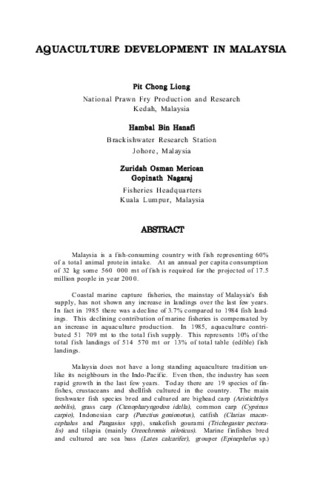
Aquaculture development in Malaysia
(Aquaculture Department, Southeast Asian Fisheries Development Center, 1988)Malaysia is a fish-consuming country with fish representing 60% of a total animal protein intake. At an annual per capita consumption of 32 kg some 560 000 mt of fish is required for the projected of 17.5 million people in year 2000. Coastal marine capture fisheries, the mainstay of Malaysia's fishsupply, has not shown any increase in landings over the last few years. In fact in 1985 there was a decline of 3.7% compared to 1984 fish landings. This declining contribution of marine fisheries is compensated by an increase in aquaculture production. In 1985, aquaculture contributed 51 709 mt to the total fish supply. This represents 10% of the total fish landings of 514 570 mt or 13% of total table (edible) fish landings. Malaysia does not have a long standing aquaculture tradition unlike its neighbours in the Indo-Pacific. Even then, the industry has seen rapid growth in the last few years. Today there are 19 species of finfishes, crustaceans and shellfish cultured in the country. The main freshwater fish species bred and cultured are bighead carp (Aristichthys nobilis), grass carp (Ctenopharyngodon idella), common carp (Cyprinus carpio), Indonesian carp (Punctius gonionotus), catfish (Clarias macrocephalus and Pangasius spp), snakefish gourami (Trichogaster pectoralis) and tilapia (mainly Oreochromis niloticus). Marine finfishes bred and cultured are sea bass (Lates calcarifer), grouper (Epinephelus sp.) and snapper (Lutjanus johni). Penaeus monodon is the dominant marine prawn species bred and cultured but culture of P. merguiensis is receiving considerable interest. Macrobrachium rosenbergii is the only freshwater prawn cultured commercially. Molluscs cultured are the blood clam (Anadara granosa) and the green mussel (Perna viridis). In 1985, blood clam and mussel culture accounted for 87% of all aquaculture production of Malaysia, freshwater fish 12%, floating cage culture of marine fish 0.7% and brackishwater pond culture 0.3%. In terms of value blood clam and mussels represented 30% (M$15M) of total value (M$49.5M), freshwater fish 57% (M$28M),cage culture of marine fin fishes 7% (M$3.4M),and brackishwater pond production 6% (M$2.1M). Aquaculture in Malaysia has considerable growth potential. It is projected that 22 000 ha of mangrove will be opened by the year 2000 for shrimp culture. Some 330 000 m2 of protected coastal waters have been identified for cage culture. Some 6500 rafts can considerably expand the present capacity. In freshwater culture about 8000 ha of land and 17 500 ha of mining pools can be developed while 200 000 ha of artificial lakes and impoundments for freshwater fish cage culture are available. Yet such development is not without constraints. Freshwater finfish culture is hampered by lack of good quality broodstock. There is also a limited market for freshwater finfishes. Marine finfish culture is limited by lack of fingerlings and good quality compounded diet to replace trash fish which is deteriorating in quality and quantity. Marine prawn culture is heavily dependent on wild spawners, the supply unpredictable and inadequate. Acid sulfate soil continues to cause the deterioration of brackishwater ponds. Cockles and mussels can be sold to export markets only if they meet specific quality standards.