Status of transboundary diseases of penaeid shrimps in Singapore

Date
2016Page views
6,231ASFA keyword

AGROVOC keyword
Taxonomic term

Metadata
Perlihat publikasi penuhShare
Abstract
Singapore has a small shrimp farming industry with approximately 54 metric tons (MT) of shrimps produced in one year from both land and coastal farms. There is also one shrimp farm producing broodstock for export. Singapore has the capability to diagnose acute hepatopancreatic necrosis disease (AHPND) through histopathology and the isolation of its causal agent which is Vibrio parahaemolyticus. The polymerase chain reaction (PCR) method for AHPND detection in shrimp is currently being undertaken to further strengthen its laboratory and diagnostic capacity. Notably, Singapore is still AHPND-free. On the contrary, white spot disease caused by white spot syndrome virus (WSSV) is a disease of concern as it affects the trade for ornamental crustaceans. Singapore has an active surveillance program for WSSV and other transboundary pathogens of penaeid shrimps. Positive detections would be followed by movement controls and stamping out protocols.
Suggested Citation
Wong, Y., & Jiang, J. (2016). Status of transboundary diseases of penaeid shrimps in Singapore. In R. V. Pakingking Jr., E. G. T. de Jesus-Ayson, & B. O. Acosta (Eds.), Addressing Acute Hepatopancreatic Necrosis Disease (AHPND) and Other Transboundary Diseases for Improved Aquatic Animal Health in Southeast Asia: Proceedings of the ASEAN Regional Technical Consultation on EMS/AHPND and Other Transboundary Diseases for Improved Aquatic Animal Health in Southeast Asia, 22-24 February 2016, Makati City, Philippines (pp. 73-78). Tigbauan, Iloilo, Philippines: Aquaculture Department, Southeast Asian Fisheries Development Center.
Type
Conference paperISBN
9789719931065Related items
Showing items related by title, author, creator and subject.
-
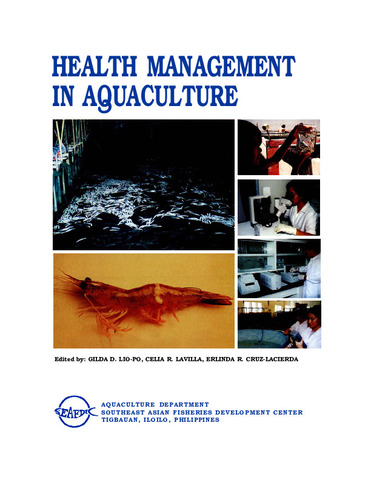
Health management in aquaculture
(Aquaculture Department, Southeast Asian Fisheries Development Center, 2001)A textbook on diseases of cultured warmwater fish and shrimps in the Philippines. Eleven chapters cover essential information on the basic principles of disease causation, major diseases of cultured fish and crustaceans, particularly shrimps, and methods of prevention and control. Emphasis is made on major diseases that occur in the Philippines and other countries in the Asian region. Included also are topics on harmful algae, immunology and molecular biological diagnostic techniques. -
Country status of aquatic emergency preparedness and response systems for effective management of aquatic animal disease outbreaks in Myanmar
(Aquaculture Department, Southeast Asian Fisheries Development Center, 2019)Myanmar is one of the OIE members and the Department of Fisheries (DoF) is highly concerned with transboundary aquatic animal pathogens. Therefore, the Aquatic Animal Health & Disease Control Section has already been formed not only for field diagnostic surveys but also for border control especially at international airport and border trade areas by checking and counter checking export and import of aquatic animals and products. At the moment, the DoF is stressing an issue of some transboundary diseases for finfish such as Gyrodactylus sp., Dactylogyrus sp., Argulus sp., Trichodena sp., Streptococcus sp., Aeromonas sp., and for crustacean are MrNV/XSV and WSSV. In addition, the DoF is facing challenges with parasitic disease and bacterial disease problems due to poor water quality management at culturing fish ponds. For the prevention and control of fish diseases within the country, the DoF is issuing Health Certificates by physical and microbiological examination of fishes and fisheries products. At the same time, Quarterly report on fish disease has being regularly submitted to NACA, OIE since 1998 until now. Although the DoF has no specific law and legislation on the control of quarantine pest and disease of aquatic animal, a good aquaculture practice has been implemented and code of conduct responsible for aquaculture is being followed in the country. The aquatic health management is a challenging issue in aquaculture development. Myanmar is still needing technical assistance to improve quarantine system especially for importation and exportation of live aquatic animals. Moreover, monitoring and surveillance programs with harmonized aquatic emergency preparedness and response system are required to boost up not only for Myanmar but also for effective management of transboundary disease outbreaks in Southeast Asia. -
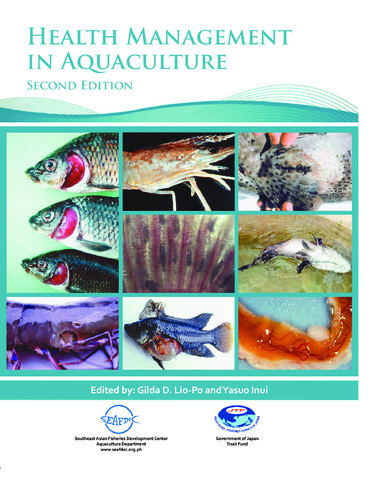
Health management in aquaculture
(Aquaculture Department, Southeast Asian Fisheries Development Center, 2010-07)A textbook on diseases of cultured warmwater fish and shrimps in the Philippines. Eleven chapters cover essential information on the basic principles of disease causation, major diseases of cultured fish and crustaceans, particularly shrimps, and methods of prevention and control. Emphasis is made on major diseases that occur in the Philippines and other countries in the Asian region. Included also are topics on harmful algae, immunology and molecular biological diagnostic techniques.