Biological evaluation of existing feed formulations for the grow-out culture of the mud crab, Scylla serrata

วันที่
2017Page views
19,143ASFA keyword

AGROVOC keyword
Taxonomic term

เมตาดาต้า
แสดงระเบียนรายการเต็มShare
นามธรรม
This study was conducted to identify a formulated pelleted feed for the grow-out culture of the mud crab. A commercial crab feed (CCF) was evaluated together with fish by-catch (FBC) and three test diets (formulated and pelleted) of similar dietary energy (1723 MJ/Kg diet) based on published works. The test diets contained 48% (D-1), 43% (D-2), and 38% (D-3) crude protein (CP), respectively. All the five dietary treatments were fed to crablets (5 to 6 g body weight) that were individually stocked in 60-L tanks. Each dietary treatment was fed to six crabs. Crustaceans grow by molting which is not simultaneous, hence, each crab was monitored daily. After the third molt (M3) survival rates in D-1, D-2 and D-3 ranged from 33%-66% compared with only 16% in FBC, and 0% in CCF where no crab survived to molt for the second time (M2). Nutrients in FBC may not be sufficient to sustain growth and survival, while water stable CCF may lack a feed attractant. Diets D-1, D-2, and D-3 were evaluated in another feeding experiment to identify the basal diet for the crab. All crabs molted until M3 and no significant differences were noted on growth performance between treatments. However, D-1 (48% CP) was identified as the basal diet due to better numerical values observed in terms of feed conversion ratios and specific growth rates.
การอ้างอิง
Catacutan, M. R. (2017). Biological evaluation of existing feed formulations for the grow-out culture of the mud crab, Scylla serrata. In E. T. Quinitio, F. D. Parado-Estepa, & R. M. Coloso (Eds.), Philippines : In the forefront of the mud crab industry development : proceedings of the 1st National Mud Crab Congress, 16-18 November 2015, Iloilo City, Philippines (pp. 69-76). Tigbauan, Iloilo, Philippines: Aquaculture Department, Southeast Asian Fisheries Development Center.
Type
Conference paperISBN
9789719931072Related items
Showing items related by title, author, creator and subject.
-
Management of feeding aquaculture species
(Aquaculture Department, Southeast Asian Fisheries Development Center, 2002)This chapter teaches the reader to: differentiate the different feeding strategies in pond culture; learn feeding management methods such as stock sampling and record keeping, calculating daily feed ration, choosing appropriate feed size, and methods of applying feeds; understand the impact of feeding management on water quality and environment and on the cultured animal’s growth, survival, and feed conversion ratio; and describe the different feeding schemes used to culture fishes (milkfish, tilapia, rabbitfish, bighead carp, native catfish, sea bass, orange-spotted grouper, and mangrove red snapper; and crustaceans (tiger shrimp and mud crab). Other species for aquaculture stock enhancement (donkey’s ear abalone, seahorses, window-pane oyster) are also discussed. -
Updates on the seed production of mud crab
Quinitio, Emilia T. ; ; ; (Aquaculture Department, Southeast Asian Fisheries Development Center, 2015)
Widespread interest in mud crab species is increasing because these are highly prized both in domestic and export markets. Among the three mud crab species commonly found in the Philippines, Scylla serrata, S. olivacea, and S. tranquebarica, S. serrata is preferred by farmers because it is larger and less aggressive than the other species. Likewise, S. serrata is the most widely distributed species in the Indo-west Pacific region. Hatchery-produced seedstock are presently used by some crab farmers in their grow-out operations. In the hatchery phase, feeding mud crab larvae with shrimp formulated diets and natural food was found to reduce the occurrence of molt death syndrome, one of the major problems in seed production. Larvae given 25% formulated diet (FD) + 75% natural food (NF; rotifers and Artemia) and 50% FD + 50% NF showed better performance than those larvae fed 100% FD, 100% NF and 75% FD + 25% NF indicating that usage of natural food, especially the expensive Artemia, can be reduced. Since the early crab instar (C) produced in the hatchery need to be grown further before stocking in grow-out ponds, two phases of nursery culture have been developed. C1-2 are grown to 1.5-2.0 cm carapace width (CW) size in the first phase and further grown to 3.0-4.0 cm CW in the second phase. Nursery rearing is done in net cages installed in ponds for easy retrieval. A combination of mussel or trash fish and formulated diet is used as feed. Domestication of the mud crab S. serrata as a prerequisite to selective breeding has been done at SEAFDEC/AQD. Likewise, defining criteria for the determination of quality of newly hatched zoeae for stocking in the hatchery was initiated. Newly hatched zoeae were subjected to starvation and stress test using formalin. Starvation failed to elicit responses that were significantly different between the good and poor quality larvae hence it is not suitable for larval quality evaluation. Based on three-year data, the formalin stress test gave mean cumulative mortalities of 2.38±0.32, 8.24±0.88, 20±1.58 in good quality larvae, and 43.74±2.39 while 22.93±4.19, 63.68±7.17, 84.29±3.88 and 97.65±1.06 for poor quality larvae at 0 (control), 20, 30 and 40 ppm formalin, respectively. As formalin level increased, cumulative larval mortality also increased regardless of the quality of the larvae. Formalin stress test proved to be a reliable method to determine whether a batch of newly hatched zoeae was of good or poor quality.
; ; ; (Aquaculture Department, Southeast Asian Fisheries Development Center, 2015)
Widespread interest in mud crab species is increasing because these are highly prized both in domestic and export markets. Among the three mud crab species commonly found in the Philippines, Scylla serrata, S. olivacea, and S. tranquebarica, S. serrata is preferred by farmers because it is larger and less aggressive than the other species. Likewise, S. serrata is the most widely distributed species in the Indo-west Pacific region. Hatchery-produced seedstock are presently used by some crab farmers in their grow-out operations. In the hatchery phase, feeding mud crab larvae with shrimp formulated diets and natural food was found to reduce the occurrence of molt death syndrome, one of the major problems in seed production. Larvae given 25% formulated diet (FD) + 75% natural food (NF; rotifers and Artemia) and 50% FD + 50% NF showed better performance than those larvae fed 100% FD, 100% NF and 75% FD + 25% NF indicating that usage of natural food, especially the expensive Artemia, can be reduced. Since the early crab instar (C) produced in the hatchery need to be grown further before stocking in grow-out ponds, two phases of nursery culture have been developed. C1-2 are grown to 1.5-2.0 cm carapace width (CW) size in the first phase and further grown to 3.0-4.0 cm CW in the second phase. Nursery rearing is done in net cages installed in ponds for easy retrieval. A combination of mussel or trash fish and formulated diet is used as feed. Domestication of the mud crab S. serrata as a prerequisite to selective breeding has been done at SEAFDEC/AQD. Likewise, defining criteria for the determination of quality of newly hatched zoeae for stocking in the hatchery was initiated. Newly hatched zoeae were subjected to starvation and stress test using formalin. Starvation failed to elicit responses that were significantly different between the good and poor quality larvae hence it is not suitable for larval quality evaluation. Based on three-year data, the formalin stress test gave mean cumulative mortalities of 2.38±0.32, 8.24±0.88, 20±1.58 in good quality larvae, and 43.74±2.39 while 22.93±4.19, 63.68±7.17, 84.29±3.88 and 97.65±1.06 for poor quality larvae at 0 (control), 20, 30 and 40 ppm formalin, respectively. As formalin level increased, cumulative larval mortality also increased regardless of the quality of the larvae. Formalin stress test proved to be a reliable method to determine whether a batch of newly hatched zoeae was of good or poor quality. -
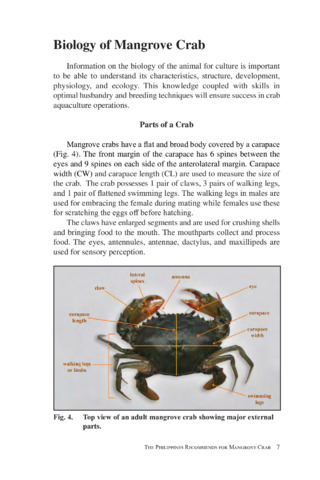
[The Philippines recommends for mangrove crab:] Biology of mangrove crab
(DOST-PCAARRD, 2021)