Collection of the orange-spotted grouper Epinephelus coioides from Tinagong Dagat and Sapian Bay in northern Panay
ดู/
วันที่
2007Page views
5,009ASFA keyword

AGROVOC keyword
Taxonomic term

Geographic names

เมตาดาต้า
แสดงระเบียนรายการเต็มShare
นามธรรม
In Capiz, northern Panay, grouper catches by hand picking, hook and line, shelters, and fish corral were low throughout the year, on average 1-3 fish from each fishing operation, but higher in Tinagong Dagat than in Sapian Bay. Epinephelus coioides was the most common of the three grouper species collected; E. quoyanus and E. malabaricus were not numerous. The 882 specimens of E. coioides from Tinagong Dagat measured from 3.6 to 39 cm in standard length; the 250 E. coioides from Sapian Bay were between 1.7 and 31.2 cm SL. The size distribution showed a modal length of about 17 cm SL (21% of the fish) in Tinagong Dagat, and 11 cm (26%) in Sapian Bay. Small juveniles 2–8 cm were collected from Tinagong Dagat in January-April 1993, but not in Jan-Apr 1994. Such small juveniles were also collected from Sapian Bay in January and in April–August 1993. Groupers 9–23 cm occurred year round, but the 9–15 cm group was more abundant from January to June. At both sites, groupers >30 cm could hardly be found. Both grouper habitats experienced wide ranges of water temperature, salinity, and dissolved oxygen during the year.
การอ้างอิง
Solis, N. B. (2008). Collection of the orange-spotted grouper Epinephelus coioides from Tinagong Dagat and Sapian Bay in northern Panay. In T. U. Bagarinao (Ed.), Research Output of the Fisheries Sector Program (Vol. 2. Reports on Fisheries and Aquaculture, pp. 93-97). Quezon City, Philippines: Bureau of Agricultural Research, Department of Agriculture.
Type
Book chapterISBN
9718511776Related items
Showing items related by title, author, creator and subject.
-
Philippine National Standard: Live, chilled/frozen grouper
(Bureau of Agriculture and Fisheries Standards, 2009)This Philippine National Standard for live, chilled/frozen grouper identifies the Philippine species of grouper, specifies their essential composition and quality factors (including size classification and quality characteristics), provides the presentation, packaging and labeling requirements, indicates the methods sampling, examination and analyses, and defines the types of defectives. It is hoped that this standard accomplishes our two pronged goal of protecting consumer health and making the Philippine fish and fishery products globally competitive. -
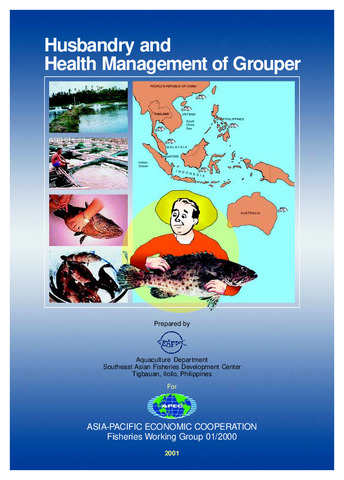
Husbandry and health management of grouper
(Asia-Pacific Economic Cooperation; Aquaculture Department, Southeast Asian Fisheries Development Center, 2001)The groupers (Family Serranidae) are among the most popular species in the live reef food fish industry in the Asia-Pacific region. Groupers are generally fast growing, hardy, suitable for intensive culture, and with excellent characteristics for processing. The high demand for these fishes is due to their unique culinary attributes and scarcity. In 1997, the Asia-Pacific region contributed about 90% to the total world aquaculture production. The regional production of farmed grouper was estimated at 15,000 tons, with China as the biggest producer contributing 8,000 tons followed closely by Indonesia. Other countries in the region commonly produce 1,000-2,000 tons annually in 1990- 1997. Groupers are generally cultured in floating net cages or earthen ponds, but cage culture is more common in Southeast Asia. Grouper pond production is becoming an attractive alternative to intensive shrimp culture in countries where management problems have forced growers to abandon shrimp farming. Although grouper culture is widespread in Asia and the Pacific, its continued development is constrained by the limited availability of fingerlings. Most economies, with the recent exception of Chinese Taipei, rely almost totally on wild-caught fry and fingerlings for stocking. This demand for wild seeds has led to unsustainable and illegal collection practices such as the use of cyanide to capture large numbers of seed with relatively less investment in time and effort. The inadequate supply of seed is further aggravated by the lack of appropriate handling techniques during collection, transport and storage of collected fish, and sometimes by an unregulated management of the wild stocks. There is also the lack of appropriate techniques for efficient grouper culture to marketable sizes. A major production constraint is heavy mortality of groupers during the collection and culture phases due to handling stress and diseases. The utilization of non-destructive devices for grouper collection, proper fish handling and increased efficiency in culture management can result to socio-economic and environmental benefits. A well-developed grouper culture operation complemented by appropriate wild grouper fishery management can provide sustainable employment to many people – from marginal fishers to farmers to traders. Grouper fisheries based on illegal or destructive fishing practices underlines the urgent need for habitat protection and sustainable utilization of natural resources. The objective of this manual is to provide a farmer-friendly practical guide for grouper farmers in the Asia-Pacific economies. It is hoped that this manual will enhance farmers’ ability to culture and handle grouper, as well as to prevent and manage disease outbreaks. -
Research on marine and freshwater fishes
(Aquaculture Department, Southeast Asian Fisheries Development Center, 1995)Most of the fish research at SEAFDEC AQD in 1992-1994 was on milkfish. Studies were conducted on year-round spawning through hormonal or environmental manipulation; optimum lipid and protein levels and ration size for captive broodstock; and the influence of spawner age on reproductive performance. The economics of hatchery operations, alone or integrated with broodstock as a commercial enterprise, was assessed. Mass production of larvae was refined with the use of commercial or SEAFDEC-formulated larval diets. Alternative rearing schemes in large tanks and ponds were tried. Hatcheryproduced and wild-caught larvae were compared in terms of growth and production in experimental nursery and grow-out ponds. Supplemental diets for brackishwater grow-out culture were formulated. Studies on broodstock management of grouper Epinephelus spp. included lipid enrichment of the diet and hormonal induction of sex inversion. Seed production techniques were developed but survival rates were low. Grouper culture was found economically feasible in experimental ponds with 'trash' fish as feed. The mangrove red snapper Lutjanus argentimaculatus was successfully induced to spawn with injection of human chorionic gonadotropin. Initial larval rearing trials were successful but survival rates must be improved. Hormonal manipulation of spawning of the Asian sea bass Lates calcarifer allows seed production during most of the year. Photoperiod manipulation leads to maturation of females, but not males, beyond the natural breeding season (April-November). Nursery rearing of 9 mm juveniles is feasible in floating net cages with night lights that attract food zooplankton. The requirements of sea bass for lipid, protein, carbohydrates, and essential amino acids were determined. In the rabbitfish Siganus guttatus, weekly injections of luteinizing hormone releasing hormone analogue (LHRHa) sustains milt production for three weeks. Thyroid hormones injected into broodstocks improved the growth of larvae to day 7. Induced spawning techniques for the Asian catfish Clarias macrocephalus were refined by determining the seasonal responsiveness to LHRHa and pimozide injections and testing for pheromonal induction of spontaneous spawning. The optimum insemination rate was determined and egg hatchability was enhanced by removal of the adhesive coat before incubation. Several practical diets for catfish during grow-out culture were tested against 'trash' fish. The broodstock management for bighead carp Aristichthys nobilis was studied. Cage-reared juveniles from cage-reared broodstock showed the best growth. To improve the reproductive performance, the broodstock diets were supplemented with vitamins A, C, and E. Research on tilapias focused on genetics and strain selection. Several strain testing procedures for Nile tilapia were evaluated in their efficiency to detect economically important strain differences. Reference lines were developed from two existing red tilapia strains to measure and reduce the effects of uncontrolled nongenetic variables in strain evaluation experiments with Nile tilapia. The tolerance of two Nile tilapia strains to heavy metals was similar when gauged by the 24-hour and 96-hour lethal concentration and by fish growth, survival, and reproductive performance. In a separate study, four strains of red tilapia showed generally higher seed production when reared in tanks than in cages. Improvements in the feed and feeding management for Nile tilapia were also studied. Intensive tilapia farming and feeding have led to oxygen depletion and fish kills in Sampaloc Lake. To rehabilitate the lake, it is imperative to reduce the farming area from 30 to 6 hectares; stop the use of commercial feeds; and remove the water hyacinths and other debris. Fish kills in Laguna de Bay have also become serious in recent years, and a review of the occurrences, losses, and possible causes is currently being conducted. Studies on the epizootic ulcerative syndrome of snakeheads in Laguna de Bay have yet to pinpoint the pathogen. Skin lesions in tilapias in several ponds and lakes in the country were found to be due to bacteria.