Transplantation, hatchery, and grow-out of window-pane oyster Placuna placenta in Guimaras and Iloilo

Share
Abstract
The windowpane oyster Placuna placenta (local name kapis) used to be harvested in large quantities and support a shellcraft industry in the Philippines, particularly in Panay Island. But the fishery and the industry declined markedly by the 1990s. Studies were conducted to transplant kapis and also to develop hatchery techniques for it in an effort to counter the population depletion. Kapis with average shell heights of 7 cm and 10 cm were transplanted from Roxas City in northern Panay Island and from Oton, Iloilo in southern Panay to Taklong Island in Guimaras during the rainy season (July–November) and the dry season (February–June). Survival of the transplants was higher during the dry season (57–60%) than during the rains (35–48%). Sexually mature kapis 10 cm in shell height were induced to spawn by temperature manipulation, water level manipulation, and use of ultravioletirradiated sea water. Spawning was successfully induced by raising the water temperature to 29±0.5oC. Eggs measured 45 μm on average, and fecundity was 5,000–10,000 per female. Kapis larvae were reared on a combination of the microalgae Isochrysis galbana, Tetraselmis sp., and Chaetoceros calcitrans, maintained at a density of 100,000 cells/ml. Three water treatment schemes were tested for larval rearing: chlorination, ultraviolet irradiation, and filtration (control). Larvae survived to the umbo veliger stage (180 μm, day 10) in chlorinated sea water whereas mass mortality occurred at the straight-hinge stage (days 4–) in both UV-treated and filtered sea water.
Suggested Citation
Garibay, S. S., Golez, S. N., & Unggui, A. S. (2007). Transplantation, hatchery, and grow-out of window-pane oyster Placuna placenta in Guimaras and Iloilo. In T. U. Bagarinao (Ed.), Research Output of the Fisheries Sector Program (Vol. 2. Reports on Fisheries and Aquaculture, pp. 119-122). Quezon City, Philippines: Bureau of Agricultural Research, Department of Agriculture.
Type
Book chapterISBN
9718511776Related items
Showing items related by title, author, creator and subject.
-
Series: PCAARRD Information Bulletin; No. 113/2021
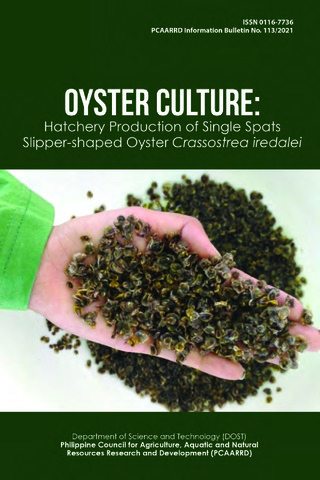
Oyster culture: Hatchery production of single spats slipper-shaped oyster Crassostrea iredalei
(DOST-PCAARRD, 2021)This manual intends to provide information on the techniques, processes, and recommend practices on hatchery production of single spats slipper-shaped oyster Crassostrea iredalei. This will serve as a guide for hatchery ... -
Research on seaweeds and mollusks
(Aquaculture Department, Southeast Asian Fisheries Development Center, 1995)Research on seaweeds focused on the carrageenan-producing Kappaphycus alvarezii and the agar-producing Gracilaria spp. Growth of K. alvarezii was better on horizontal lines than on vertical or cluster lines from bamboo rafts. All morphotypes (brown green, and red) grew faster at 50 cm than at 100 cm below the water surface, but the green morphotype showed better carrageenan properties. A socioeconomic survey of K. alvarezii farming in Panagatan Cays, Antique revealed that a farmer has an average annual production of 3 tons/ha (dry) with the fixed bottom and hanging longline methods. Three species of Gracilaria in natural beds in lloilo showed monthly variations in biomass and agar quality; G. heteroclada had the highest biomass and gel strength. When this species was grown in tanks, growth and agar sulfate content were influenced by the interaction of light, salinity, and nutrients. Enriched and unenriched stocks of G. heteroclada differed in agar quality. When G. heteroclada was grown with the tiger shrimp Penaeus monodon in extensive ponds, the highest growth rate and production were obtained at the seaweed stocking density of 250 g/m2; this was in November when average water temperature, transparency, and salinity were low. Salinity tolerance varies among Gracilaria species.Oyster (Crassostrea iredalei) and mussel (Perna viridis) farming in Western Visayas were assessed in 1992 in terms of the culture methods, socioeconomics, marketing, and profitability. A more localized survey of oyster and mussel fanning was conducted through rapid rural appraisal in two coastal towns in 1993. A farmer-participatory study followed in 1994 for the culture of oysters, mussels, seaweeds, and rabbitfishes in a river mouth in Dumangas, lloilo. Green mussel, brown mussel (Modiolus metcalfei), and seaweeds transplanted to Dumangas from Capiz have reproduced. In another study, the green mussel was tested as a biological filter in tiger shrimp ponds; shrimps stocked with mussels grew better than those without. A nationwide survey on the Placuna placenta fishery in 1993 showed 27 remaining 'kapis' beds; many others have been depleted due to excessive gathering, pollution, siltation, and trawling. Broodstocks are being developed to produce 'kapis' seed for grow-out and restocking. For the first time at AQD, adult donkey-ear abalone Haliotis asinina from the wild spawned naturally in laboratory tanks. Juvenile abalones can be successfully grown on Gracilaria or abalone diet. -
Bivalves
(Aquaculture Department, Southeast Asian Fisheries Development Center, 1994)Mollusc research at the Aquaculture Department of the Southeast Asian Fisheries Development Center from 1989 to 1991 was primarily focused on the highly exploited window-pane oyster, Placuna placenta Linnaeus. Other species studied were the saddle-shaped oyster, Placuna sella, the slipper-shaped oyster, Crassostrea iredalei, and the green mussel, Perna viridis. Research on P. placenta aimed to develop techniques in seed production (broodstock maturation and induced spawning), transplantation, and stock assessment and restocking of depleted natural beds. The annual variations in the reproductive activity, condition index, and proximate composition of P. sella were determined. A socioeconomic study of oyster (C. iredalei) and mussel (P. viridis) farming practices in western Visayas, central Philippines is on-going and will provide information on current culture methods and their profitability. An inventory of mollusc researches conducted in the Philippines has been done and the culture techniques and research gaps are being reviewed and identified. This information will guide further research on molluscs in the Philippines.