Journal Articles, Conference Papers and Book Chapters by SEAFDEC Staff: Recent submissions
1281-1300 / 1693
-
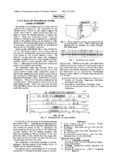
A new device for recording the feeding activity of milkfish
(The Japanese Society of Scientific Fisheries, 1981)Knowledge on the feeding activity is basic and very important for rearing fish. The information on the feeding activity rhythm of the animal suggests the proper time to feed it. Many devices have been designed to record the feeding activities of aquatic animals. Some are mechanical devices which are difficult to maintain in good conditions for a long time. None of the present devices can be applied to milk-fish because of its characteristic manner of taking food. In this paper, a new electrical device for recording the feeding activity of milkfish is reported. -
Viability of frozen algae used as food for larval penaeids
(Fisheries Research Society of the Philippines, 1981)Freezing with added chemicals as flocculants and protectants as means of preserving stock cultures was tried with four species commonly used as larval food. The species were Chaetoceros calcitrans, Skeletonema costatum, Tetraselmis chuii , and Isochrysis galbana. Except in I. galbana , this method successfully preserved the viability of the algae tested. C. calcitrans , was viable up to eighteen months storage; T. chuii , four months; and S. costatum , two months. Cryophylaxis did not seem to greatly increase the viability of frozen cells except with T. chuii ; however, with the diatoms, viability was preserved regardless of the harvesting flocculant used and whether or nor protectants were added. -
Effect of different stocking combinations on growth, production and survival of milkfish (Chanos chanos Forskal) and prawn (Penaeus monodon Fabricius) in polyculture in brackishwater ponds
; Primavera, Jurgenne (Elsevier, 1981)
Milkfish (Chanos chanos) and prawn (Penaeus monodon) were stocked in 500 m2 earthen ponds from 12 November 1978 to 15 March 1979 at the following combinations: 2000 milkfish fingerlings per ha (treatment I); 2000 milkfish fingerlings plus 4000 prawn juveniles per ha (treatment II); and 2000 milkfish fingerlings plus 8000 prawn juveniles per ha (treatment III), with three replicates per treatment. Highest combined net milkfish and prawn production was obtained in treatment III with 492.1 kg/ha followed by treatment II with 404.1 kg/ha, and treatment I (milkfish only) with 280 kg/ha. Differences in combined net production between treatments III and I and between treatments II and I were statistically significant at the 5% level. Average net production of milkfish alone was also highest in treatment III followed by treatment II and treatment I, although differences were not significant. Average net production for prawn was also better in treatment III than in treatment II but the difference was not significant. However, mean weight of prawn was higher in treatment II compared to treatment III. Average survival rates were high for milkfish in all treatments ranging from 90 to 96%, but low for prawn at around 50% for both treatments. There was no significant difference in survival rates of milkfish among treatments and of prawn between treatments II and III. The competition index between milkfish and prawn at the given stocking combinations was negative indicating a positive, advantageous influence of prawn on milkfish production.
(Elsevier, 1981)
Milkfish (Chanos chanos) and prawn (Penaeus monodon) were stocked in 500 m2 earthen ponds from 12 November 1978 to 15 March 1979 at the following combinations: 2000 milkfish fingerlings per ha (treatment I); 2000 milkfish fingerlings plus 4000 prawn juveniles per ha (treatment II); and 2000 milkfish fingerlings plus 8000 prawn juveniles per ha (treatment III), with three replicates per treatment. Highest combined net milkfish and prawn production was obtained in treatment III with 492.1 kg/ha followed by treatment II with 404.1 kg/ha, and treatment I (milkfish only) with 280 kg/ha. Differences in combined net production between treatments III and I and between treatments II and I were statistically significant at the 5% level. Average net production of milkfish alone was also highest in treatment III followed by treatment II and treatment I, although differences were not significant. Average net production for prawn was also better in treatment III than in treatment II but the difference was not significant. However, mean weight of prawn was higher in treatment II compared to treatment III. Average survival rates were high for milkfish in all treatments ranging from 90 to 96%, but low for prawn at around 50% for both treatments. There was no significant difference in survival rates of milkfish among treatments and of prawn between treatments II and III. The competition index between milkfish and prawn at the given stocking combinations was negative indicating a positive, advantageous influence of prawn on milkfish production. -
Acute toxicity of un-ionized ammonia to milkfish (Chanos chanos) fingerlings
(Fisheries Research Society of the Philippines, 1981)The acute toxicity of un-ionized ammonia to milkfish (Chanos chanos) fingerlings was determined using a static bioassay system. The 24-, 48-, 72-, and 96-hr LC50 values were calculated at 25.74 ppm NH3-N (1.89 ppm NH3), 23.06 ppm NH3-N (1.46 ppm NH3), 21.62 ppm NH3-N (1.25 ppm NH3) and 20.65 ppm NH3-N (1.12 ppm NH3), respectively. -
Developmental and ecological stages in the life history of milkfish Chanos chanos (F.)
(Fisheries Research Society of the Philippines, 1981)Seven stages in the life history of milkfish Chanos chanos are suggested: embryonic, yolksac larval, larval, postlarval, juvenile, sub-adult and adult stages. These were based on morphological differences and on their particular ecological requirements. The latter include: behavioral pattern, food and feeding habits, and habitat requirements. Throughout the life cycle of milkfish the stronger driving force with determines particular behavioral strategies can be attributed to the evolutionary response of the organism of food distribution (availability) followed by predation pressure. -
Pigmentation pattern in the early developmental stages of milkfish (Chanos chanos): A key for larval identification.
(Fisheries Research Society of the Philippines, 1981)Pigmentation patterns are presented for 5 - 20 day old milkfish (Chanos chanos) and are discussed in terms of their use in larval identification. -
Survival, growth and production of Penaeus monodon Fabricius at different stocking densities in earthen ponds with flow-through system and supplemental feeding.
(Fisheries Research Society of the Philippines, 1981)Penaeus monodon juveniles (P53-P54, 0.45 g) were stocked in 200 m2 earthen ponds with water exchange rate of 5-10% daily, and reared for 3.5 months. Stocking density levels of 2.5, 5.0, 10 and 20 prawns/m2 were designated as treatments A, B, C and D, respectively. Pelletized formula feed was given daily from the second week of stocking at 10% of biomass and was reduced bi-weekly by 1% to a final rate of 5% of biomass. Significantly, high survival was achieved in treatment A, 98.6% followed by B, 95.3%; D, 87.6% and C, 86.5% (P < 0.05). The final average body weight obtained varied inversely with stocking density. Mean body weight for treatments A and B were significantly higher than those of treatments C and B. Results also showed significant differences among all paired means of the final weights except between treatments C and D. -
Feeding behavior and food preference of Penaeus monodon Fabricius with scrap Tilapia mossambica
(Fisheries Research Society of the Philippines, 1981)The time of day during which P. monodon feeds at different depth levels in earthen ponds, and its preference for three types of tilapia feeds (dry, fresh and fermented) were determined. It was observed that P. monodon concentrated at the bottom beds during the day and along the periphery of dikes during night-time, with a slight tendency to swim and feed towards the surface as darkness increased. P. monodon showed special preference for dried tilapia compared to fresh and fermented tilapia. P. monodon also showed adaptability to the platform method of feeding, especially during night-time. -
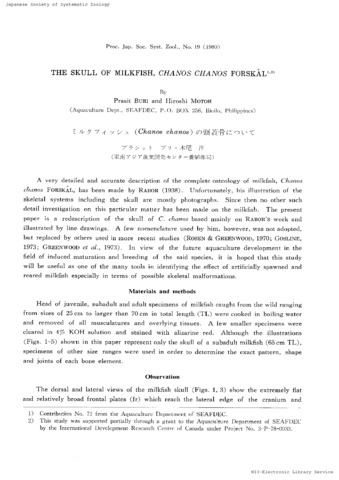
The skull of milkfish, Chanos chanos Forsskal
(Japanese Society of Systematic Zoology, 1980)The skull of the milkfish, C. chanos, is described so that it may be used as a tool in identifying the effect of artificial propagation in terms of skeletal malformations. -
The effects of feeds and feeding levels on the survival of a prawn, Penaeus monodon larvae
(Kagoshima University Research Center for the South Pacific, 1980)Penaeus monodon larvae were grown from zoea1 to mysis2 stages using varying levels of single-celled Chaetoceros sp., baker's yeast, and a combination of the two. The effects of feeds and feeding on the survival rates of the larvae were discussed. The highest survival rate of 76.8% was obtained when the larvae were fed on a mixture of Chaetoceros sp. and baker's yeast at feeding levels of 10-50 x 103 cells per ml of sea water and 1 g per ton per day, respectively. When the larvae were fed on Chaetoceros sp. alone, feeding level of 10-50 x 103 cells per ml of sea water seemed to give optimal survival rate. The results of the present study also suggest that baker's yeast could be applied in the mas culture of Penaeus monodon larvae. -
Studies on the fungal diseases in crustaceans. II. Haliphthoros philippinensis sp. nov. isolated from cultivated larvae of the jumbo tiger prawn (Penaeus monodon)
(Mycological Society of Japan, 1980)Haliphthoros philippinensis sp. nov., isolated from larvae of P. monodon is described and illustrated as new. The fungus grew at a temperature range of 13.5-36.3 C, with the optimum of 29.3-34.5 C. Growth occurred in peptone-yeast extract-glucose broth containing 0.3-7% NaCl, with optimum concentrations of 1-4%. At 8% NaCl concentrations, growth was not observed. Its pH range for growth was 5-11. -
Rearing of the larval stages of prawn, Penaeus japonicus Bate, using artificial diet.
(Kagoshima University Research Center for the South Pacific, 1980)Survival and growth rates of the zoeal and mysis stages of the prwn, Penaeus japonicus Bate, were studied using natural and artificial diets. The highest survival rate, 34.2%, was obtained in the larvae fed with the artificial diet, Diet-B. Larvae fed with the diatom, Chaetoceros gracilis, plus Artemia nauplii did not give the best survival; however, growth was the fastest in this group. The larvae metamorphosed into the mysis3 stage in 8 days. The results thus seem to demonstrate tat Diet-B is an effective diet for the early larval stages of the prawn, P. japonicus. -
Preliminary studies in some aspects of amino acid biosynthesis in juveniles of Penaeus monodon Fabricius: II. Partial purification and characterization of muscle L-glutamate dehydrogenase
(The Philippine Biochemical Society, 1980)A method of partially purifying L-glutamate dehydrogenase, a key enzyme in the biosynthesis of non-essential amino acids, from the muscle of P. monodon juveniles is presented. Enzyme extraction with Tris-acetate buffer, ammonium sulfate fractionation, DEAE-cullulose chromatography, and Sepharose 4B chromatography were used. A 260-fold purification was obtained, but the recovery of enzyme activity was low. Possible modification in the method and the need for further purification are discussed. P. monodon possesses an enzyme which catalyzes the de novo synthesis of glutamate from alpha-ketoglutarate and ammonia. The enzyme has a pH optimum for the reductive amination of alpha-ketoglutarate between pH 8.0 and 8.2. The low Michaelis-Menten constant (1.03 x 10⁻⁴M) of the enzyme for alpha-ketoglutarate strongly suggests the physiological importance of this pathway in P. monodon. Substrate inhibition by alpha-ketoglutarate at high non-physiological levels was observed and discussed. The molecular weight of the native enzyme estimated by molecular sieve chromatography is 320,000 daltons. Subunit studies using SDS polyacrylamide gel electrophoresis suggest that the enzyme possesses a unique molecular organization compared to those derived from other sources. -
Preliminary studies in some aspects of amino acid biosynthesis in juveniles of Penaeus monodon Fabricius: I. Incorporation of 14C from (U-14C) acetate into amino acids to precipitable proteins
(Philippine Biochemical Society, 1980)Ion-exchange chromatography in conjunction with radioisotope labelling techniques were used to investigate the incorporation of 14C from (U-14C) - acetate into amino acids of precipitable proteins in P. monodon juveniles. Highest 14C radioactivity was found in the adidic amino acids, aspartic acid and glutamic acid. Little but significant radioactivity was observed in alanine, cysteine, glycine, proline and serine. Amino acids which incorporated little or no 14C were arginine, histidine, isoleucine, leucine, lysine, methionine, phenylalanine, threonine, tyrosine and valine. It appears that P. monodon juveniles could not synthesize these amino acids from acetate. The essential nature of these amino acids in P. monodon is discussed. -
Occurrence of milkfish, Chanos chanos (Forsskal) eggs around Panay Island, Philippines
(The Faculty of Fisheries, Nagasaki University, 1980)A total of 551 milkfish eggs was collected by horizontal tows with a fish larval net in the waters around Panay island during the period from April 1976 to June 1979. The maximum number obtained by a single tow was 33 eggs. Most of the eggs were collected from Cuyo East Pass, with some from the waters around the Cagayan Islands and a single egg from the Sibuyan Sea. Almost all the eggs were collected during the period frim March to June, with a peak in April, one month ahead of the peak of fry occurrence. Very often milkfish eggs occurred in shallow waters around islands or close to the coasts, while they were sometimes found at locations remote from land and as deep as 900 m. Water temperatures and salinities at locations shere milkfish eggs were found ranged from 26.7 to 30.8°C and from 32.9 to 34.5 ppt. The eggs were rather evenly distributed from the surface to at least 20 m down. The eggs found in the early morning collections were in the early stages of development; those found later in the day were more advanced. It seems that spawning of mikfish takes place at midnight, and that the incubation period of eggs in the wild is about 20 hours. -
Microsporidian parasite of the white prawn Penaeus merguiensis de Man: A preliminary report
(University of the Philippines, 1980)Electron microscopy of the ovary of the white prawn, Penaeus merguiensis De Man reveals the presence of the different stages in the life cycle of a species of microsporidia. This is the first such report of microsporidian infection of prawns, locally or abroad. Heavy infection causes the whitening of the entire ovary and the inability of spawners to spawn, a condition which unless controlled is a serious threat to prawn culture. Studies are being undertaken with the end in-view of controlling and/or preventing the infection. -
Fishing methods and gears in Panay Island, Philippines
; Bagarinao, Teodora (Faculty of Fisheries, Kagoshima University, 1980)
The authors surveyed the fishing methods and gears in Panay and smaller neighboring islands in the Philippines in September-December 1979 and in March-May 1980. This paper is a report on the fishing methods and gears used in these islands, with special focus on the traditional and primitive ones. -
Effects of different sex ratios on maturation, fecundity and hatching rates of ablated Penaeus monodon wild stock
; Primavera, Jurgenne; (Fisheries Research Society of the Philippines, 1980)
The minimum number of males per female that would still ensure high maturation, fecundity and hatching rates in Penaeus monodon broodstock, is determined. Wild stock P. monodon were stocked in 4 m diameter circular tanks at different sex ratios (0:1, 1:1, 1:2 and 1:4 male to female) for a duration of 55 days. All females were ablated on one eyestalk. Males remained unablated. The 1 male: 2 females ratio is recommended on the basis of highest percentage of first, second and third spawners, total and average fecundity. In the all-female treatment (0:1 ratio), 19.65% of the females spawned, but the 3.3 million eggs produced were not fertilized, resulting in a 0% hatching rate. -
Effect of various salinity levels and stock manipulation methods on the survival of milkfish fry (Chanos chanos) during storage.
(Fisheries Research Society of the Philippines, 1980)The survival and growth of milkfish (Chanos chanos ) fry stored in plastic basins at different salinity levels and stock manipulation methods without aeration and fed with hard-boiled chicken egg yolk over a period of 14 days were determined. Results showed that survival rate and increase in body weight did not differ significantly (P > .05) at different salinity levels nor with different stock manipulation methods. Moreover, there was no evidence of a significant interaction between salinity and stock manipulation method. The highest survival rate was 97.8% with stock manipulation 1 and 8 ppt salinity, while the lowest was 95.% with stock manipulation 1 at 32 ppt salinity. Results indicated that there was no need to reduce the salintiy of water used in storing fry in order to obtain higher survival rates as commonly believed. Sufficient food and maintenance of good water quality appeared to be more important than salinity for higher survival of fry during storage. -
Effect of substrate types on fecundity and nauplii production of ablated Penaeus monodon Fabricius
; Primavera, Jurgenne; (Science and Technology Information Institute, Department of Science and Technology, 1980)
The survival, spawning, fecundity, and nauplii production of ablated Penaeus monodon females reared in flow-through broodstock tanks with white coralline and black sand substrates for 62 days, were assessed. Prawns exposed to the white coralline substrate consistently produced eggs with significantly higher (P - 0.05) average hatching rates and total nauplii production than those exposed to the black sand substrate. No differences were observed in the fecundity, spawning and survival rates in both treatments. It was observed that nightly sampling of ablated females during experiment 2 produced a higher number of spawning (48) and total number of nauplii produced (6.8 milion) compared to twice weekly sampling in experiment I (29 spawnings and 3.0 million nauplii) for the white substrate.