Journal Articles, Conference Papers and Book Chapters by SEAFDEC Staff: Recent submissions
Now showing items 1261-1280 of 1693
-
Gonadotropin profiles in serum of milkfish treated with salmon pituitary homogenate
(University of the Philippines Los Baños, 1983)Serum gonadotropin (GtH) levels were determined by radioimmunoassay (RIA) in adult regressed milkfish injected or implanted with various doses of salmon pituitary homogenate (SPH). Gonadotropin profiles of injected or implanted milkfish show similar trends. Elevation of serum GtH occurred a day after treatment in all groups irrespective of the administered dose. The level dropped after 2 or 3 days and in the implanted fish, was at the initial level 10 days after treatment. The expected slow and sustained release of hormone from the SPH pellet was not obtained even at the high dose given. A preliminary investigation of the milkfish pituitary homogenate using the salmon-GtH-RIA system shows no cross reaction of milkfish GtH with salmon GtH antibody, indicating that the milkfish and salmon gonadotropins are immunologically distinct molecules. -
The mechanics of mass occurrence and recruitment strategy of milkfish Chanos chanos (Forsskal) fry in the Philippines
(Kagoshima University Research Center for the South Pacific, 1983)The daily and hourly catch of milkfish Chanos chanos (Forsskal) fry in the coast of Hamtic, Panay Island in the Philippines was recorded over a period of 16 weeks, and correlated with time, location, types of gear, and lunar and tidal variations. About 4000 fry were marked and released, scanning electronmicroscopy was employed to examine the feeding habit of the fish. The results obtained suggest an active process governing the occurrence and movement of fry in coastal waters. The appearance of the fry is related to the developmental stage of the fry and is subject to lunar modulation. Interaction with predators in coastal waters has produced diverse and selective antipredator adaptations, such as body transparency, the use of timing (seasonality, tidal conditions), and distribution patterns. The maximization of resource utilization and minimization of resource sharing also occurs in a seasonal basis. High mortality rate in shallow coastal waters is counteracted by high recruitment rate and specific behavioural and physiological adaptations to ensure successful and fast colonization of backwaters. It is suggested that higher food availability in the nursery ground exerts a stronger selective pressure over predation, and act as the major force in the migration from offshore to shore waters. -
Intestinal glucose transport in carnivorous and herbivorous marine fishes
(Springer Verlag, 1983)The influx and transepithelial movements of glucose and their effects on the electrophysiology and Na transport in upper and lower intestines of the herbivorous surgeonfish, Acanthurus mata , and carnivorous eel, Gymnothorax undulatus , were measured. The K t G and J max G of glucose influx into the tissues were higher in the surgeonfish upper intestine than in the surgeonfish lower intestine or in both segments of the eel intestine. A prominent diffusion-like transport component was also measured in all four segments during influx experiments. Net transepithelial glucose fluxes (0.05 mM) were greater in eel intestine than in those of the surgeonfish largely due to an apparent lower apical membrane permeability of the former coincident with reduced backflux of glucose from epithelium to lumen. All four stripped intestinal segments exhibited non-significant (from zero; P >0.05) or small, serosa-negative transepithelial potential differences (-0.1 to -2.2 mV), and low transepithelial resistances (40–88 O cm -2 ). Each tissue displayed significant ( P P >0.05) change the transepithelial resistance, but did induce a significant ( P J net Na with added luminal glucose, these increased net cation fluxes were not quite significant ( P >0.05). It is concluded that coupled Na-glucose transport occurs in these tissues, but that metabolic enhancement of unrelated current-generating mechanisms also takes place and may modify depolarizing effects of organic solute transfer. -
The visual feeding threshold and action spectrum of northern anchovy (Engraulis mordax) larvae
Bagarinao, Teodora ; (California Cooperative Oceanic Fisheries Investigations, 1983)
The visual feeding threshold and action spectrum of 10-15-mm northern anchovy larvae were determined, using as criterion the incidence of two or more rotifers in the guts of 50% of larvae tested under different spectral irradiances. The threshold sensitivity ot broadbank blue-green light is at 0.15 µWcm-2=0.61 lux. The action spectrum shows a mixumum in the green wavelengths around 530 nm: the weighted threshold irradiances at various wavelength bands converge at a mean value of 0.14 µWcm-2anch eff. The visual abilities of the anchovy allow them to feed at a depth of 74 m at noon on clear days, and at the surface during twilight and bright nights, and appear to be well adapted to the anchovy's habitat in turbid, greenish coastal waters. Comparisons with younger anchovy larvae show that changes in visual function accompany changes in eye and retinal morphology, specifically the recruitment of rods. Moreover, 10-15-mm anchovy larvae can feed to a limited extent (10%) in the dark when food densities are high (20-40 rotifers/ml). In March, which is the peak spawning season of the anchovy in southern California and Baja California, the 10-15-mm larvae have 13 hours each day to feed.
; (California Cooperative Oceanic Fisheries Investigations, 1983)
The visual feeding threshold and action spectrum of 10-15-mm northern anchovy larvae were determined, using as criterion the incidence of two or more rotifers in the guts of 50% of larvae tested under different spectral irradiances. The threshold sensitivity ot broadbank blue-green light is at 0.15 µWcm-2=0.61 lux. The action spectrum shows a mixumum in the green wavelengths around 530 nm: the weighted threshold irradiances at various wavelength bands converge at a mean value of 0.14 µWcm-2anch eff. The visual abilities of the anchovy allow them to feed at a depth of 74 m at noon on clear days, and at the surface during twilight and bright nights, and appear to be well adapted to the anchovy's habitat in turbid, greenish coastal waters. Comparisons with younger anchovy larvae show that changes in visual function accompany changes in eye and retinal morphology, specifically the recruitment of rods. Moreover, 10-15-mm anchovy larvae can feed to a limited extent (10%) in the dark when food densities are high (20-40 rotifers/ml). In March, which is the peak spawning season of the anchovy in southern California and Baja California, the 10-15-mm larvae have 13 hours each day to feed. -
The quantitative dietary protein requirements of Penaeus monodon juveniles in a controlled environment
(Elsevier, 1983)Penaeus monodon juveniles (average weight = 1.32 g) were kept in individual 2 l perforated plastic containers, 10 of which were placed in each of the twenty-four 50 l rectangular wooden-glass aquaria supplied with seawater filtered through a sand-gravel filter (32–34 ppt; 26.5–29.0°C; pH, 7.6–8.2) at 0.8–1.01 l/min. Eight diets were prepared containing 25–60% protein and fed at 10% of the body weight/day for the first 2 weeks and 8% for the succeeding 4 weeks. Shrimps fed the 40% protein diet produced the best growth, feed conversion ratio (FCR), protein efficiency ratio (PER) and survival rate. However, shrimps fed the 30, 35 and 45% protein diets produced comparable results. The protein content of the shrimps was directly related to the level of protein diet up to 50%; whereas fat content seemed to be inversely related up to 50% protein diet. -
Seasonal variation in food and feeding of Penaeus monodon Fabricius (Decapoda, Natantia)
(E.J. Brill, 1982)A preliminary study on feeding habits of P. monodon F. (cf. Marte, 1980) indicated seasonal variations in feeding in this species. Similar observations have been reported for P. aztecus Ives and P. duorarum Burkenroad. The present paper confirms this preliminary observation and provides indications of a relationship between feeding activity and spawner occurrence. -
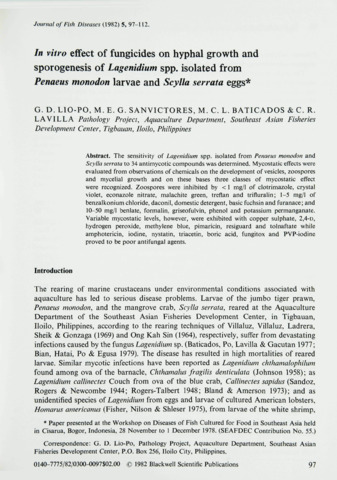
In vitro effect of fungicides on hyphal growth and sporogenesis of Lagenidium spp. isolated from Penaeus monodon larvae and Scylla serrata eggs.
(Blackwell, 1982)The sensitivity of Lagenidium spp. isolated from Penaeus monodon and Scylla serrata to 34 antimycotic compounds was determined. Mycostatic effects were evaluated from observations of chemicals on the development of vesicles, zoospores and mycelial growth and on these bases three classes of mycostatic effect were recognized. Zoospores were inhibited by < 1 mg/1 of clotrimazole, crystal violet, econazole nitrate, malachite green, treflan and trifluralin; 1-5 mg/1 of benzalkonium chloride, daconil, domestic detergent, basic fuchsin and furanace; and 10-50 mg/1 benlate, formalin, griseofulvin, phenol and potassium permanganate. Variable mycostatic levels, however, were exhibited with copper sulphate, 2,4-D, hydrogen peroxide, methylene blue, pimaricin, resiguard and tolnaftate while amphotericin, iodine, nystatin, triacetin, boric acid, fungitox and PVP-iodine proved to be poor antifungal agents. -
Gill lesions associated with acute exposure to ammonia.
(University of the Philippines, 1982)The histopathological effects of the 96 hr LC50 at 20.65 ppm NH3-N on the gills of milkfish fingerlings were examined qualitatively. Lesions observed were hypertrophy, hyperplasia, fusion of the lamellae, epithelial lifting, lamellar telangiectasis, disruption of the epithelial layer, lamellar detachment, vacuolation of the lamellae and the blood cells, and presence of several mitotic cells. The physiology of the histopathological lesions observed is discussed. -
Vertical diurnal migration of Daphnia cucculata and Eudiaptomus graciloides in eutrophic Frederiksborg Castle Lake, Denmark
(University of the Philippines at Los Baños, 1982)In euthrophic Frederiksborg Castle Lake, Berg & Nygaard were the first to study vertical migration. They obtained water samples at various time intervals over several days and concluded that the bulk of the population of the zooplankton they were studying shifted from one depth to another. D. cucculata and E. graciloides are the two most dominant zooplankters in Frederiksborg Castle Lake. The vertical migration of these species was studied, and the observations are reported in this paper. -
Studies on the digestive proteases of the milkfish Chanos chanos
(Springer, 1982)The protease activity of crude extracts from various organs of the digestive tract of two groups of milkfish was determined. One group (Sample A) derived their food from ponds that had predominantly unicellular algae while the other group (Sample B) were reared on ponds dominated by the filamentous green algae Chaetomorpha brachygona . In general, crude extracts from Sample A fish had a higher protease activity than Sample B fish. In both samples, high protease activity was observed in crude extracts from the pyloric caeca, intestines and pancreas. Chymotryptic activity was observed in crude extracts of pancreas, intestines and pyloric caeca of both fish samples. Tryptic activity was, however, observed only in fish grown on unicellular algae. Experimental evidence suggests that a powerful trypsin inhibitor in Chaetomorpha brachygona may account for the absence of tryptic activity in all crude extracts of Sample B fish. The presence of this inhibitor may also explain the widely observed poor growth rate of milkfish reared on this natural food. -
Ascorbic acid sulfate sulfohydrolase (C2 sulfatase): the modulator of cellular levels of L-ascorbic acid in rainbow trout.
(National Academy of Sciences of the United States of America, 1982)The enzyme L-ascorbic acid 2-sulfate sulfohydrolase (C2 sulfatase) was purified from rainbow trout liver. The enzyme catalyzes the hydrolysis of L-ascorbic acid 2-sulfate and has a pH optimum at 6.0. It has a molecular weight of about 117,500 at pH 5.0 and is inhibited by a number of sulfhydryl blocking agents including L-ascorbic acid. C2 sulfatase activity was observed in most metabolic organs of rainbow trout. These findings suggest that the physiologic role of the enzyme is to maintain adequate cellular concentrations of L-ascorbic acid in the fish. The activity of the enzyme is controlled by L-ascorbic acid through feedback inhibition. Comparison of kinetic constants and inhibition patterns suggests that C2 sulfatase is structurally identical to human arylsulfatase A. However, unlike C2 sulfatase, human arylsulfatase A may not be involved in ascorbate metabolism. Its physiologic substrate is reported to be cerebroside-3-sulfate, not L-ascorbic acid 2-sulfate. A scheme is proposed to account for the functional divergence of these two structurally identical enzymes. -
Developmental stages of a microsporidian parasite of the white prawn, Penaeus merguiensis de Man 1888
(University of the Philippines, 1982)A microsporidian parasite found to invade the ovaries of the white prawn, Penaeus merguiensis de Man, 1888, causes the whitening of the mature female gonads. Ultrastructure examination of the white ovaries reveal the presence of spores and other developmental stages of the parasite. The earliest stage observed is the schizont which contains a few cisternae of endoplasmic reticulum, many ribosomes and a thin plasma membrane. The next stage is the sporont characterized by a pansporoblast membrane, an increase in the amount of endoplasmic reticulum, appearance of more vesicles and of polar filament precursors. Diplokaryotic schizonts and sporonts are also found. Division of the sporonts gives rise to uninucleate sporoblasts. At this stage, the spore organelles start to form and the cell acquires a degree of plarity. The polar filament and the polar sao appear and the sporont membrane complex develops into a sporoblast wall. The sporoblast is transformed into a spore with a polar cap, posterior vacuole, polaroplast, and two laters of spore wall, the exospore and the endospore. The polar filament is a tubular structure consisting of seven coils which after the second coil taper abruptly distally. All these stages of development of the parasite are observed in the infected ovaries within which its life cycle is completed. A probable mode of transmission and life cycle of the parasite is presented. -
Histopathology of microsporidian infection in white prawn, Penaeus merguiensis de Man, 1888.
(University of the Philippines, 1982)Different stages of the white prawn, Penaeus merguiensis de Man, were examined for microsporidian infection. The parasite was found only in adult female prawns exhibiting white instead of the normal olive-green ovaries. Non-germinal tissues were not infected. Spores found in the digestive tract, abdominal muscles, hepatopancreas, heart and gills were extracellular in location and did not have any histopathologic effect on these organs. -
Effect of light quality and eyestalk ablation on ovarian maturation in Penaeus monodon
; Primavera, Jurgenne (University of the Philippines Los Baños, 1981)
Prawns were subjected to the following treatments: blue light, red light, natural light, and natural light plus unilateral eyestalk ablation. Unablated prawns under blue and natural light developed stage III ovaries; under red light ovarian maturation reached only stage II. Ablation resulted in full maturation of ovaries and subsequent spawning. The external changes of the ovary were generally the same for both the ablated prawns under natural light and the unablated under different light qualities. Under blue light, however the ovary at stage III had numerous atretic cells and the diameter of its ova was more uniform. The maturation stage and mean gonadosomatic indices were high for the ablated and low for the unablated prawns. -
An assessment of algal growth in net cages in Laguna Lake
(Fisheries Research Society of the Philippines, 1981)Quantitative determination of the algal population, in terms of cells/ml and biomass/ml, was conducted during the first month of growing P. monodon postlarvae in Laguna Lake. Algae were sampled from each side of net cages at depths of 15, 30 and 45 cm below the water surface. Accumulation of algae appeared to be influenced by the direction of water flow. Moreover, growth of algal species was inversely proportional to depth of water. After two weeks, algal biomass was estimated to reach 4.5 kg per cage (1 x 1 x 1 m). Diatoms (Chrysophyta) predominated throughout the experimental period followed by members of Cyanophyta and Chlorophyta. -
A comparison of two prawn (Penaeus monodon ) brood stock systems—land–based tanks and marine pens
Primavera, Jurgenne; (World Aquaculture Society, 1981)
The paper compares two prawn (Penaeus monodon) brood stock systems—land-based tanks and marine offshore pens. Construction costs and annual maintenance and operating costs total US\$1,430 and \$2,550 for the tank and \$1,500 and \$3,680, respectively, for the pen. The 12 m3 ferrocement tank requires power for a 24-hour seawater flowthrough and can stock 50 animals/run for a projected yearly production of 8×10⁶ nauplii for 1.2 × 10⁶ juveniles (0.1 to 0.5 g body weight). The 16×16×4 m pen made of bamboo and nylon net materials can accommodate 300 brood stock/run with a projected annual production of 30 × 106 nauplii or 4.5 × 10⁶ juveniles. Discussion includes general requirements, mortality and maturation rates, and criteria for choosing a brood stock system. -
Lactate dehydrogenase isozyme patterns during the development of milkfish, (Chanos chanos (Forskal))
(University of the Philippines at Los Baños, 1981)Polyacrylamide disc gel electrophoresis was done to determine the lactate dehydrogenase (LDH) isozyme patterns for fry (5-3 mg), fingerling (6-12 g), pond-size (150-250 g) and adult (6-9 kg) milkfish. The patterns were tissue specific; the different tissues examined, viz., eye, liver, heart, and skeletal muscle had different expressions of LDH isozymes. The resolved patterns appeared to be products of LDH gene loci A, B, and C. Subunits A and B were present in all tissues. A4 and B4 were predominant in skeletal and heart muscle, respectively; the two associated non-randomly in vivo and formed only the heteropolymers A3B and AB3. A liver band, L4, was most conspicuous in the fingerling, pond-size, and adult; it was assumed to be coded by locus C. A negatively charged band, X4, was detected in fully developed ovary and in fry homogenized as whole individuals, but it could not be resolved in tissues of fingerling. Six-mo old stunts and 3-mo old fingerlings had similar LDH patterns for all tissues examined. The patterns for 11-mo old stunts and fingerlings also were similar but the one for the eye of the former was the same pattern resolved for the eye of adults. There was no change in the LDH isozyme patterns of milk fish stunted for 6 mo under different salinity levels (0-5, 15-20, 32-35 ppt). -
The hydraulic control structure: A threat to the fishpen industry in Laguna de Bay.
(Natural Resources Management Center, 1981) -
Identification of postlarvae of the genus Penaeus appearing in shore waters
(Carcinological Society of Japan, 1981)Diagnostic features for the identification of postlarval Penaeus found in the shore waters of the Philippines are described and categorized based on specimens caught from the wild and those hatched and reared in the laboratory. Differentiating features for postlarval Penaeus are given which include the relative length of the antennular flagellum, the shape of the rostrum and number of rostral teeth, the antennal spine, the spinules on the dorsal caina of the sixth abdominal segment, and chromatophore patterns. Postlarval Penaeus were classified into two species and two groups as follows: (1) P. monodon, larger in size with dense chromatophores, and the long inner antennular flagellum being more than 2.0 times the outer antennular flagellum; (2) P. semisulcatus, the inner flagellum being 1.6 to 2.0 times the outer antennular flagellum, the the absence of chromatophore on the middle portion of the telson and uropods; (3) P. merguiensis group, less pigmented, the inner flagellum being less than 1.6 times the outer flagellum and (4) P. japonicus group, a short rostum, presence of spinules on the dorsal carina of the sixth abdominal segment, and dense chromatophores. The determinations were confirmed by rearing experiments. -
Studies on the habitat and food of juvenile milkfish in the wild
; Bagarinao, Teodora (Fisheries Research Society of the Philippines, 1981)
Juvenile milkfish (Chanos chanos ) were collected from several different wild environments in Panay Island and neighboring islands. The fish were measured and the food ingested examined. Conditions of milkfish habitats were also described. It was found that the fish can live and grow in almost any kind of coastal wetlands of calm and rich sediments, such as coralline lagoon, mangrove lagoon, estuary, and bay. In the waters where plant materials were rich at the bottom, the fish fed on them and their intestines were significantly long, while in other waters where less plant materials were available at the bottom, the fish fed but with considerable amount of animal elements and possessed shorter intestines. These differences are considered as adaptations of the fish to different habitats.