Enriched Ulva pertusa as partial replacement of the combined fish and soybean meals in juvenile abalone Haliotis asinina (Linnaeus) diet


Share
Abstract
The potential of enriched Ulva pertusa meal as feed ingredient in abalone juveniles, Haliotis asinina was evaluated. Four isonitrogenous and isolipidic diets were formulated which contain 27% protein and 5% lipid. Enriched U. pertusa meal replaced 0% (control), 10%, 20%, and 30% of protein from fish and soybean meals in the formulated diets. Thirty randomly selected abalone juveniles with average weight and shell length of 0.45 g ± 0.01 and 12.71 mm ± 0.01, respectively, were placed in each of the twelve 60-L oval fiberglass tanks equipped with a flow-through seawater system. Abalone were given diets at 3–5% body weight daily for 120 days in three replicate samples. Results showed no significant differences (p > 0.05) in percent weight gain, shell length, specific growth rate, feed conversion ratio, and protein efficiency ratio even up to 30% replacement level. Apparent dry matter digestibility of U. pertusa meal in abalone diet was 92%. Crude protein content of the abalone fed diets 1 (10% enriched U. pertusa meal) and 3 (30% enriched U. pertusa meal) was significantly (p < 0.05) higher than those fed on basal diet. Enriched U. pertusa meal can partially replace fish and soybean meals as protein source in formulated diets for abalone, Haliotis asinina juveniles.
Suggested Citation
Santizo-Taan, R., Bautista-Teruel, M., & Maquirang, J. R. H. (2020). Enriched Ulva pertusa as partial replacement of the combined fish and soybean meals in juvenile abalone Haliotis asinina (Linnaeus) diet. Journal of Applied Phycology , 32(1), 741-749. https://doi.org/10.1007/s10811-019-01977-5
Type
ArticleISSN
0921-8971; 1573-5176Koleksi
- Journal Articles [1266]
Related items
Showing items related by title, author, creator and subject.
-
Can Ulva reticulata replace Gracilariopsis heteroclada as natural food for the abalone Haliotis asinina?
Lebata-Ramos, Ma. Junemie Hazel ; (Springer, 2021-02-04)
Abalone are among the most important fishery resources with high commercial values worldwide, with Haliotis asinina being the most in demand and widely studied species in the Philippines. Abalone culture in the country mainly depends on the red alga, Gracilariopsis heteroclada, as food for cultured stocks. This however, is not sustainable as this alga is also being farmed both for agar production and human consumption. Hence, other sources of natural food need to be explored for large-scale culture of abalone. This study investigated the viability of Ulva reticulata as food for abalone. This green alga is common in the intertidal zones of the Philippines but of no commercial value. H. asinina early juveniles (N = 60, shell length 2.12–3.07 cm, body weight 1.7–5.9 g) obtained from the Abalone Hatchery of SEAFDEC Aquaculture Department were randomly distributed (n = 10) in three replicate containers and fed with G. heteroclada and U. reticulata for 15 days. After 15 days, abalone fed with G. heteroclada were significantly larger and heavier (2.82 ± 0.04 cm and 4.64 ± 0.19 g) than those fed with U. reticulata (2.62 ± 0.03 cm and 3.45 ± 0.14 g). Abalone fed with U. reticulata also exhibited weakness, hardfoot, and easily detached from the walls of the culture containers. Based on these results, despite its availability in large quantities, U. reticulata could not be solely used as an alternative natural food to G. heteroclada for abalone culture. However, its potential as a partial substitute to G. heteroclada may be further examined.
; (Springer, 2021-02-04)
Abalone are among the most important fishery resources with high commercial values worldwide, with Haliotis asinina being the most in demand and widely studied species in the Philippines. Abalone culture in the country mainly depends on the red alga, Gracilariopsis heteroclada, as food for cultured stocks. This however, is not sustainable as this alga is also being farmed both for agar production and human consumption. Hence, other sources of natural food need to be explored for large-scale culture of abalone. This study investigated the viability of Ulva reticulata as food for abalone. This green alga is common in the intertidal zones of the Philippines but of no commercial value. H. asinina early juveniles (N = 60, shell length 2.12–3.07 cm, body weight 1.7–5.9 g) obtained from the Abalone Hatchery of SEAFDEC Aquaculture Department were randomly distributed (n = 10) in three replicate containers and fed with G. heteroclada and U. reticulata for 15 days. After 15 days, abalone fed with G. heteroclada were significantly larger and heavier (2.82 ± 0.04 cm and 4.64 ± 0.19 g) than those fed with U. reticulata (2.62 ± 0.03 cm and 3.45 ± 0.14 g). Abalone fed with U. reticulata also exhibited weakness, hardfoot, and easily detached from the walls of the culture containers. Based on these results, despite its availability in large quantities, U. reticulata could not be solely used as an alternative natural food to G. heteroclada for abalone culture. However, its potential as a partial substitute to G. heteroclada may be further examined. -
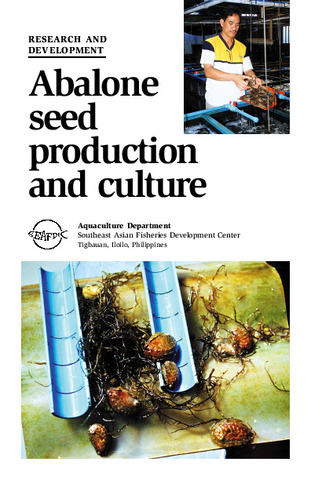
Abalone seed production and culture
(Aquaculture Department, Southeast Asian Fisheries Development Center, 2000)Details the research conducted at AQD for the tropical abalone Haliotis asinina. AQD has developed the rudiments of a hatchery protocol. -
Research on seaweeds and mollusks
(Aquaculture Department, Southeast Asian Fisheries Development Center, 1995)Research on seaweeds focused on the carrageenan-producing Kappaphycus alvarezii and the agar-producing Gracilaria spp. Growth of K. alvarezii was better on horizontal lines than on vertical or cluster lines from bamboo rafts. All morphotypes (brown green, and red) grew faster at 50 cm than at 100 cm below the water surface, but the green morphotype showed better carrageenan properties. A socioeconomic survey of K. alvarezii farming in Panagatan Cays, Antique revealed that a farmer has an average annual production of 3 tons/ha (dry) with the fixed bottom and hanging longline methods. Three species of Gracilaria in natural beds in lloilo showed monthly variations in biomass and agar quality; G. heteroclada had the highest biomass and gel strength. When this species was grown in tanks, growth and agar sulfate content were influenced by the interaction of light, salinity, and nutrients. Enriched and unenriched stocks of G. heteroclada differed in agar quality. When G. heteroclada was grown with the tiger shrimp Penaeus monodon in extensive ponds, the highest growth rate and production were obtained at the seaweed stocking density of 250 g/m2; this was in November when average water temperature, transparency, and salinity were low. Salinity tolerance varies among Gracilaria species.Oyster (Crassostrea iredalei) and mussel (Perna viridis) farming in Western Visayas were assessed in 1992 in terms of the culture methods, socioeconomics, marketing, and profitability. A more localized survey of oyster and mussel fanning was conducted through rapid rural appraisal in two coastal towns in 1993. A farmer-participatory study followed in 1994 for the culture of oysters, mussels, seaweeds, and rabbitfishes in a river mouth in Dumangas, lloilo. Green mussel, brown mussel (Modiolus metcalfei), and seaweeds transplanted to Dumangas from Capiz have reproduced. In another study, the green mussel was tested as a biological filter in tiger shrimp ponds; shrimps stocked with mussels grew better than those without. A nationwide survey on the Placuna placenta fishery in 1993 showed 27 remaining 'kapis' beds; many others have been depleted due to excessive gathering, pollution, siltation, and trawling. Broodstocks are being developed to produce 'kapis' seed for grow-out and restocking. For the first time at AQD, adult donkey-ear abalone Haliotis asinina from the wild spawned naturally in laboratory tanks. Juvenile abalones can be successfully grown on Gracilaria or abalone diet.